
MacARTHUR waded ashore into theaters in 1977, one year after the Centennial celebration’s much-publicized but half-masted salute to WW2 in Midway and seven after the mighty salvo thundered out of Patton. Successful military leaders may have streaks of genius (or good luck) but their battle plans would just be pins on tables without dependable personnel and the means to carry them out. In this case the decisive factor was in the commitment degrees from competitive studios. Retired general Frank McCarthy produced both Patton and MacArthur, each saga of an outsized personality dominated by the lead actor, fire-breathing George C. Scott flat-out magnificent as flamboyant George Patton, reliably sturdy Gregory Peck very good as self-deifying Douglas MacArthur. But McCarthy and Scott had 20th Century Fox pulling out the stops, while McCarthy and Peck were poorly served by Universal, the same B-team who’d cut corners and gone just partway on Midway, making one of modern history’s most crucial battles about as gripping as a book report. Despite having a subject in MacArthur who historically was far more interesting, important and influential than the arresting but regionally subordinate showboat Patton, the exciting Fox epic stands as superior to this two-star generalization in every respect. Douglas and his monumental ego would not be pleased.
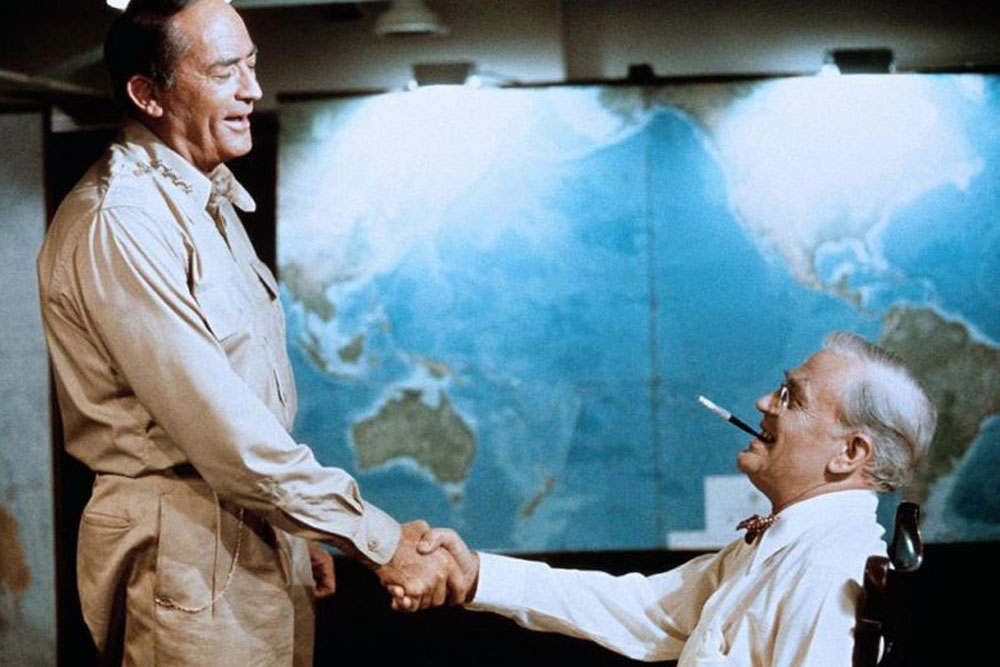
Leaving aside the pros and cons of the man, his actionful and exotic life (1880 to 1964) would’ve been much better served by a mini-series. Cheating him and us, the movie instead contents itself with a 130-minute highlights pass from 1942 in the Philippines until his commencement speech at West Point in 1962, skipping thru defeat and triumph in the Pacific in World War Two, the Occupation of Japan, the Korean War and confrontations with Presidents Franklin Roosevelt (Dan O’Herlihy, feeling like a guest star impression) and Harry Truman (Ed Flanders adding some expected feistiness). Joseph Sargent was primarily a capable TV director; he scored two good feature pictures (Colossus: The Forbin Project and The Taking Of Pelham One Two Three) but this assignment rates as merely adequate. Peck is fine, and there are some decently staged battle scenes (brief, furious), though their effectiveness is undercut by insertions of vintage documentary combat footage with obviously different film stock. With the budget was pared down to $9,000,000 even the credits typeface looks cut-rate.

The script from Hal Barwood (The Sugarland Express, Dragonslayer) and Matthew Robbins (Corvette Summer, Mimic) comes off as a cut & paste job, riddled with clumsy geographic errors and handy omissions (caught by surprise in the Philippines and Korea), studded with artificial exposition points that ring flat. The only dialogue flair displayed is when MacArthur’s actual oratory and asides show up, allowing Peck rein to enjoy the cadence and flow that distinguished the general’s lofty/soaring/pompous delivery. The best is probably his exhortation to the Filipinos upon honoring his famous pledge to return: “The hour of your redemption is here. Rally to me. Let the indomitable spirit of Bataan and Corregidor lead on. As the lines of battle roll forward, rise and strike. For your homes and hearths, strike! For future generations of your sons and daughters, strike! In the name of your sacred dead, strike! Let no heart be faint. Let every arm be steel. The divine guidance of God points the way. Follow in His name to the Holy Grail of righteous victory.”
Peck: “I admit that I was not terribly happy with the script they gave me, or with the production they gave me which was mostly on the back lot of Universal. I thought they shortchanged the production.”
Jerry Goldsmith, who did a majestic job scoring Patton, was recruited, but even his efforts feel lackluster, as does the diffuse, sleepy look of most of the cinematography. All in, a let-down, though at least it’s better than Inchon. But then Gomer Pyle is better than Inchon.
A platoon of familiar faces uniformed-up as assorted officers: Nicholas Coster, Russell Johnson (as Admiral Ernest King), Art Fleming (as W. Averell Harriman), Dick O’Neill, G.D. Spradlin, Kenneth Tobey (as Admiral Halsey), Charles Cyphers. Marj Dusay plays MacArthur’s wife Jean. Box office was $26,200,000, #32 in ’77.
 Movies ala Mark