
A KISS BEFORE DYING didn’t do much business in 1956—$1,900,000 ranking 141st place—but it attracted some notice for presenting the underside to Robert Wagner’s heretofore upright screen image. He followed up later in the year with another bad guy, as Spencer Tracy’s rotten younger brother in The Mountain. It was considerably more successful but doesn’t carry the same cachet of retrospective interest, that adventure’s avaricious looter taking a back seat to his cold-blooded murderer in this suspenser, one of the era’s raft of pictures that took noir & pulp elements outdoors in CinemaScope and Deluxe color. Who would ever believe Bob Wagner guilty of a capital crime, especially involving a loved one? Gee…
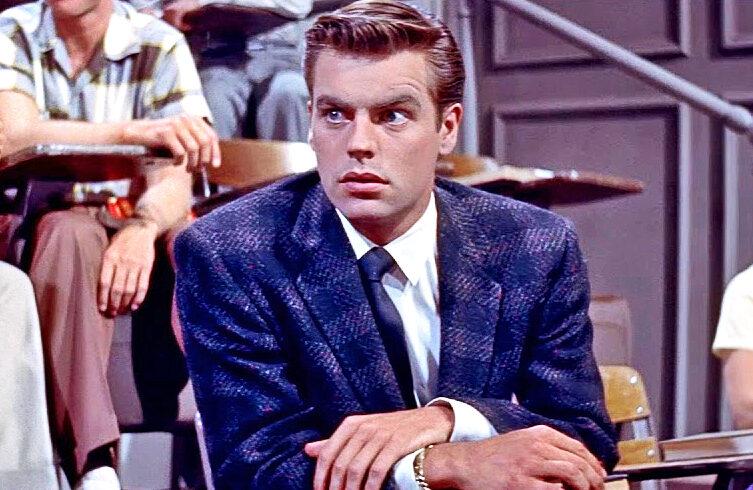
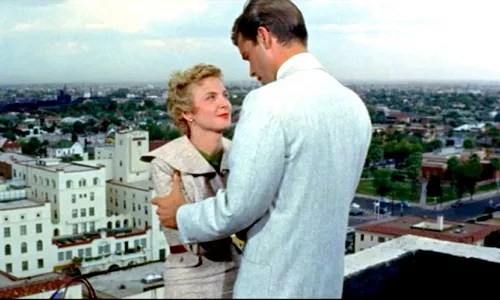
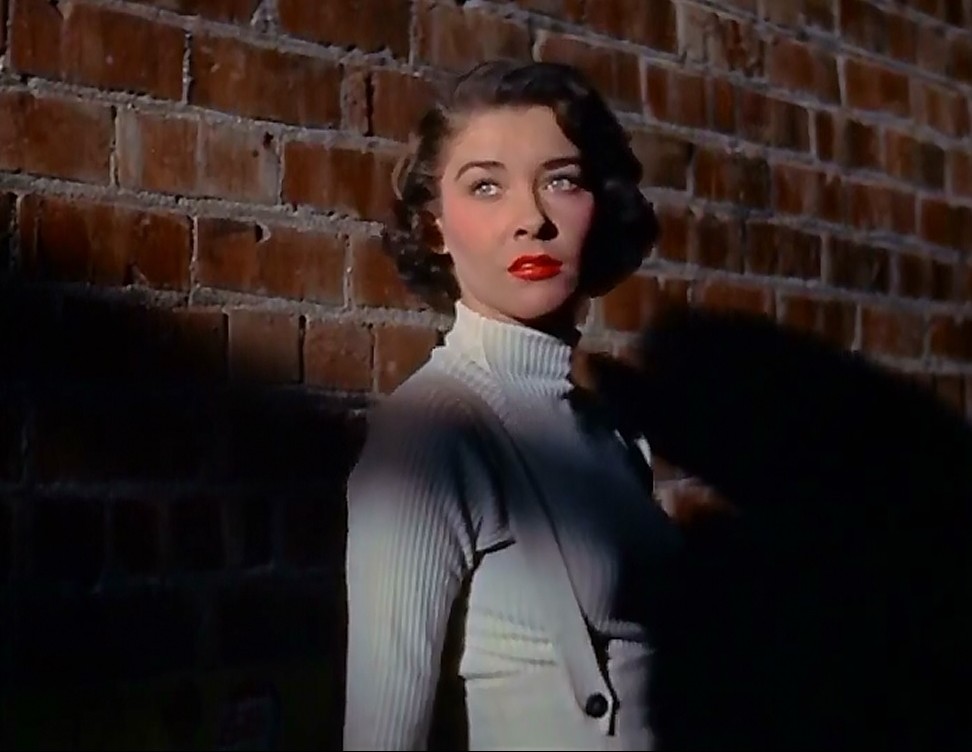
Tucson, Arizona. University student ‘Bud Corliss’ (Wagner, 25) was a big deal in high school and had a sterling war record. Set on getting ahead via the fast track, he has wooed & won fellow student ‘Dorothy Kingship’ (Joanne Woodward, 25), daughter of a wealthy mining magnate. But pregnancy—the unplanned, unmarried, ‘dad will disown me’ kind—throws Bud’s plans in the diaper bin, and simp Dorothy’s naivete and decency isn’t what drew Bud’s interest to start with. When a methodical scheme to poison her fails, Bud ups the ante in a more dramatic and guaranteed fashion. Later, he charms her slightly older sister ‘Ellen’ (Virginia Leith, 30) who has no idea Bud knew Dorothy, and, like her sister, trusts him and falls for him—albeit not in quite the same way as Dorothy.

Directed by first-timer Gerd Oswald, the story was based on a novel by Ira Levin, his first. Lawrence Roman (Under The Yum Yum Tree, Red Sun, McQ) wrote the screenplay. Locations in & around Tucson are well served by Lucien Ballard’s cinematography. Lionel Newman’s score feels off-kilter during the title music, better suited to something less serious, then later it goes into overdrive once too often as Bud/Bob’s dark doings increase. The plot doesn’t stand close inspection, and much of the acting is see-thru.

This was Woodward’s second picture, one she later called her worst, Leith is slinky attractive but stilted. In support, Mary Astor has some effective moments as Bud’s mother, while George Macready as the sisters father is so broadly unsympathetic he’s nearly villainous. Jeffrey Hunter is badly served in a dull role as a teacher, outfitted with glasses and a pipe (to seem intellectual?), one of four times he was stuck playing backup for bland boy-toy Wagner. ‘The Brylcreem Kid’ is much more effective than usual in this offering, one time where his pancake flat way with dialogue matched the insincerity of the character. The movie, a minor affair with one real jolt (or drop) has drawn more microscope attention in its disc afterlife thanks to Wagner’s up close & personal ‘association’ with a tragic ‘accident.’ Nuff said. *
94 minutes, with Robert Quarry, Howard Petrie and William Walker. Remade in 1991 with Matt Dillon and Sean Young.

* For Gerd Oswald this was the first and best of a mostly undistinguished 14 features (some cite Crime Of Passion as worthwhile). He did do a fine job as a second-unit director on The Longest Day, handling the harrowing Saint-Mere Mere Eglise parachute sequence. He also manned 15 episodes of the 1963-65 series The Outer Limits, including two of the best, Fun and Games and The Invisible Enemy.
Taking a deadwood part beneath callow pretty boy Wagner must’ve been a blow to the more handsome, likable and talented Hunter, 29, but he could console himself with three better roles that year, all westerns, The Proud Ones, The Great Locomotive Chase and crucially, The Searchers. That classic also introduced him to John Ford, who cast him twice more (The Last Hurrah, Sergeant Rutledge). Ford had Wagner foisted on him once (What Price Glory) and was singularly unimpressed. 20th Century Fox, maybe based on fanmail from teenyboppers (it couldn’t have been charisma), or maybe Bob’s gift for oozing schmooze, had them favor Wagner over Hunter, who was also billed under him in White Feather, The True Story Of Jesse James and In Love And War. Miss Leith would stake a claim to bizarre fame as the bodyless head of The Brain That Wouldn’t Die.
 Movies ala Mark