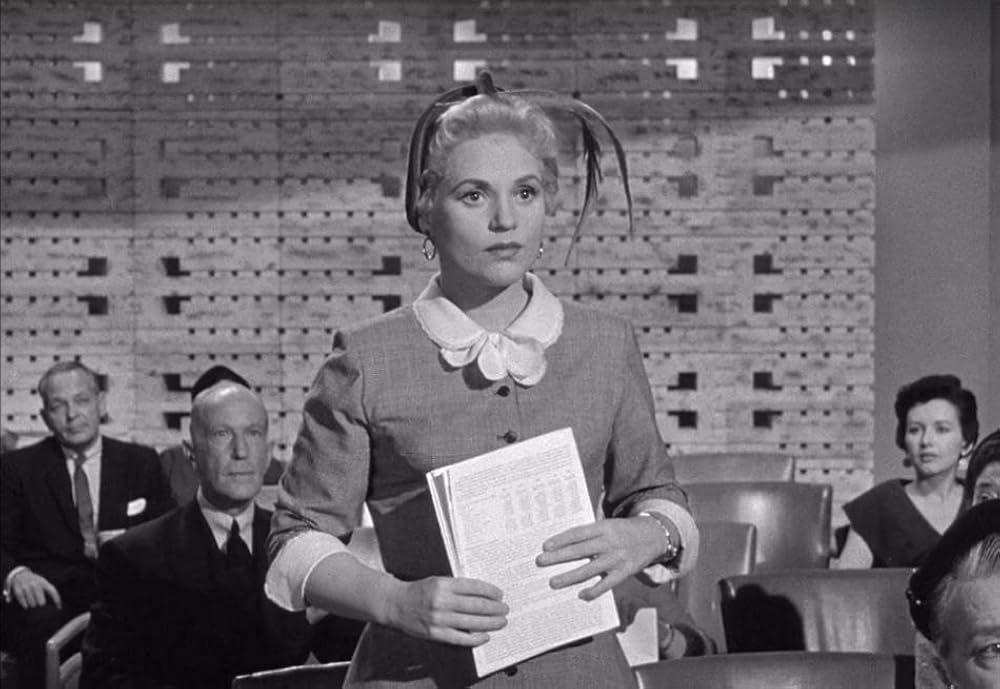
THE SOLID GOLD CADILLAC pits the honesty of a crusading stockholder against corrupt corporate hierarchy—a lone upstart female (with ideas yet!) meddling in the man’s world of commerce—in a 1956 satire on the vulture-culture of Big Business. Among the 1954 dramas Executive Suite and Woman’s World and similarly serious ’56 entries The Man In The Gray Flannel Suit and Patterns, this one instead wielded light comedy and mature romance as its weapons of choice, predating the cynical ’60’s swipes of The Apartment and How To Succeed In Business Without Really Trying. It may not have ended the forever war of Capitalism v. citizens, but at least it won a battle, thanks to the shining star of PFC Judy Holliday.
BLESSINGTON: “Boys, there’s one rule in business: If you can’t crush them, join them. If you can’t kill them, acquire them. Now, we can’t kill Miss Partridge.” SNELL: “How do we know until we’ve tried?”
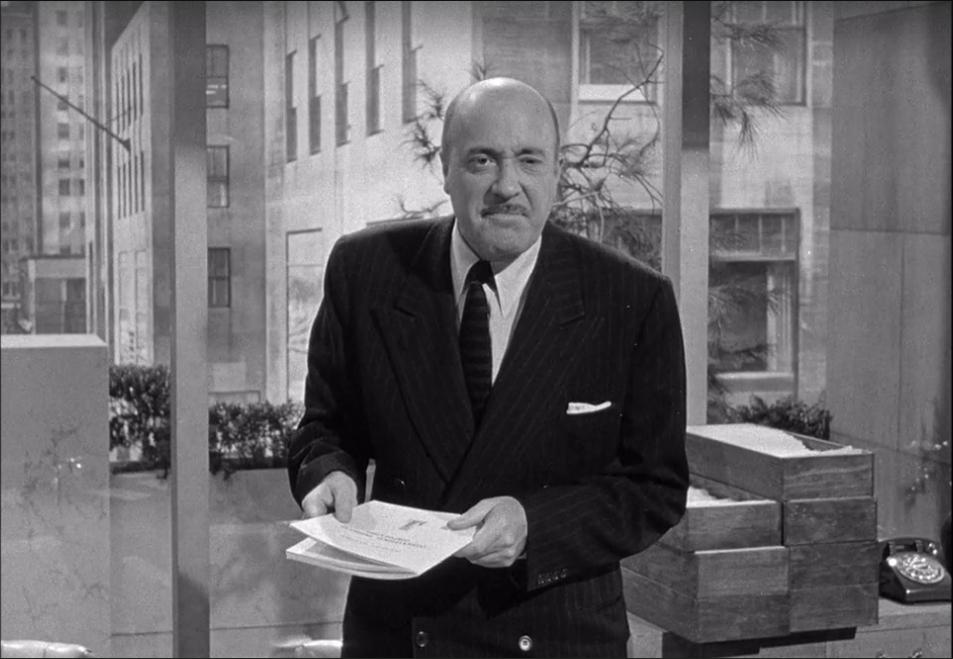
Fred Clark, 1914-1968
The smug boys club at the top of billion-dollar ‘International Projects’ have it made, snowing stockholders with b.s. while fleecing them to further stuff their own already packed pockets. Then ‘Laura Partridge’ (Holliday), a ‘nobody’ with a mere ten shares, shows up a meeting and flummoxes the suited ones to such an extent that they resort to hiring her in order to silence her. But Laura has wiles behind her smiles, and she finds an ally—and maybe more—in ‘Ed McKeever’ (Paul Douglas), the company founder and former chairman who has resigned to go to D.C. to work for the Pentagon. Like Laura, Ed is honest. Like Laura, Ed is single.

Directed by on-the-rise Richard Quine, the screenplay by Abe Burrows was taken from the play (526 performances) by George S. Kaufmann and Howard Teichmann. George Burns does a little narration—59 at the time, he hadn’t worked on a film since 1939 and wouldn’t again until 1975—and it’s brightly scored by Cyril F. Mockridge. The show is black & white until the finale, which jumps into color to showcase the title vehicle, a 1956 Cadillac Eldorado Biarritz convertible.

“How could they do a thing like that? How could they do a thing like that—what am I saying? Of ‘course’ they could do a thing like that!”
Holliday glows in another pitch-perfect performance, re-teamed with Douglas eight years after they worked on Broadway in “Born Yesterday” (in the 1950 movie version Douglas was replaced by Broderick Crawford), and their chemistry is a win. Another plus is that the lineup of corporate connivers are personified by John Williams, Fred Clark, Ray Collins and Ralph Dumke. The show isn’t particularly surprising in setup or wrapup, and is not what you’d call hard-hitting (you could only obliquely indict the system without being accused of being a Commie–and, speaking of wallowing in deceit, the all-mighty Pentagon may as well have been the Taj Mahal) but it’s consistently amusing. The easy excuse you need to watch: it’s another of only nine movies blessed by Judy Holliday. *

Ranked 33rd at the box office for 1956, grossing $7,100,000. Holliday had another outing that year, the comedy-drama Full Of Life; it trailed at #91. She made just one more movie, Bells Are Ringing, four years later.
Oscar winner for Costume Design, a nominee for Art Direction. With Arthur O’Connell, Hiram Sherman, Neva Patterson, Richard Deacon, Madge Blake and Suzanne Alexander. 99 minutes.

* On the house—Paul Douglas quotes: “The studio camera man enjoys working with me. You know why? It’s because he doesn’t have to worry about my bad angle — they’e all bad. He doesn’t have to fuss with the lights or anything, because nothing he could do could make me look better. I’m a cinch for the make-up men too. They figure nothing can be done, so that’s what they do.” “The public’s so relieved to see somebody besides a junior Adonis in the boy-meets-girl set-up they give me a cheer. Guys look at me and say, ‘If that mug can win a gal, It’s a cinch for me.'”

Paul Douglas, 1907-1959
 Movies ala Mark