
THE MARK certainly meant well, and among its good performances contains the best in its leading man’s career, getting him an out-of-left-field Oscar nomination for Best Actor. Yet other than critics and those who frequented what used to be called “art house” theaters in big cities, and despite ads challenging “A Most Mature Motion Picture!” few people saw it back in 1961, and it remains a rarity today. Why? With due respect for the quality work of the actors, the manifest flaws in the dated screenplay draw a sympathy-dry answer: raise your hand if you like movies about child molesters. *

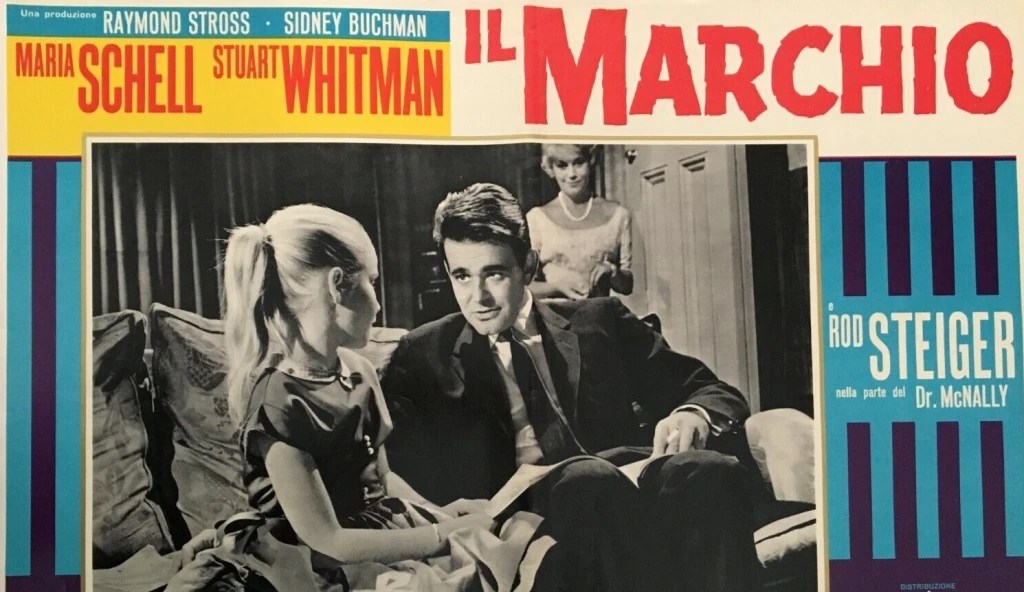
London. Released from a stint in stir and intensive counseling ‘Jim Fuller’ (Stuart Whitman) is placed in a responsible corporate job, secures a room with landlords who practically think he’s the son they never had, and begins a tentative yet progressively deepening relationship with a beautiful co-worker (Maria Schell), a widow with a 9-year-old daughter who thinks Jim is dandy. What the genial-yet-tense Jim, his dedicated psychiatrist (Rod Steiger, low-key) and we watching know—and that they don’t—is that Jim was in prison for attempted child molestation of a girl he abducted from a schoolyard. Can the demons of his past stay away for good? How tolerant are those who’ve come to know him? Is that smooth-talking prick from a tabloid rag just interested in innocent conversation?

Directed by Guy Green (The Angry Silence, A Patch Of Blue, A Matter Of Innocence), the talk-stoked but defanged script by Sidney Buchman (Theodora Goes Wild, Mr. Smith Goes To Washington, Cleopatra) and Stanley Mann (The Mouse That Roared, The Collector, A High Wind In Jamaica) was adapted from the 330 pages of Charles E. Israel’s 1958 novel. For starters, the glaring escape valve cheat is that Jim did not carry out his act, so the sympathy deck is too-conveniently stacked from the get-go. It would be a different thing entirely if he did the deed, or was a serial predator: not a cinch-sell for the rehabilitation hogwash then. The sessions with the shrink make for decent drama and acting exchanges but they simply don’t comport to treatment reality, let alone jive with mountains of accumulated statistical evidence regarding those who do these acts; what’s worse than knowingly damaging children? The bit that he had “I just can’t” problems with a beautiful nymphomaniac is a limp too far. There were several movies that year dealing with heretofore forbidden subjects; Victim, about a man blackmailed over his homosexuality, Town Without Pity and Something Wild, each about the trauma of rape. There’s certainly nothing wrong with unsettling or controversial subjects, but playing fair is appreciated.

Steiger’s Irish accent is much easier to take than the one he’d trotted out for Run Of The Arrow a few years earlier, he resists temptation to showboat; the keen and warm Schell is always a pleasure; the other supporting players all eminently sound. Those irksome screenplay issues are fought to a draw by Whitman’s surprisingly strong performance, easily career-best. It’s often mentioned that his surprise Academy Award shot was more for daring to take the role, and for the ‘important’ subject matter, and an argument could be made that notice ought to have gone instead to the swan songs of legends James Cagney (One,Two,Three) or Clark Gable (The Misfits). Yet Whitman really is excellent here, allowed to run a gamut of emotions but not veering into phony gnashing or snares of easy sentiment. At 33, he’d been around since 1948, bit parts gradually leading to bigger ones. 1961 was key, with three other movies at large: The Comancheros (exciting and a hit—gracias, Duke), Francis Of Assisi (beyond dull) and The Fiercest Heart (a blah retread of Untamed, including lifted footage); they all did more business than The Mark. For some reason, after this film he went with a much huskier vocal delivery in faves like Rio Conchos and Sands Of The Kalahari. He’s in nearly every scene in The Mark, and alone is reason enough to recommend the movie, even if numerous plot points are dicey.

Done for a lean £260,000/$468,000, approximately £7,396,000/$8,992,000 in 2025. In the US, where an “adult” film like this would play in special venues in big cities, and with the subject matter was unlikely to pull crowds anyway it made just $200,000, ranking 142nd in ’61. It was a year when movies concerning kids that people lined up for included entertainments a tad more reassuring, like The Parent Trap and Babes In Toyland.
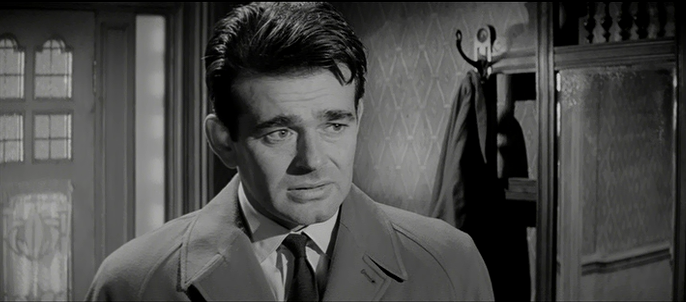
Filmed in Ireland. Keen b&w camerawork from Douglas Slocombe. With Brenda de Banzie (who wants to mother Jim), Donald Houston (tabloid sleazeball), Donald Wolfit (understanding boss), Maurice Denham (de Banzie’s windbag husband), Paul Rogers (co-worker jealous of Jim), Eddie Byrne (fellow convict who taunts Jim), Amanda Black (Ruth’s adoring pixie daughter, therefore a test) and Marie Devereux, as the lust-driven lass Jim fled from. 127 minutes.
* Subject objectivity: Kevin Bacon very good in The Huntsman; Jackie Earle Haley splendid in Little Children; Stanley Tucci horrifying in The Lovely Bones; and of course Peter Lorre and David Wayne in their versions of M. As an innocent man destroyed by accusation, Mad Mikkelsen in The Hunt.

 Movies ala Mark