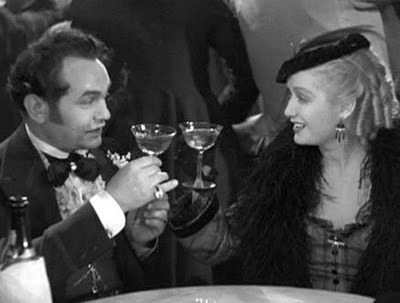
BARBARY COAST, the one in North Africa (“to the shores of Tripoli”) was infamous for centuries of piracy, brigandage that eventually had the brand new United States engaging in its first foreign war (paging 1950’s Tripoli). A few decades after that escapade, the wild & woolly California Gold Rush turned San Francisco & environs into our home-cooked version thanks to its well-earned rep for overall debauchery: gambling dens, drink dives, brothels. The sort of western fun (law & disorder, vigilantism, anti-Chinese bigotry) that spawned the appropriately gaudy and rollicking 1935 movie directed by Howard Hawks. Now that you’re primed…

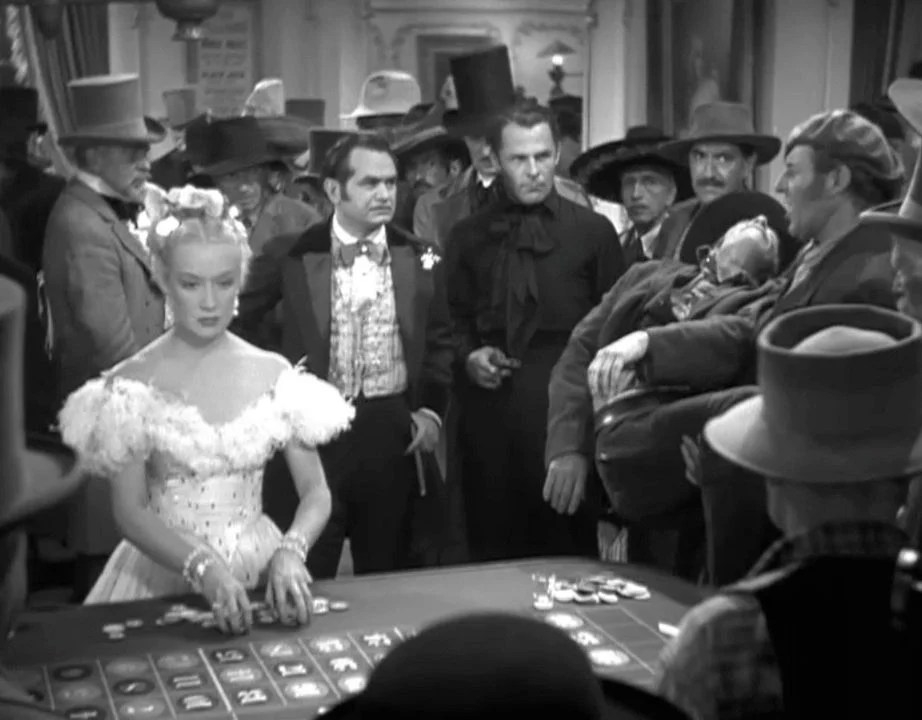
San Francisco, 1850. Arriving in the pea-soup fog of the Bay, ‘Mary Rutledge’ (Miriam Hopkins, 32) thinks she’s there to wed the owner of a gold mine, only to find he’s dead, likely murdered. That was probably by the kingpin owner of the ‘Bella Donna’, fancy-attired but fierce ‘Louis Chamalis’ (Edward G. Robinson), who employs minions like cheerfully corrupt ‘Old Atrocity’ (Walter Brennan) and ‘Knuckles Jacoby’ (Brian Donlevy), dark-clad and black at heart. Switching gears faster than you can say “gold-digger” Mary goes to work for Chamalis as a roulette hustler; he admiringly christens her ‘Swan’—was this the first Hawksian woman with a nickname? Then, gear-switch part 2; she has a meet-sweet with handsome miner ‘Jim Carmichael’ (Joel McCrea), who is part naive-bumpkin/part erudite scholar who spews literary references faster than Swan can spin the rigged roulette wheel back at the Bella Donna. Someone, or two, are going to get jealous, ripped off, hurt and even.
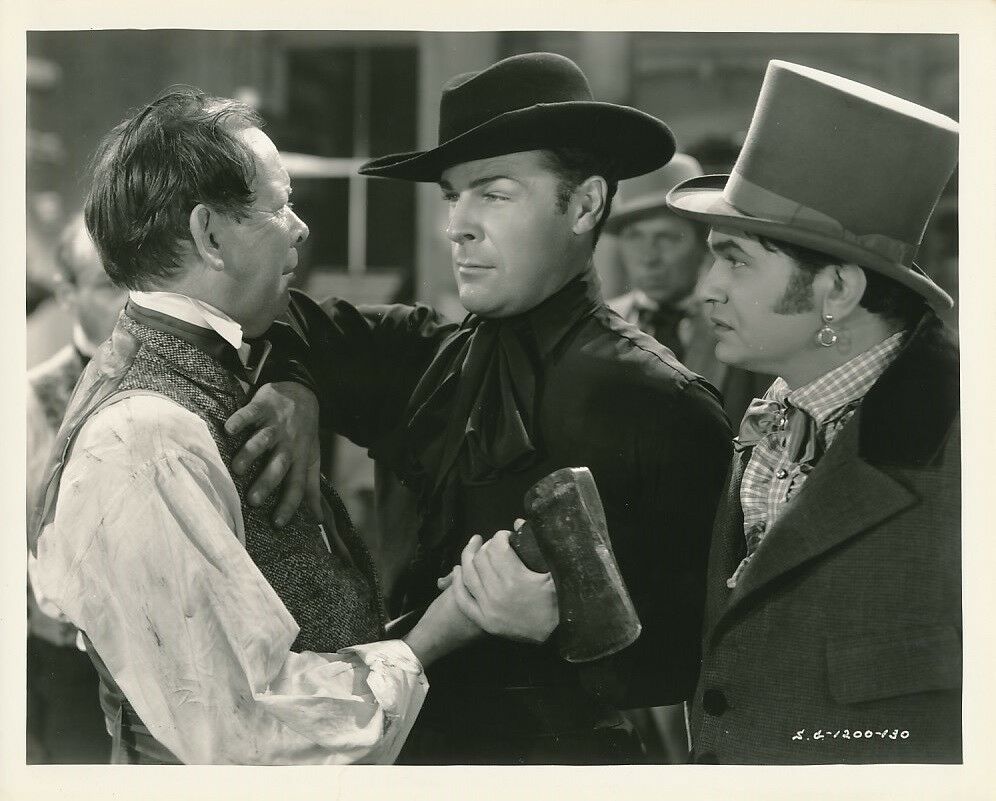 Historical excess is fertile ground for melodramatic indulgence, which can be fun, trying, or both at once. This time out, both. Hawks stages the rowdy crowd scenes well, the costuming and sets are period garish and it’s excellently photographed, the cinematography from Ray June (China Seas, Test Pilot) was nominated for an Academy Award. The casual harassment of the immigrant Chinese is historically accurate but it’s also played for laughs (this was the 1930’s). The tireless Brennan (22 roles in 1935 alone) so impressed Hawks that he cast him five more times, all plum parts—Come And Get It, Sergeant York, To Have And Have Not, Red River and most memorably, Rio Bravo. Donlevy, 34, had been in films for 12 years but had only logged 10 minor credits; his utter meanie in this picture edged him into a number of colorful villain roles (In Old Chicago, Jesse James, Union Pacific, most notably Beau Geste) before he moved up into tough good guy territory with The Great McGinty and Wake Island. And Robinson’s amusing.
 Then…there’s the script, mouthfuls of foolishness delivered by the normally estimable Ben Hecht and Charles MacArthur. Just ridiculous, though to cut them some slack they were challenged by the stifling demands of the Hays Code and likely pestered to distraction by taste-optional producer Samuel Goldwyn. The acting by Hopkins and McCrea is…bad. She’s so over-the-top theatrical she might as well be seven years back in the silents. Her well-known inner diva didn’t sit well with Robinson, who found her infuriating (he wasn’t alone). The easygoing McCrea managed to get along with Hopkins in five assignments, but his performance in this opus is the weakest of his career. Everyone is sandbagged by the mostly risible dialogue. *
One of the few grin-worthy exchanges—SWAN: “Thank you? You seemed almost human for a moment.” LUIS: “Well, then, how about you being human for a change, huh?” SWAN: “I’d like another drink, please.” LUIS: “Swan, why don’t you ever kiss me of your own accord, huh? Why don’t you ever put your arms around me and kiss me like you meant it?” SWAN: “Wait’ll I have my drink.”
91 minutes that cost between $778,000-1,000,000 and made $2,900,000, 32nd in ’35. With Frank Craven (brave newsman ‘Col. Cobb’–ya think his place will get busted up?), Harry Carey (‘Jed Slocum’, we need someone grim enough to lead a necktie party), Donald Meek (‘Sawbuck McTavish’, destined to get fleeced, then plugged cuz he won’t keep his brogue quiet) and J.M. Kerrigan (‘Judge Harper’–an honest judge? cough). Somewhere jostling in the crowd see if you can pick out David Niven (24), Jack Pennick, Jim Thorpe and Hank Worden (34, debut).
We hasten to plug a really fun review at ‘The Blonde At The Film’—https://theblondeatthefilm.com/2014/03/03/barbary-coast-1935/

* Hypocrisy, thy name is Censorius—the first script drew the priss-tsk of the Hays Code scold-in-chief Joseph Breen: “The whole flavor of the story is one of sordidness, and low-tone morality.” After scribes Hecht & MacArthur banged thru months of revisions (no doubt between enough drinks to raise the Bay) the thrust of the tale—based on a 336-page bestseller by Herbert Asbury (“The Barbary Coast: An Informal History of the San Francisco Underworld“)—was bleached from one where men sought pleasure in booze, cards and hookers to a love story, one “between a fine, clean girl” and a poetic young fella, with “no sex, no unpleasant details of prostitution”, containing “full, and completely compensating, value…the finest and most intelligent picture I have seen in many months”. Where’s a decent opium den when you need one?
 Movies ala Mark