
WALK, DON’T RUN as a title refers to a sporting event that figures in the climax of this comedy, but it also serves to sum-up Cary Grant’s graceful, make-it-look-easy exit from his 35-year film career, his charm and skill at dialogue jousting and physical gags age-cured but undiminished in his farewell performance. The 1966 rom-com isn’t top drawer—Sol Sak’s script reworks 1943s The More The Merrier and 114 minutes takes the expected airiness a reel-too-far—but it’s easily engaging enough and Cary’s fans will indulge without complaint. Veteran director Charles Walters also closed out his feature film career with a polished win, if not a glittering smash. *
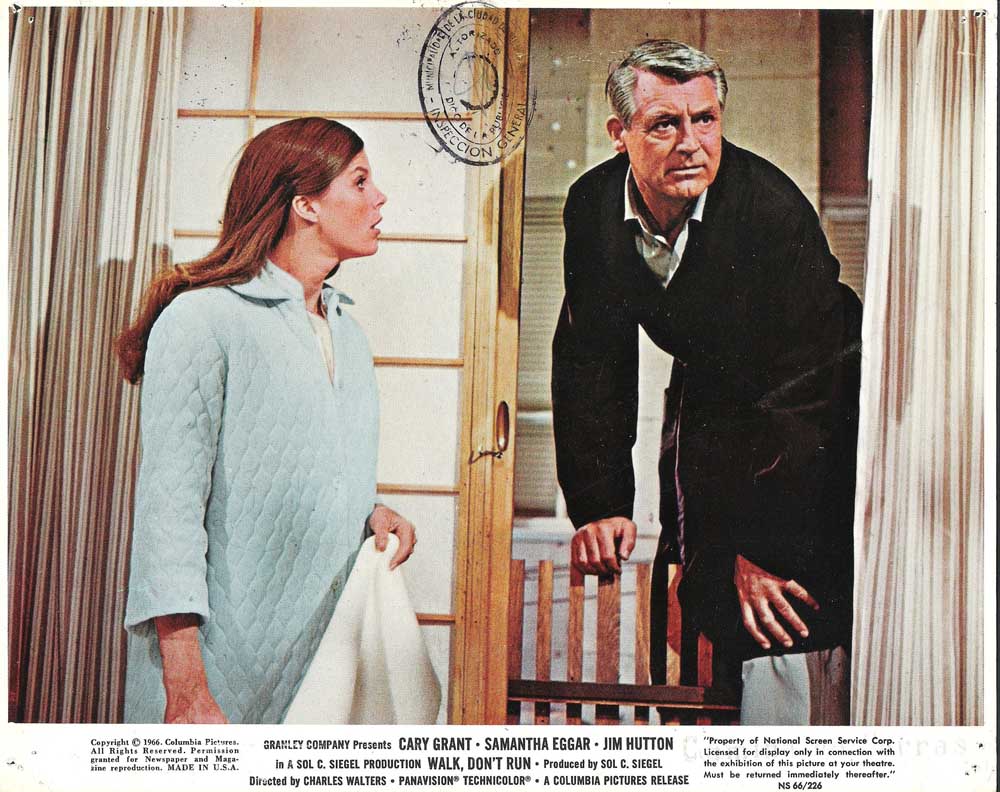
British business tycoon ‘Sir William Rutland’ (Grant, 61) comes to Tokyo but he’s two days early on his reservation and every hotel is booked due to the 1964 Olympic Games. He talks his way into sharing a small apartment with young ‘Christine Easton’ (Samantha Eggar, 26), who’s engaged to a dorky toff in the diplomatic service. For reasons that suit the triangle waltz of the plot, Rutland sublets half of his room to American athlete (and budding architect) ‘Steve Davis’ (Jim Hutton, 31), there for the Games, and as it turns out, for Christine, since William schemes to put the two younger people together. Because he’s older, wiser and nice. And he’s Cary Grant.
 Fluff, generally fun, especially in the middle section. Shot in Tokyo, though much was done on obvious studio sets. That artificiality doesn’t distract since the material is so lightweight that details are irrelevant to the joke flow. The written byplay itself isn’t much to crow over but the three leads finesse it adroitly. Eggar followed her dramatic coup in The Collector with this proof that she could do ‘silly’ with assurance. Grant requested Hutton for the part, the gangly, tall drink-of-water having earned comic cred and audience approval in a slate of funny roles since 1960. The match-make angle between Eggar and Hutton is standard mid-60’s coy stuff, and there are expected culture-gags (polite bowing gets a workover, as do chopsticks and public bathing) but the smooth timing, off-center deliveries and likable personalities of the stars ensure a lazily pleasant whiling away of downtime.
Grosses tabbed $10,000,000. With John Standing (colorless as ‘Julius P. Haversack’, the stuffbag fiancee), Miiko Taka (of Sayonara), Ted Hartley (his jobs as a fighter pilot and businessman more laudable than his acting career–he later ran RKO), George Takei (29, the year he started trekking stars as ‘Lt. Sulu’; here he’s a perplexed yet patient police captain) and the venerable Teru Shimada (shortly to attempt to “Kill Bond. Now!” in You Only Live Twice).

* Grant’s previous three, 1962’s That Touch Of Mink, ‘63’s Charade and Father Goose in 1964 had all been top-1o hits. Walk, Don’t Run came in 31st in 1966. In her memoir “Good Stuff: A Reminiscence of My Father, Cary Grant” his daughter Jennifer put it “Dad had a sense of the apex. Perhaps his skill at comedy translated to life as well. He knew timing. There’s a natural limit for everything. The height of an experience. Beyond the crest, it’s all downhill. The way I translate it is, when you’re at the top of your game…get out. Dad did that in his career.”
Hutton, on tap & target: Where The Boys Are, The Honeymoon Machine, Bachelor In Paradise, The Horizontal Lieutenant, Period Of Adjustment, Looking For Love, Major Dundee, The Hallelujah Trail, Never Too Late. Not every one was a winner, but he was a marked asset in all of them.

 Movies ala Mark