
THE TAMING OF THE SHREW has been generating laughter and debate for more than four centuries since William Shakespeare wrote it back in 1591. Well, that date is given leeway of a year or three, since from that time to this (and those to come) much of what the Bard wrote, when he did it, what he meant with it and what it means “in the now” undergoes constant microscopic weeviling, by those erudite enough to be vetted in the universe of verse (Old World variety) and those with unground axes, keen on making their own political/social/sexual point about something that has never been settled for absolute certain. In other words, marriage. Is this bawdy farce he left/blessed/saddled us with really an early rom-com for ruffians or did wily Will presciently outfox both the crude and the critical with a skewering of men’s collective ego-fragility? Prithee, how much do you, ordinary person, Jane or James Average, really & truly give a flying-by-night fig?
KATE: “Of all things living, a man’s the worst!” PETRUCHIO: “I tell you ’tis incredible to believe how much she loves me.”
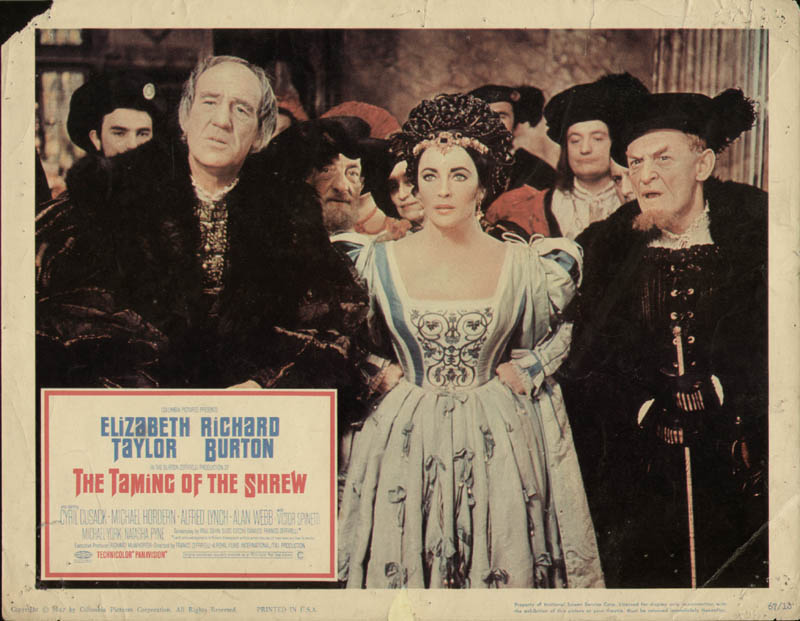
Padua, Italy, the 16th-century. Wealthy merchant ‘Baptista’ (Michael Hordern) seeks to marry off his two daughters. Younger, good-natured ‘Bianca’ is desired by besotted student ‘Lucentio’ (Michael York, 24 in his film debut) but Baptista decrees that big sister ‘Katharina’ (Elizabeth Taylor) be married first. Trouble is, for one reason or another, she’s a psycho bitch from hades on wheels. Enter blustering Verona vagabond ‘Petruchio’ (Richard Burton), keen for fortune and if that entails wooing and ‘taming’ the violence-disposed Kate, well, a man’s gotta do. Especially if he’s a wine-swilling dog. Other salivating suitors for Bianca conspire to help Petruchio take Kate away so they can horn in on nice guy Lucentio’s seeming lovelock on the sister who isn’t quite as bright or close to being as outlandishly sexy but also isn’t as potentially homicidal. Petruchio finds it all the ensuing embarrassment to be great sport.
At the peak of their box office hit parade, Liz & Dick co-produced this $4,000,000 1967 version, risking direction to feature first-timer Franco Zeffirelli, who also managed the screenplay with Paul Dehn (Goldfinger, The Spy Who Came In From the Cold, The Deadly Affair) and Suso Cecchi D’Amico (Senso, Big Deal On Madonna Street, It Started In Naples). The piece had been done 38 years previously, with the lauded star couple of their day Mary Pickford and Douglas Fairbanks (married at the time but on the skids), and later there was the musical-comedy sendup in 1953’s fun Kiss Me Kate.

Verily, we say fornicate thyself if ye canst taketh a jest.
Though proven before the camera since she was ten years old, Taylor, 34, had never attempted uh, Elizabethan acting and was nervous over the challenge, jitters hardly soothed by a cast loaded with English, Irish and Welsh pros born-to-the-Bard, not least her husband. At 41, Burton’s pre-movie star career on stage had Shakespeare by the beard, but on film he’d only gone there a few times: as 19th-century thespian Edwin Booth in 1955’s Prince Of Players, in a 1960 TV movie of The Tempest and a 1964 ”filmed play’ of Hamlet. The two superstars complement one another here; after Who’s Afraid Of Virginia Woolf? it’s their most spirited collaboration. Taylor gets a tad screechy at times (like Katharina, duh), but her quiet moments are telling and the emotions showing on her face register well. Burton’s having a rarefied field day Among the choice supporting players, Hordern takes top honors; he’s marvelous, even better than he was in A Funny Thing Happened On The Way To The Forum, a brilliantly funny performance cheated of an Oscar nomination.
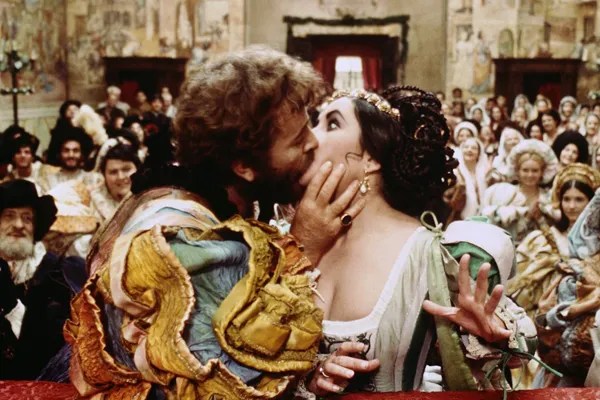
Zeffirelli had cinematographer Oswald Morris, a master at lighting and levels of color saturation (Moulin Rouge, Moby Dick), go for a painterly look recalling Italian Renaissance art. The comic exuberance and deeply buried longing are coated by Nino Rota’s lovely music score. Shaved down from the play, the movie runs 122 minutes. Still, the headlong pace can wear some: we think this battle of the sexes is best enjoyed in dollops of ten or fifteen minutes, like taking a break from a rich feast so you can rejoin with a fresh appetite for more. Did someone mention sex?
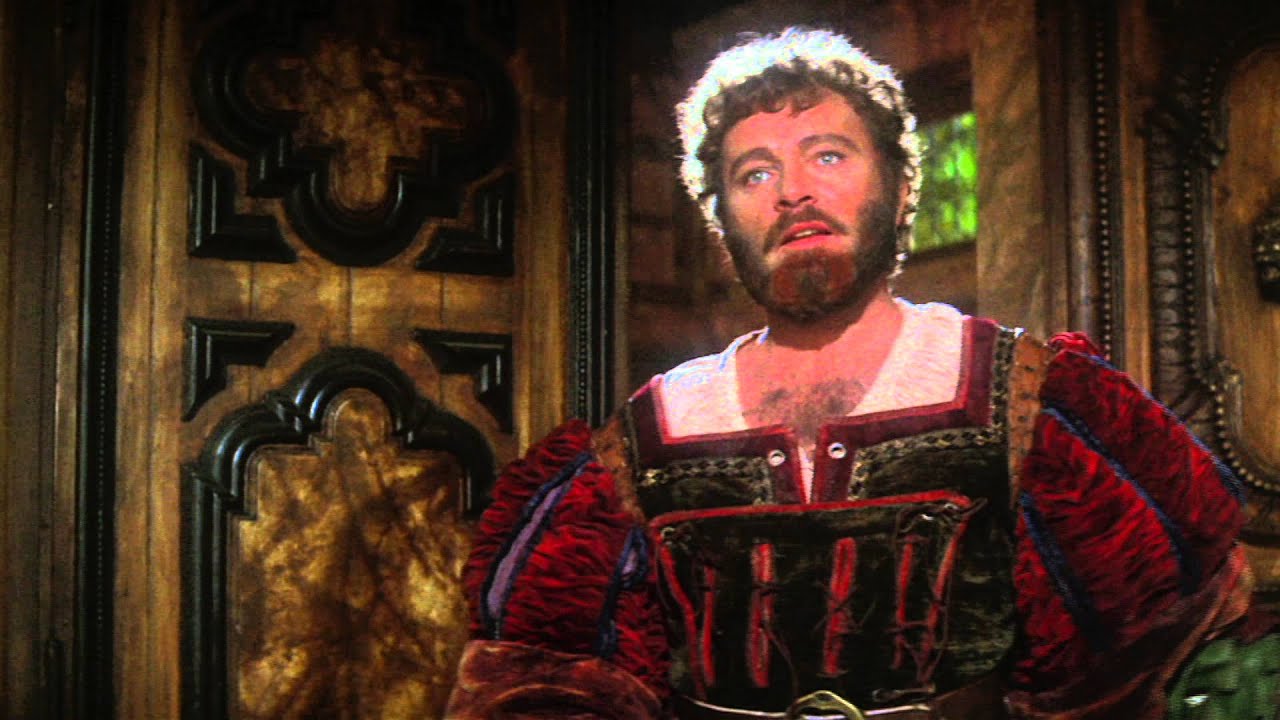
Sterling supporting actors in top form: Cyril Cusack (‘Grumio’), Alfred Lynch (‘Tranio’), Alan Webb (‘Gremio’), Victor Spinetti (‘Hortensio’), Natasha Pine (20, as Bianca). The Art Direction and Costume Design garnered Oscar nominations. A gross of $8,800,000 in the States placed spot #34 in ’67, with a further $4,000,000 paid forth internationally.
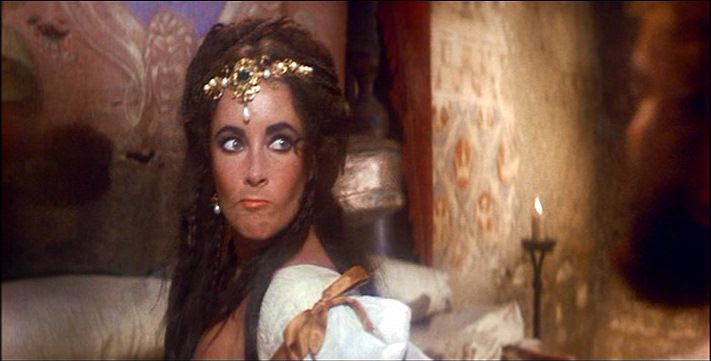
* Burton, from his endlessly amusing diary, about how he and Liz felt toward their first-time-at-the-helm director, writing that she “now really loathes him, largely because he is a ruthless selfish multi-faced ego-mad COWARD. It is this last that both of us find most objectionable. I am by no means heroic morally but I can make decisions and accept advice. This chap can do neither.”
Zeffirelli followed up a year later with a hit version of Romeo and Juliet, then 22 years on with his take on Hamlet.
Liz: “I was so scared. It was the first time I’d tried to do Shakespeare. And my beloved was no help at all. ‘You do it on your own’, he said. The first couple of days I was so frightened I couldn’t even say ‘hello’, so they had to redo them. Richard did advise me, ‘Don’t think of it as verse – don’t pronounce it to a metronome as you were taught in school.’ And gradually I began to have fun with it.”
This lush and lusty treat ended the winning streak for the world’s most famous (and over-publicized) celebrity power couple. They had two more releases that year but the worthwhile The Comedians didn’t fare too well at 41st place and dud Doctor Faustus died by its own hand at 83rd. Afterward, Burton would score solo successes with Anne Of The Thousand Days and Where Eagles Dare, but as a screen team they spiraled into critical and box office ignominy with Boom!, Hammersmith Is Out and Under Milkwood.

 Movies ala Mark