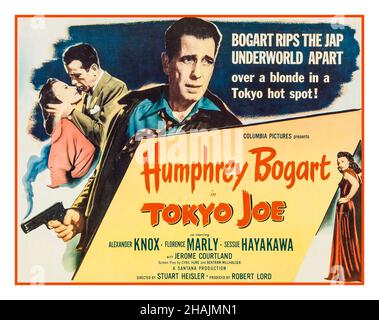
So much for soft-balling the pitch
TOKYO JOE, played by Humphrey Bogart, levels with a partner: “I got in this for the dough and no other reason.” The line lays out what Bogie likely felt about the film itself, 88 minutes better spent watching another of the star’s movies. His production company, Santana, made out okay with the dough end of the deal, a $5,300,000 gross taking 53rd place among the releases from 1949. But the dough was left uncooked in the script bowl, the pasty ingredients concocted by Cyril Hume and Bertram Millhauser a stale retread of Casablanca, minus colorful characters played by intriguing actors. The score from George Antheil (The Pride And The Passion) tries to summon flavor but it’s a losing battle against the wan script, slack direction and creeping déjà vu, or its Japanese equivalent.
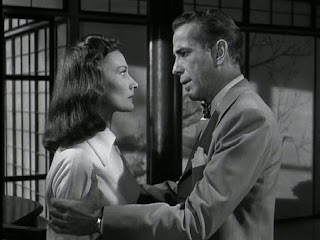
“You must remember this”—is a long way from Morocco
A few years after World War Two, ‘Joe Barrett’ (Bogart, 49) returns to Tokyo, where he’d run a bar and casino before the war. Hoping to restart his business, he’s stunned to discover his wife—who he’d presumed had died in Japan during the war—is alive and remarried. Intent on taking her away from her new husband, he gets involved with ‘Baron Kimura’ (Sessue Hayakawa), a shady man of means who had been the head of Japan’s secret police. Their scheme to run an airline business attracts the attention of the American occupation forces. Joe’s caught in webs of cross-purpose loyalties.

Hoping to build a bridge to a better movie
Second-unit location footage of Tokyo clashes with unconvincing studio sets back in the States, the secondary characters are uninteresting as written and performed, the subplot with a child is feeble, tension is absent and the romantic jazz is a dead loss. One of the numerous ‘exotic’ foreign actresses brought to Hollywood after the war, expression-frozen Florence Marly doesn’t click at all as the lost & refound wife, and Alexander Knox as her new husband has about as much charisma as a chair. Imposing silent era star Hayakawa returns to the screen in this movie, but his heavily accented English is a debit: he was more effective the following year in Three Came Home, and later of course, inspired in The Bridge On The River Kwai. Bogart does a Mitchum and coasts thru it; a paycheck is a paycheck.
Directed by Stuart Heisler (The Glass Key,Tulsa). With Teru Shimada, Gordon Jones, Jerome Courtland, Rhys Williams, Lora Lee Michel (child actress with a disturbing life story), Hugh Beaumont, Whit Bissell.
Well, they got the mountain right at least
* Need to know basis—Czech-born French import Marly and her husband—Count Adolf Degenhart von Wurmbrand-Stuppach—got into promoting “fresh cells”, a ‘fountain of youth’ scheme created by a Mexican doctor. It was derived from the embryos of sheep.
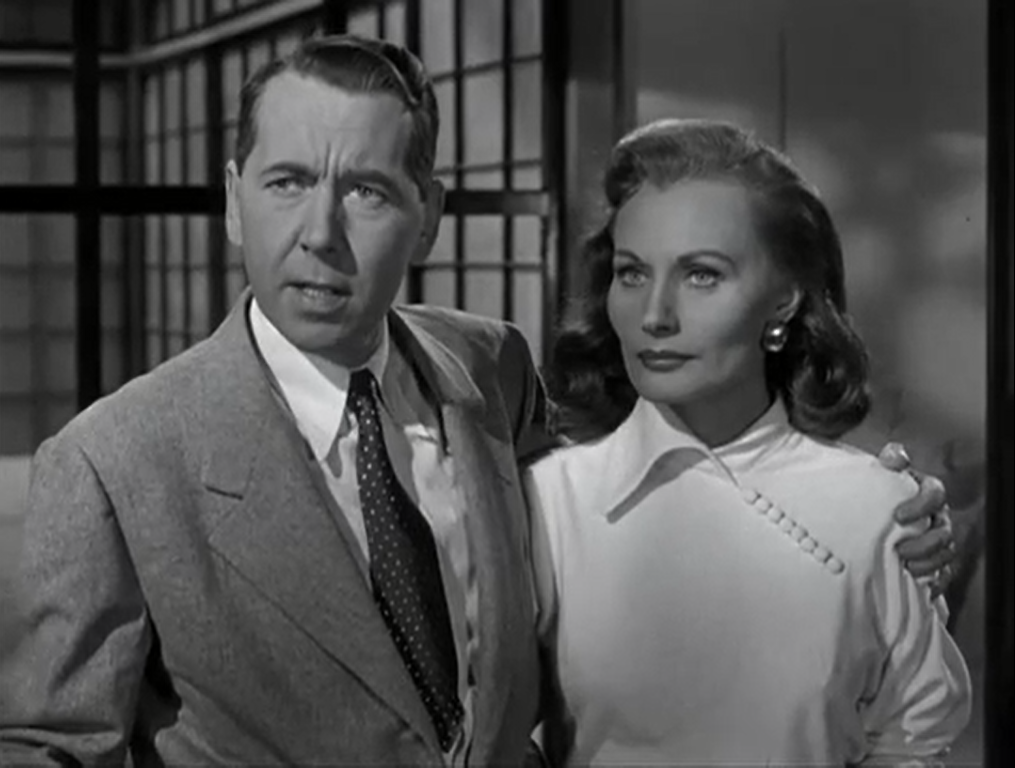
Knox & Marly: nominated for Most Uncharismatic Supporting Couple of 1949
 Movies ala Mark