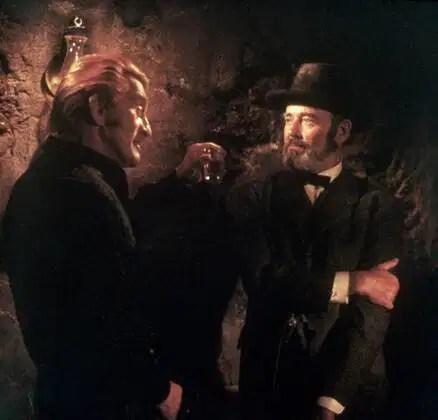
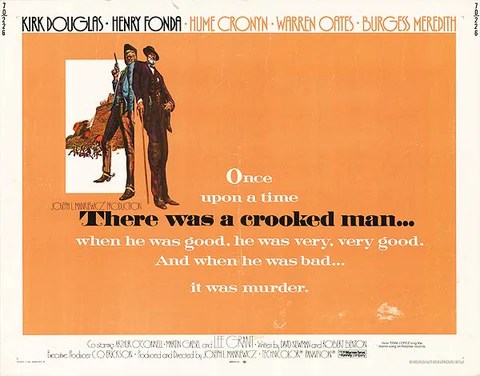
THERE WAS A CROOKED MAN…released in 1970, was fortunately followed two years later by Sleuth. What do they have in common? Both were directed by Joseph L. Mankiewicz. Sleuth, a witty two-man mystery thriller, was a critical and popular hit, and nabbed a quartet of Oscar nominations, including one for direction. It was the lauded writer/director’s last movie, so he went out on a graceful win. Otherwise this smug, dismal downer, a ‘hip’ western in the mocking mode of the period, may have finished his accomplishment-stoked career with a critical and popular dud, 84th place and a $3,000,000 gross tagging it as one of 70’s bumper crop of costly flops. A hard-working cast wring what juice they can out of a barrel of sour mash. *
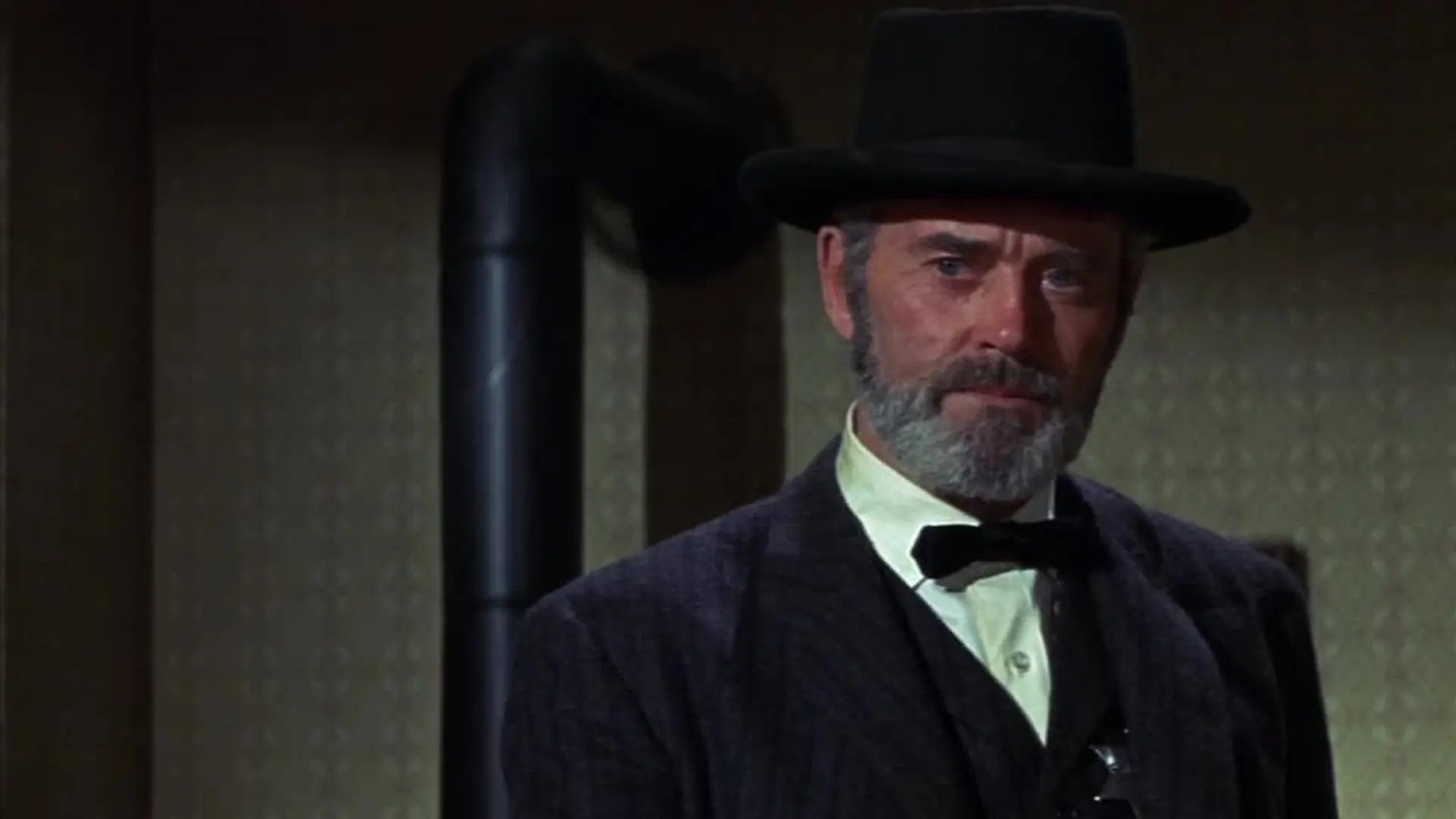
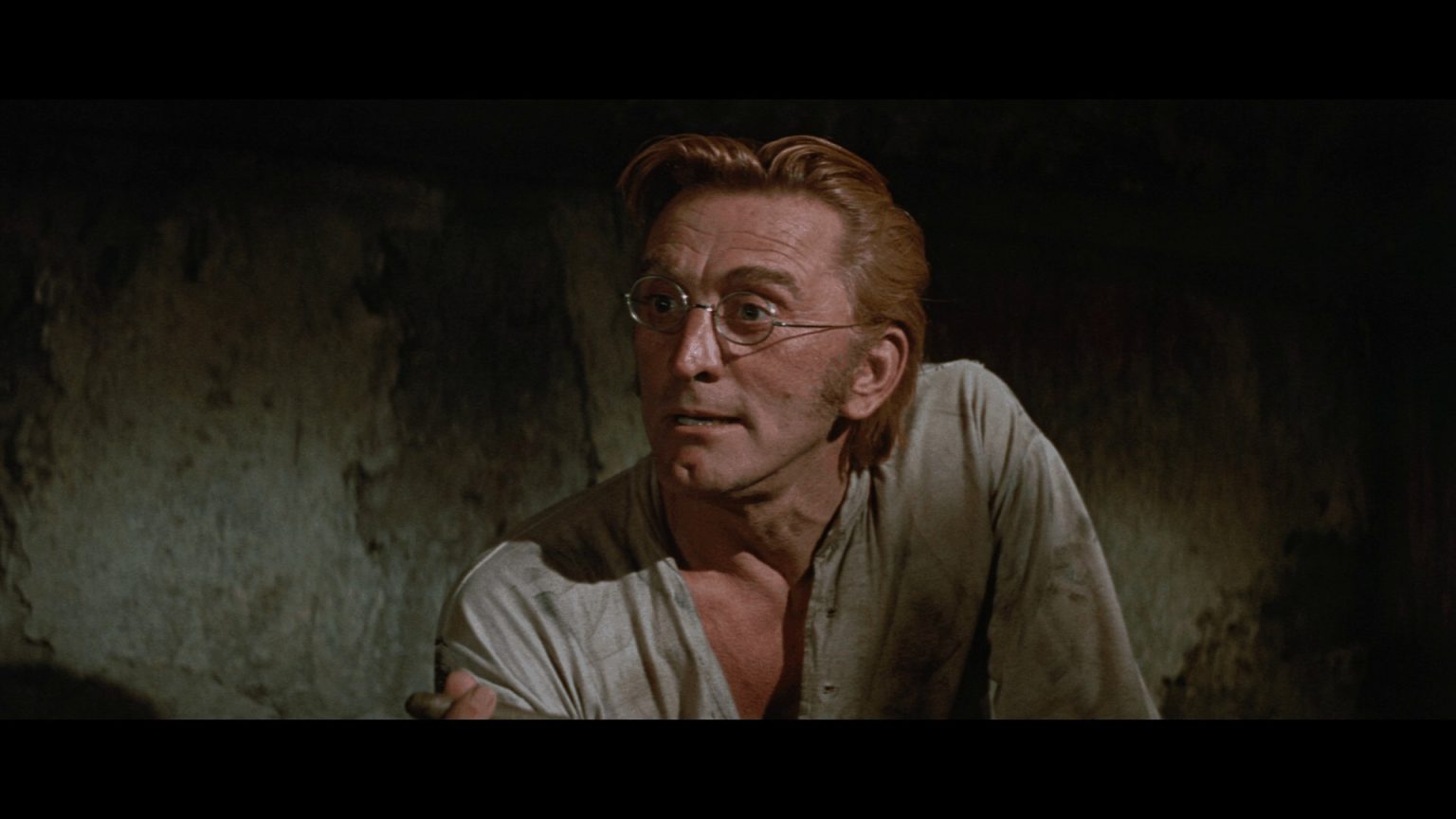 1883 Arizona. Dapper, charming and blithely unscrupulous ‘Paris Pitman Jr.’ (Kirk Douglas) is busted after a robbery and sentenced to ten years in a desert prison hellhole. When liberal-minded ex-sheriff ‘Woodward Lopeman’ (Henry Fonda) takes over as warden, he hopes to enlist Pitman to go along with his reformer ideas. But Paris has other plans, and they include his picked crew of cell-mates. Aiding & abetting are rather dim outlaw ‘Floyd Moon’ (Warren Oates), aged lifer ‘the Missouri Kid’ (Burgess Meredith), bickering gay con-men ‘Cyrus McNutt’ (Hume Cronyn) and ‘Dudley Whinner’ (John Randolph), genial, unlucky freshman ‘Coy’ (Michael Blodgett) and ‘Ah Ping’ (Olympic decathlon hero C.K. Yang), silent but deadly.
 Mankiewicz directed & produced but he didn’t write it; the cynicism-soaked script, originally titled “Hell”, was the red-headed step-child of David Newman and Robert Benton, their first after striking outlaw paydirt with Bonnie And Clyde. Charles Strouse, who did the score for Bonnie And Clyde, was along for the ride, coating the 19th-century time & place detailing with a cutesy 20th-century soundtrack. The lavishly created $300,000 set of the prison and the sun-baked locations in California’s Joshua Tree Natl. Park are undercut by Harry Stradling Jr.’s modish cinematography, the overuse of zoom lensing piling on the put-on. Visually as well as thematically, the movie’s relentless bleakness is draining. Douglas is in his self-satisfied prick element, Fonda in relaxed-to-indifferent mode. Oates is given little to do with an underwritten character, ditto handsome and likable Blodgett (career-tarnished that year with the idiocy of Beyond The Valley Of The Dolls); the acting honors go chiefly to ornery cuss Meredith, snippy hen Cronyn and flustered martyr Randolph.
The 126 minute running time was studio-chopped (wisely for once) from Mankiewicz’ intended 165, although the cut excised Lee Grant’s role to a “hey, was that Lee Grant? moment. With pro turns from Alan Hale Jr., Arthur O’Connell, Martin Gabel, Bert Freed, Victor French, Claudia McNeil, Gene Evans, Jeanne Cooper, Barbara Rhoades, Pamela Hensley, Ann Doran, Larry D. Mann, Byron Foulger.

* Your once-youthful scribe recalls seeing this at a drive-in when I was fifteen, with a brother-in-law (not the cool one) and thinking it was pretty neat in its trendy, nihilistic way. Now, apart from the skill-sets of the actors, it just comes off mean and lazy, obvious and pointless.
Then-freshman Benton (the more talented of the Newman-Benton duo) was 37 at the time, the legendary Mankiewicz 60. Benton recalled “He was very patient with us and delightful. We learned a lot of craft, though we could derail Joe very easily by asking him to tell us stories about Victor Fleming or Ernst Lubitsch or the studios or whatever”…”I’d rather argue with Mao Tse Tung or Vladimir Putin. Joe could shred you in two seconds. His humor could be both loving and caustic, and you wanted to stay away from the caustic part.”
 Movies ala Mark