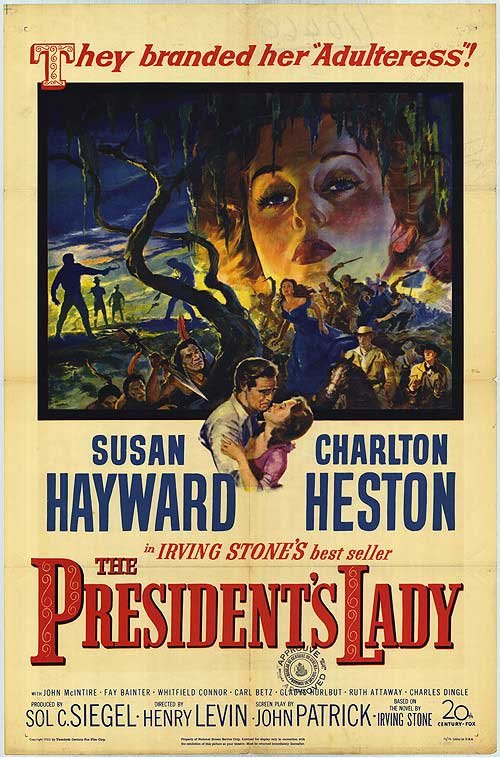
THE PRESIDENT’S LADY of this 1953 historical biopic is Rachel Donelson Robards, 1767-1828, married—with a great deal of difficulty—to America’s frontier & Revolution-spawned Andrew Jackson. Directed by Henry Levin, the storyline begins in 1789 (Andy and Rachel each 22) and concludes 40 years later with his inauguration as the 7th President of a fractious, ever-expanding country. John Patrick’s script was based on Irving Stone’s 352-page novel, a bestseller. Alfred Newman’s rousing main title music opens another of his fine scores from the era, one of the strong elements of a now-neglected movie. *
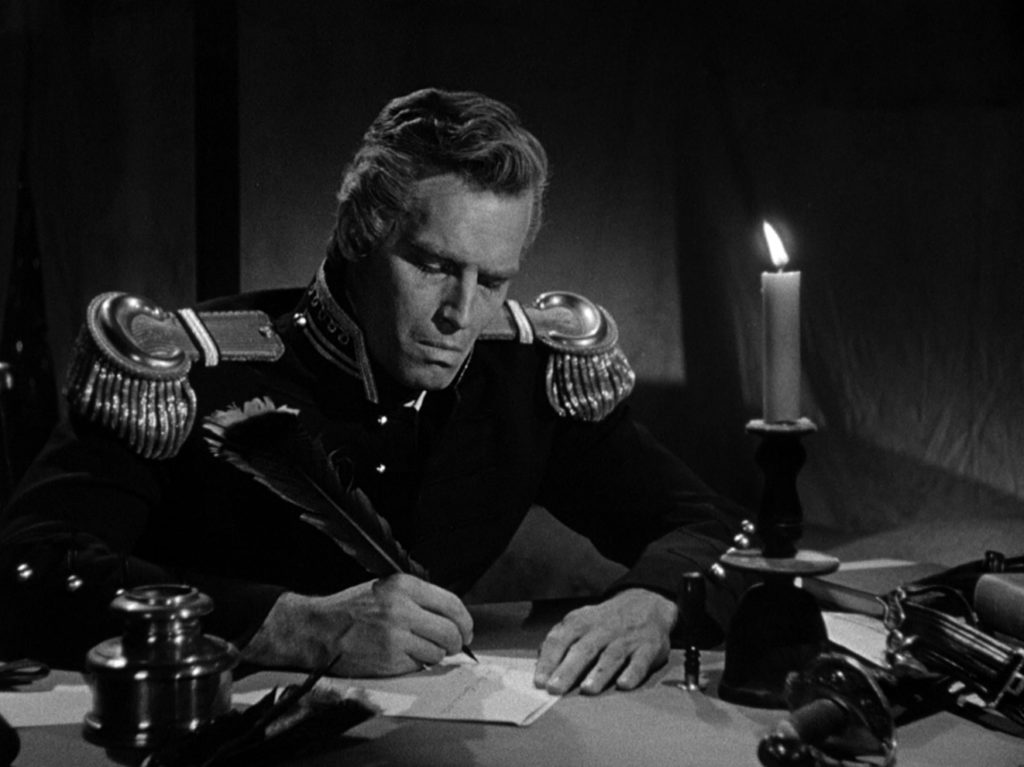
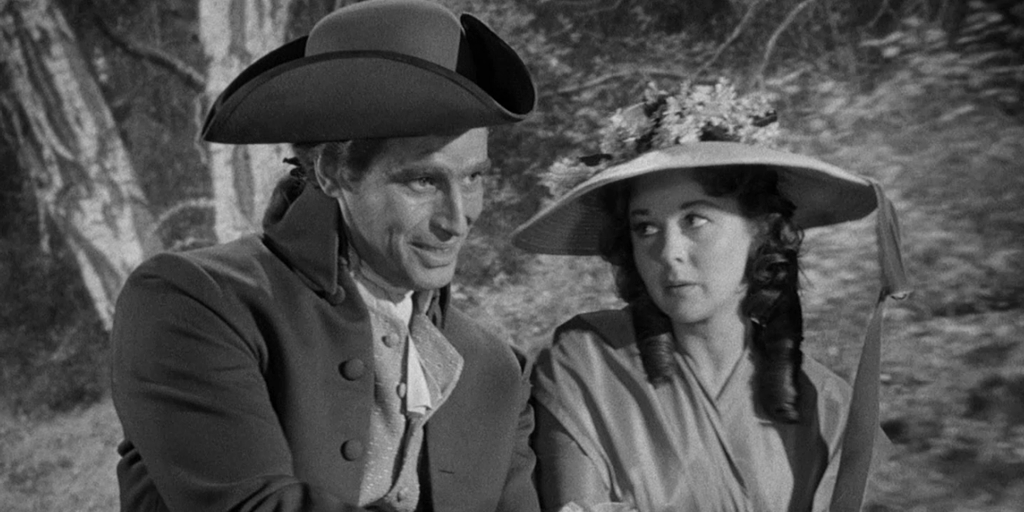
Rachel Donelson Robards (Susan Hayward) is surprised when a rangy frontiersman (and Tennessee’s Attorney General) named Andrew Jackson (Charlton Heston) shows up at her farm, hoping to board for a night or two. A friendship develops, but she’s married, and husband Lewis Robards is a jealous boor. He also has a slavegirl plaything. Rachel and Andrew bond further after dodging attacks from the hostile Creek tribe, and eventually she leaves her husband for Andrew. But divorce from Robards, and her new marriage to Jackson, is complicated by legal issues, Robard’s nastiness and constant insults from those who accuse her of adultery. Though gentle with her, Jackson’s pride has a violent streak, and this was a time & place where honor meant something that you could kill or be killed over. Over many years together they endure one triumph (Jackson a national hero after clobbering the British at New Orleans) and loss (their adopted son, a Creek orphan, dies) after another.
“What wrong have I done that I should be punished?”
It’s a good fit for the stars, hers secured, his rising. At 35, Hayward’s other ’53 outing was the silly Africa adventure White Witch Doctor, which let her do more of her frequent over-acting: here she was warmer, less mannered, and she does quite well with the progressive aging of her character (good makeup helping). For Heston, 29, this was one of the earliest of over a dozen times he played a historical character (he’d revisit Jackson five years later in the remake of The Buccaneer) and the material is richer than his other jobs that year, the mediocre westerns Arrowhead and Pony Express and the lame drama Bad For Each Other (‘but good for laffs’). At that time he was toiling thru a slew of glowering hardass roles; he’s much more likable here than in his other vehicles of the period. **
“No man can say what he will about my wife.”
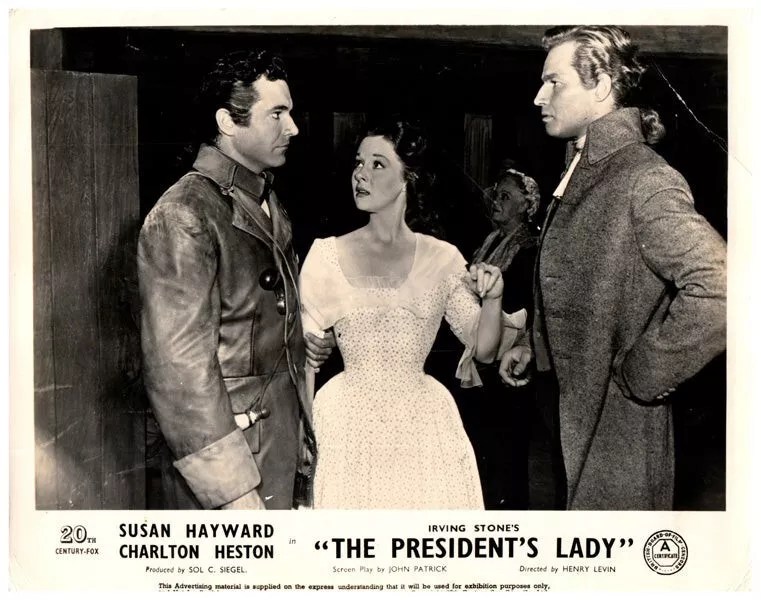
Heston has a terrific, rip-roaring brawl with Jim Davis and an exuberant full-tilt horse race with Carl Betz (31, his first credited part). A public slur after the race provokes a duel: a mistake because if there’s anything you don’t do with Andrew Jackson (or his contemporary Jim Bowie, for example) is insult their wife, manhood or, heck, choice of cool buckskin jacket. “I never thought it would do any good to wear fancy clothes, but it saved my life by a half-inch.” Best said with a fever after being shot in the chest; the shooter no longer talking, or breathing…

As a director, Henry Levin had some wins (Journey To The Center Of The Earth, Where The Boys Are, The Wonderful World Of The Brothers Grimm) and some embarrassments (Murderer’s Row, The Ambushers): he did a decent job on this assignment, constricted some by the modest budget ($1,475,000), and Fox’s pros helped it pull Oscar nominations for Art Direction and Costume Design. At the box office this ranked 88th in ’53, grossing $4,100,000.
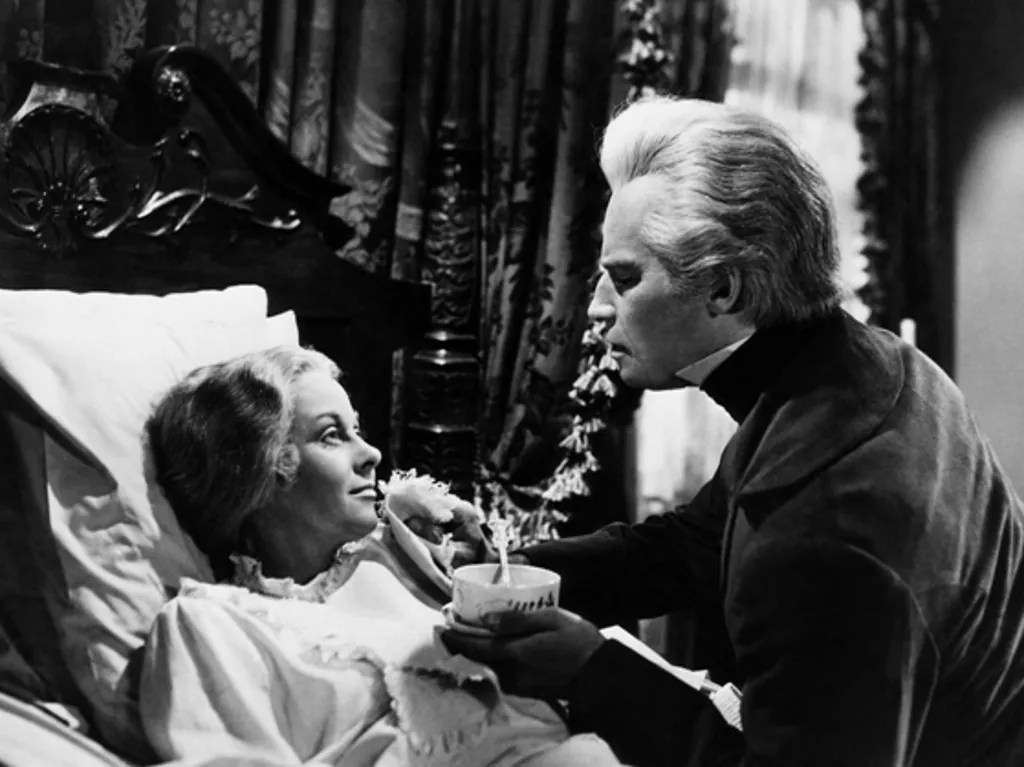
On hand in frontier garb are John McIntire (always reliable, as Andrew’s loyal friend, repeatedly telling him to watch his temper), Fay Bainter (fine as Rachel’s kindly mother), Whitfield Connor (the vindictive Robards: Connor was predominately a successful stage actor, just a few films), Nina Varela, Ralph Dumke (grating), Ruth Attaway (a interesting personality off screen, stuck in her film debut with the ‘beloved faithful house slave’ part), Margaret Wycherly, Charles Dingle (a minor gig for this superb actor, a descendant of Jackson opponent Davy Crockett!), James Best, Willis Bouchey, Vera Francis (beauteous “Toast of Harlem” pinup, as Robards’ slave mistress) and George Chakiris (waitin’ in the wings). 96 minutes.
“Andrew, sometimes I think politics has taught you to be devious.”
* Author Irving Stone, 1903-1989 wrote four non-fiction works but it was his 15 historical novels that secured fame and fortune, including “Lust For Life” and “The Agony And The Ecstasy,” both made into movies. Besides “The President’s Lady”, Stone explored the lives of John & Abigail Adams and Abraham Lincoln & Mary Todd. When “The President’s Lady” was written, Jackson was revered. Since then, his reputation has suffered (he owned over 100 slaves, oversaw the Indian Removal Act of 1830) which may account for this engaging movie being mostly ignored today.
** Chuck the Heston, in Reel Life—along with his later turn at ‘Old Hickory’ in The Buccaneer, Charlton the Chiseled played Moses, John the Baptist, Marc Antony (three times), El Cid, Michelangelo, Sir Thomas More, Henry VIII, Robert Devereaux the Earl of Essex, Cardinal Richelieu,William Clark, Brigham Young, Buffalo Bill Cody, Gen. Charles Gordon and Joseph Mengele. Plus providing the voice of God, twice.
Heston v. Hayward: “Fortunately, we had an actress …who made her character a woman of flesh and blood – a true frontier girl, a passionate wife, and a devoted companion.”
 Movies ala Mark