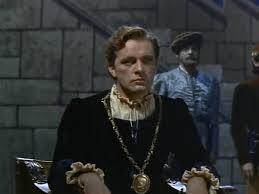
PRINCE OF PLAYERS is 19th-century thespian Edwin Booth, 1833-1893, son of famed Shakespearean player Junius Brutus Booth, 1796-1852, and older brother to another actor, John Wilkes Booth, 1838-1865, one who turned fame to infamy. Based on Eleanor Ruggles book, this 1955 biodrama was scripted by Moss Hart, produced & directed by Philip Dunne.*
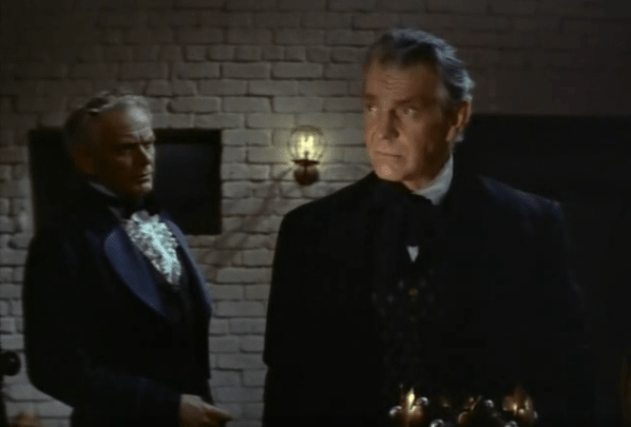
The story-line starts in 1838, with Edwin as a boy watching his ferociously talented but booze-battered father go from lionized to ruined. Raymond Massey rips into his part as the towering but tormented Junius. At 58 Massey had three more patriarchal-power parts that year; two as dominating fathers, in East Of Eden and Seven Angry Men, one as a general, in Battle Cry. Moving forward, Edwin as a man (Richard Burton) takes center stage, and despite his own demons (liquor, depression) that he suspects are inherited and inescapable, he garners theatrical fame and personal happiness when married to fellow performer Mary Devlin, 1840-1863 (Maggie McNamara). Life delivers blows, however, not least the one fired by John Wilkes (John Derek), the firebrand younger brother who secures his own place in history, by an act, during a play, in a theater.
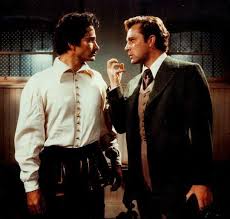
The rise & fall of the Booth’s certainly has the triumph-meets-tragedy ingredients of a classic Great American Story, family success and trauma enacted literally on stage. Yet the fact-based (not too Holly-fictionalized) drama doesn’t fare as well transferred to screen, even with the lure of CinemaScope. Though one of the draws for patrons was the chance to see Richard Burton performing scenes from Shakespeare, the show sags under the weight of too much Bard, with the distancing effect of the wide-screen camera and rather uninspired direction sapping energy from what should be highlights. Burton’s voice is an obvious plus, Massey is strong, Derek displays effective urgency. McNamara, 26, cast from her popularity in The Moon Is Blue and Three Coins In The Fountain, comes off flat next to Burton; their scenes don’t provide emotional needed chemistry. She didn’t do another movie for eight years (The Cardinal) before retiring. Bernard Herrmann adds an okay score, one of his lesser efforts. Crowds failed to flock and it languished at 147th place, a $1,700,000 gross a big black eye balanced against a production cost of $1,570,000.

With Charles Bickford, Elizabeth Sellars (as sister Asia Booth, 1835-1888), Eva Le Gallienne, Ian Keith, Eleanor Audley, William Walker, Mae Marsh, Paul Frees, Henry Kulky, Richard Deacon, Ben Wright and John Doucette. 102 minutes.
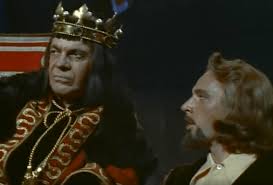
Who Dunne it?—yep, a Dunne pun. As a screenwriter, Philip Dunne had an excellent track record, working at 20th Century Fox for 25 years. His 36 screenplays took in many good and very popular pictures, his ten as a director (this his first in that capacity) were less successful. His pithy take on the failed Prince of Players: “it was too larded with Shakespeare”. About Burton: “He hadn’t mastered yet the tricks of the great movie stars, such as Gary Cooper, who knew them all. The personal magnetism Richard had on the sound stage didn’t come through the camera.”
Burton, diary entry in 1971: “I remember the high hopes I had of that film and my disappointment at its indifferent reception. The original script by Moss Hart was very good when I agreed to do it but a year later when I actually did it had been murdered by [Fox boss Darryl F. Zanuck] and his hacks. Some of it was salvageable, however ,which accounts for what little success we had. It seems to me that I was outrageously pretty in those days and much prefer my present hard and ravaged countenance.”
After two Oscar nominations (My Cousin Rachel, The Robe), along with a good war flick (The Desert Rats), the critical and box office duds of Prince of Players and The Rains Of Ranchipur not only soured Burton on Hollywood (and vice versa) but augured in a frustrating streak of creative and financial misses that ran until the early 60s.

 Movies ala Mark