
MY SISTER EILEEN scored a deserved hit in 1942; as one of the year’s brightest comedies it got the great Rosalind Russell her first of four Oscar nominations for Best Actress. The good germ came from Ruth McKenney (1911-1972), who wrote ten books, the best-known a short story collection about the time she and her younger sister shared a scruffy apartment in Greenwich Village. Adapted as a play by Joseph A. Fields and Jerome Chodorov, it scored two years and 864 performances on Broadway. During that run, they wrote the script for the 1942 film version, directed by Alexander Hall, who was vetted for handling humor from wins like Little Miss Marker and Here Comes Mr. Jordan. *
“I’m not worried about you, Eileen. Not when there’s a man alive.”
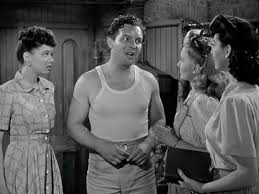
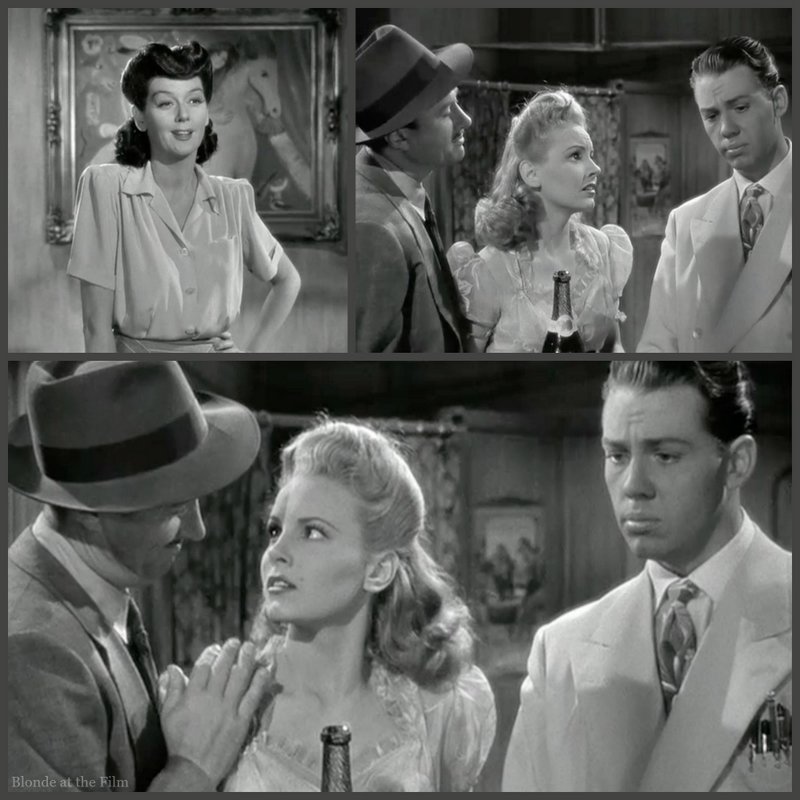
Sisters ‘Ruth’ (Russell, 34) and ‘Eileen’ (Janet Blair, 21) boldly relocate from the career doldrums of Columbus, Ohio to the rocket-paced beehive of Manhattan’s Greenwich Village, plunking down out of naivete and desperation into a one room basement ‘apartment’ whose single window is at sidewalk level. Hopeful writer and practicing cynic Ruth meets a motor-mouth magazine editor (Brian Aherne) who may be helpful—at least to her vocation, Ruth and romance have a losing streak—while pretty (and pretty ditzy) actress wannabe Eileen is a man-magnet, drawing fellas by the score. The bustling bohemian neighborhood teems with neighbors, former tenants and total strangers, who drop by without notice, the human jumble resulting in a good deal of referee calls from protective Ruth, the older and wiser of the two.
“Doesn’t anybody knock around here?”

Very funny movie doesn’t exactly serve as a commercial for men, most of whom, except for Aherne’s character, are portrayed as lecherous boobs—the p.c. vultures will go into anaphylactic shock with the leer-quotient—but what comes thru triumphant over the doltish or cavemanish boys clubbing is an early version of Girl Power: feminism thru sibling sisterhood as displayed by Russell and Blair.
Savvy, flawless with a retort, nimble as a cat with physical bits, subtle at conveying heart and hurt, Russell’s skill as a comedienne was secured by the humanity and truth under the joking. After putting in time in 18 films over six years, she gained momentum in ’39 with The Women, walloped a home run in ’40 with His Girl Friday, followed by six more comedies and one jokey adventure (They Met In Bombay) before making this part one of her signature pieces. It’s further to her credit that she’s playing someone who’s supposed to be kind of an ugly duckling; not many glamorous leading ladies of the day would risk that.
Far from ugly or anything close to a mallard, the saucy, sexy, self-aware former big band singer Blair had done four pictures before this–three the same year—and would make nine more in the 40s, then just five over the three decades after. She’s a winsome charmer in this show, too smart and likable to lazily play the role as a cutout dumb blonde; you care what happens to Eileen and are glad she has a cool big sis to watch out for her. Blair should’ve garnered an Academy Award nomination in the supporting actress category.
Urbane and handsome Aherne, 39, unsung today, was quite popular at the time. A year later when he left Columbia studio to serve as a flight instructor for the Royal Air Force, the studio reported his income as $144,958/$2,632,000 in 2024, second only to studio czar Harry Cohn. Aherne didn’t have the sexy dash of Errol Flynn or the puckish panache of Cary Grant; he did well, though, as noble, doomed leaders—Juarez (an Oscar nomination as Emperor Maximilian of Mexico), Capt. Smith in 1953’s Titanic (I remember thinking he was cool at six years old first seeing that classic on TV), King Arthur in Lancelot and Guinevere. Yet he also logged quite a few comedies; he’s at possibly his freest and most excitable in My Sister Eileen.
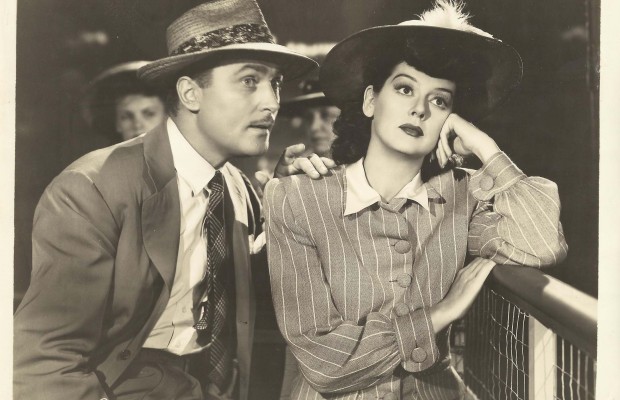
The gross of $6,300,000 put it #22 of ’42. Later adapted into “Wonderful Town” a hit Leonard Bernstein musical (Roz was back, won a Tony), then into a 1955 musical-comedy feature film remake, finally a one season TV show in 1961.
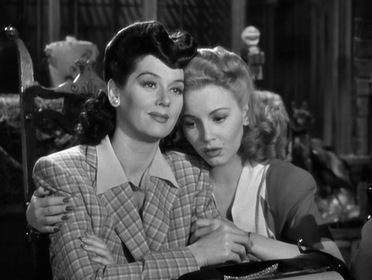
As New York City ‘characters’ adding to the mirth: George Tobias (‘Appopolous’, landlord and ‘modern artist’), Allyn Joslyn (slimy ‘Chic Clark’—trust a guy named ‘Chic’?), Gordon Jones (‘Wreck Loomis’, one tackle too many), Richard Quine (13 years later he’d direct the remake), June Havoc (20 years later Roz would play Havoc’s real-life suffocating stage mother in Gypsy), Donald MacBride (sputtering angry cop, ‘Lonigan’), Clyde Fillmore (head of ‘Craven’ publishing), Jeff Donnell, (debut), Ann Doran, Charles Halton, Arnold Stang (debut), Forrest Tucker (ten parts that year before enlisting in the Army), and—showing up for blink & miss gag at the finish—The Three Stooges (Moe Howard, Curly Howard, Larry Fine) as subway construction workers. Grant Mitchell and Elizabeth Patterson are both funny and touching as the gals’ father and grandma back in Ohio. 97 minutes.
* Rallying against the mostly depressing war news (defeat after defeat) Hollywood in 1942 produced a crack unit of comedies. Eileen and her sis kept company with Road To Morocco, The Major And The Minor, four Abbott & Costello’s (Ride ’em Cowboy, Rio Rita, Pardon My Sarong, Who Done It?), My Favorite Blonde, Woman Of The Year, The Palm Beach Story, The Man Who Came To Dinner, To Be Or Not To Be, I Married A Witch, a couple of Andy Hardy’s….Hitler, Mussolini & Tojo should have read the Tana leaves and wised up: any ‘soft’ society that could salvo this many laughs while getting clobbered was going to deliver one helluva payload payback when the assembly lines cranked up. Think before picking a fight.
Eileen moved to L.A. and married writer Nathanael West. On December 22, 1940, they were killed in a car wreck: it was four days before they were scheduled to attend the Broadway opening of the play that bore her name. Further tragedy visited Ruth when in 1955 her husband of 18 years committed suicide. On her 44th birthday. Their daughter was named Eileen.
 Movies ala Mark