
SAINT JOAN had art mirror life when it figuratively suffered the same fate as its namesake heroine. Stacked odds had impassioned 19-year-old peasant girl Jeanne d’Arc burned alive in 1431, cruel thanks for saving France long enough that it could eventually save itself. In adapting George Bernard Shaw’s 1923 play, the 1957 film version was doused in boiling oil by critics with most of the searing undergone by its innocent star, 18-year-old newcomer Jean Seberg. The scorch made the inexperienced actress a de-facto martyr: the film’s problems rightly lay at the heavy paws of its fire-breathing dragon of a director, Otto Preminger. *
“Do you expect people to love you for showing them up?”

Graham Greene handled adapting Shaw’s stage screed/tragedy to the demands of the screen. The play generally tops 2 hours, 45 minutes. Greene and Preminger whacked that down by nearly an hour: the shuffle and crimp don’t just stifle action (there is none until the fiery finish) and result not just in a jumpy narrative but serve to underline historical anachronisms in the dialog, music scoring (otherwise fine) and chronology. By eliminating the how-she-got-there setup which would let us better appreciate her mystical appeal, in leaving out the crucial battles that not only showed her power but help jostle the audience with movement, and then jumping too rapidly ahead to get to the grotesquely rigged trial, Greene and Preminger muffed it. Instead of passion we’re left with witty but windy arguments: the immovable Church hierarchy vs. Joan’s ‘heretical’ voices, contesting regions of France vs. the ‘Goddamns’ (the English), political expedience and practicality vs. decency and justice. Wily, even surprising, acting by the pros in the cast, and with some effective moments from the earnest, unfairly maligned leading lady (mauled by the brutish director, castigated by cruelly catty critics) it’s stillborn from talk, talk & more talk, in obvious sets, flavorless costumes and with zilch for atmosphere.
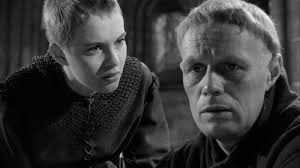
Other than two Americans in the biggest parts, and Austrian-born Anton Walbrook, the cast is a roll call of dependable declaimers from Britain, not a weak link among them. Next to Iowa-fresh 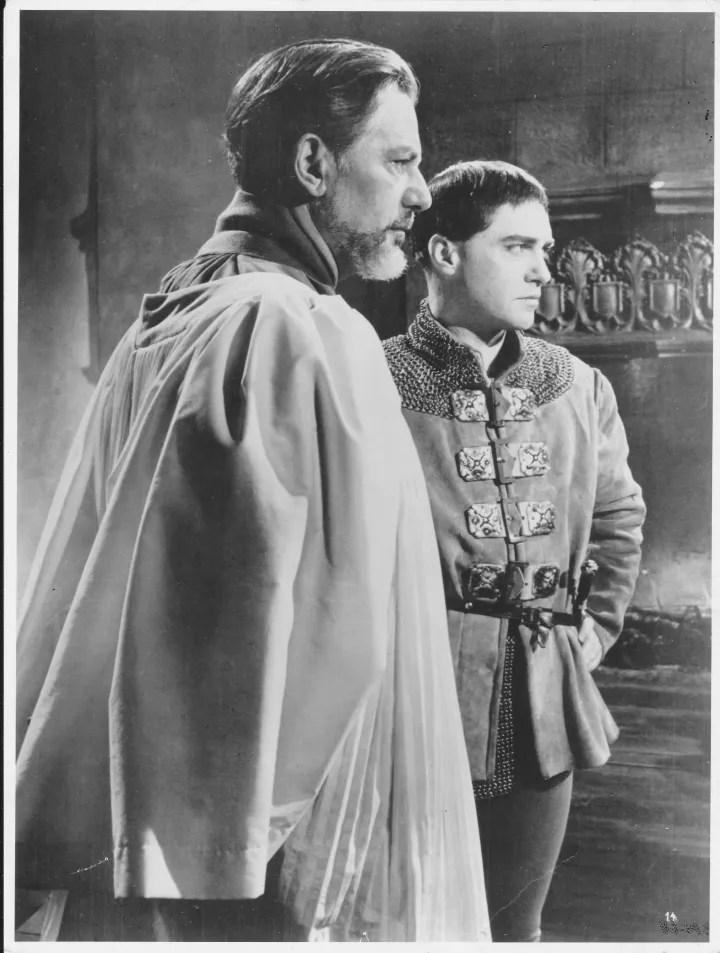 Miss Seberg (she’d had exactly one season in summer stock) the second most important part–and star billing–went to veteran Richard Widmark, 42, in the crucial role of The Dauphin Charles VII, dithering haplessly in dealing with the English threat and from his own spiderweb of advisors. In a portrayal different from any other in his career he’s clearly enjoying a chance to go full-silly as the infantile ruler-to-be. He came in for a good deal of criticism for playing out of his usual style and manner, similar to Gregory Peck’s Ahab in Moby Dick and Marlon Brando’s Fletcher Christian in Mutiny On The Bounty. Dissed at the time, those performances look inspired in retrospect and from my end of the siege tower we’ll crossbow that Widmark’s daft clown is daring, funny and really enjoyable. He sandwiched this costumer departure between two typically sturdy pieces of work in The Last Wagon and Time Limit.
“That is how the messages of God come to us, through our imagination.”
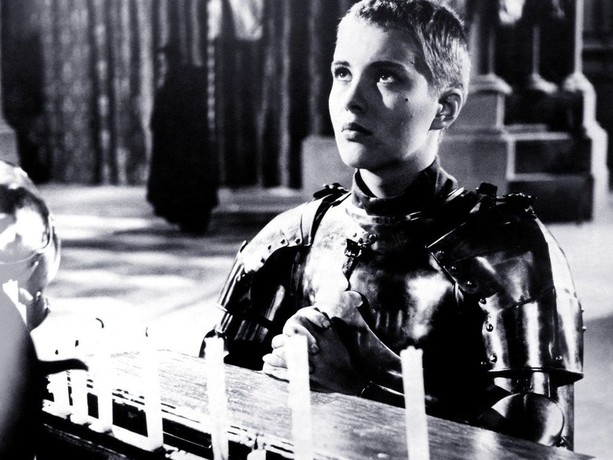
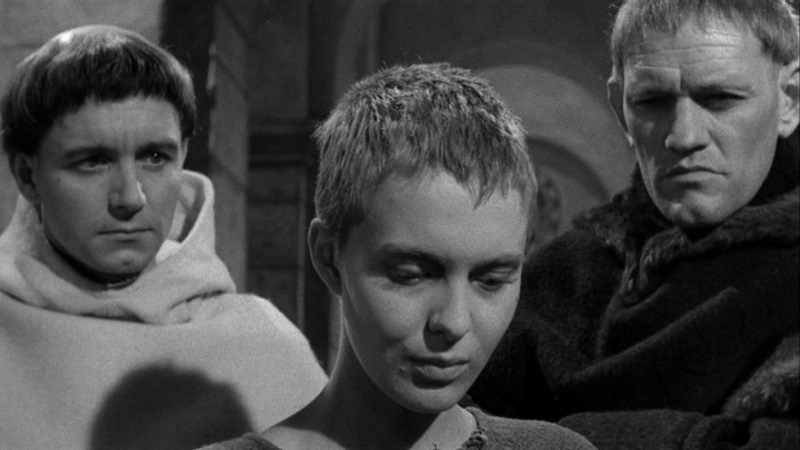
As for the beleaguered Jean Seberg, plucked from obscurity by Preminger after a casting call on the order of Scarlett O’Hara (hundreds interviewed out of 18,000 applicants) her acting is variable. The plaintive, straight-ahead Midwest American delivery jars at first, especially against the cultured Brits trying to out-scorn each other and the capering Widmark, but she improves as the story progresses and capably expresses moments of honesty, confusion and hurt that are nothing to be ashamed of. In large part the confusion and hurt was real because she was subjected to constant abuse from her bullying director, who reveled in taking the Marine drill instructor approach. The list of actors and actresses who were demolished by his on-set tantrums is a long one. This interesting movie is flawed because of his approach (he produced as well) and Greene’s treatment, not due to the hopeful, eventually poignant efforts of his star.
Dire reviews didn’t help pull patrons. Cost:$1,000,000. Grosses: according to Cogerson, just $1,100,000, 147th place in ’57. Other sources indicate less than half as much.
“Some of the people laughed at her. They would have laughed at Christ.”
The emotionally evocative (if anachronistic) score was composed by Mischa Spolianski. 110 minutes, with Richard Todd (very good), John Gielgud (effortlessly imperious), Felix Aylmer, Archie Duncan, Harry Andrews (getting wild with righteous fervor), Margot Grahame, Barry Jones, Francis de Wolff, Finlay Currie (nasty this time), Victor Maddern, David Hemmings (15, second part, uncredited, as a page boy) and Norman Rossington.
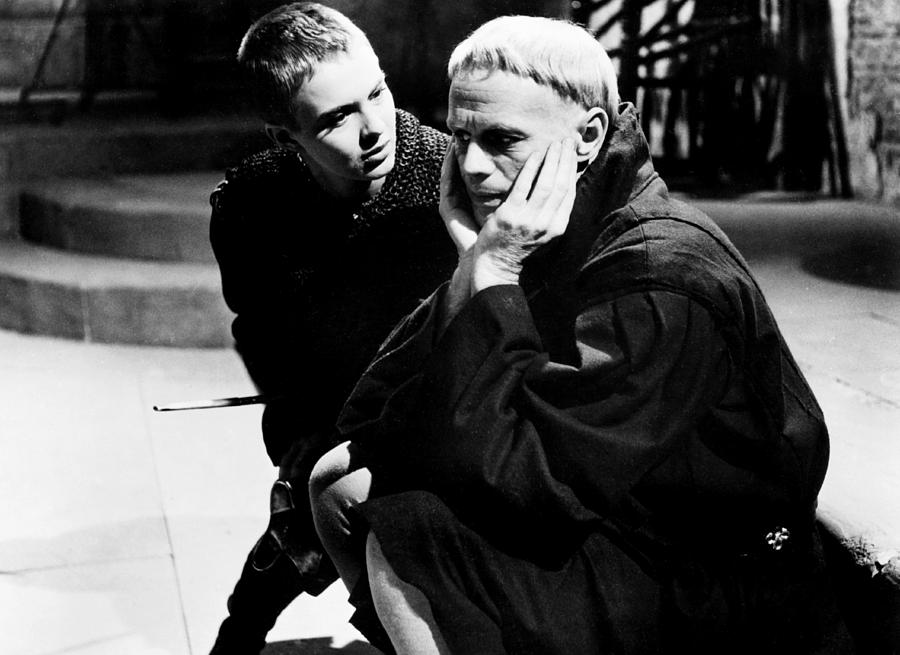
* Seberg: “I have two memories of Saint Joan. The first was being burned at the stake in the picture. The second was being burned at the stake by the critics. The latter hurt more.”
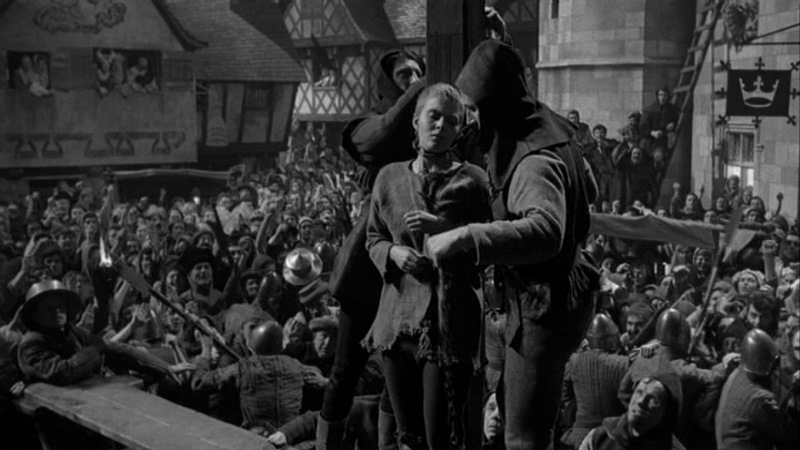
Closely watch the immolation sequence (photo below) for the quick moment when the special effects misfired and Seberg reacts to being singed.
‘Otto the Terrible’ put her into another film, 1958’s Bonjour Tristesse, but it tanked as well: like Saint Joan its reputation, and that of the once-snubbed, ill-fated actress, has risen. We’re not fans of that movie, or Seberg’s performance in it, feeling she did better as Joan.

The last straw, literally. Stage hands aiding already tormented Jean Seberg after gas canisters went off and nearly Arc’d her for real.
 Movies ala Mark