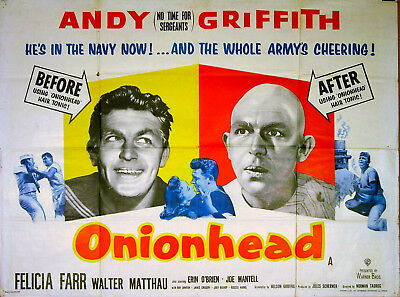
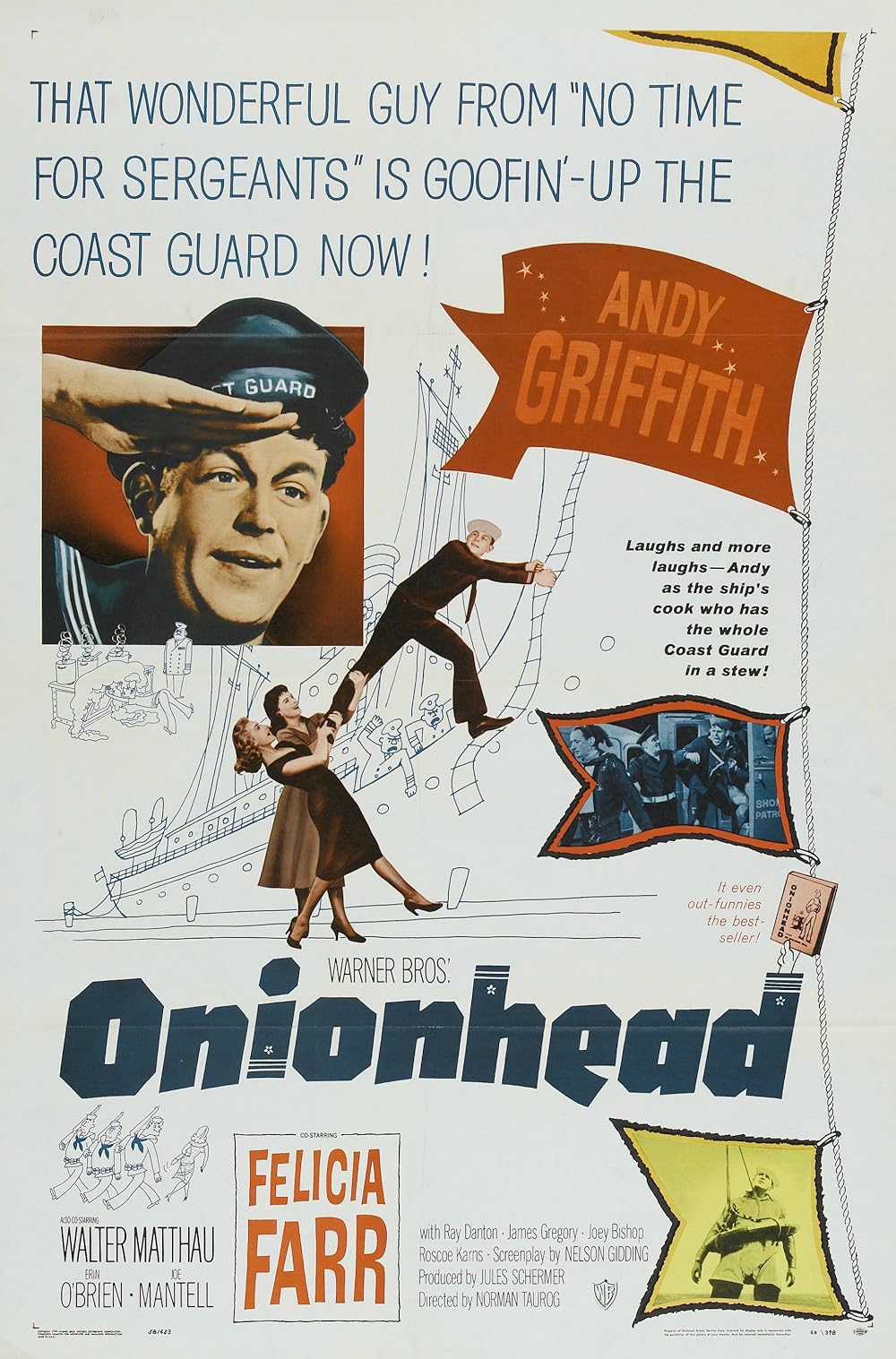
Untruth-in-advertising: mixing up the Coast Guard with the Navy and the Air Force with the Army.
ONIONHEAD, when it’s noted at all, is slagged as the movie that drove Andy Griffith into TV, since its relative failure stopped his budding screen career in its tracks. It was his third feature, coming after the 1957 critical success A Face In The Crowd and the service comedy No Time For Sergeants, which was the 5th biggest hit of 1958. Onionhead followed five months later that year, and faltered into 46th place. That’s actually not bad for a property with that off-putting title: Cogerson cites the gross as $5,700,000, better than a good number of higher profile pictures that year and enough to easily cancel the $960,000 Warner’s put into making it. Nonetheless, critics were unimpressed and patrons disappointed, expecting a broad comedy like ‘Sergeants‘—this one is set in the Coast Guard—instead getting drama that had some laughs (not very good ones) scattered thru generally downbeat material. It isn’t terrible, but the commendable elements don’t suffice for the weak ones. On to ‘Mayberry’, Andy…
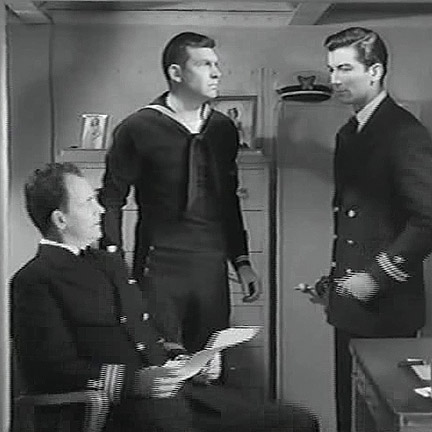
In 1941, ‘Al Woods’ (Griffith, 32) impulsively quits college and joins the Coast Guard. During his enlistment, he’s assigned to becomes a cook (with zip experience) and learns the job under harsh tutelage from ‘Red Wildoe’ (Walter Matthau), a touchy alcoholic lifer. Al’s tour of duty includes a fling with Boston bar sexpot ‘Stella Papparonis’ (Felicia Farr), conflict with his ship’s most caustic officer, drunken binges with pals and helping fight a German U-boat after the war gets underway.
Confronting agent over the script?
Directed by Norman Taurog, it was written by Nelson Gidding (I Want To Live!, Odds Against Tomorrow, The Andromeda Strain) off Weldon Hill’s novel, 378 pages based on some of his own Coast Guard experiences. We can’t speak for Hill’s book, but the pessimism infused film and its unhappy characters aren’t much more of a commercial for the Coast Guard than the same year’s The Naked And The Dead was for the Army. Matthau’s good at being a sourball, and Farr exudes a mix of sexual tension and vulnerability. Ray Danton plays to type as a slick bastard, and Joey Bishop does his typical deadpan shtick (was he ever really funny?). Griffith’s prickly character isn’t sufficiently sympathetic and we’re asked to accept Al’s caveman come-on as somehow being babe candy (“Pardon me while I fall down laughing” to quote ‘Peachy Carnahan’). The charm from No Time For Sergeants is missing in action.
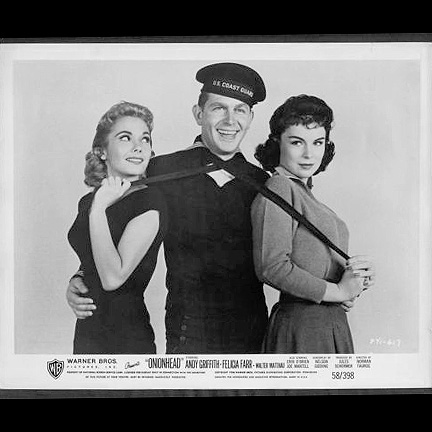
Yeah, right
AL: “Now get this straight – I brought you home as a favor to Red. And you might…” STELLA: “Oh, I married the wrong guy. It should have been you. I don’t care what you think, but love me, love me, love me.” AL: “Get away from me! Other guys have had unfaithful wives but you’re not even that. I pity Red.” STELLA: “Al! Pity me!” AL: “For what? For being a cheap, dirty, little tramp?” STELLA: “You think I want to be like this? Don’t you think I’d like to be happy and find love like other women? Don’t you think I’d like to be satisfied with one man? You, you don’t know what it’s all about. I can’t help what I am. I was born this way. One look at me and every man thinks I’m made for love. Well, that’s a laugh. Because I’m just the opposite. I’ll never know the meaning of love. But I want to know. I want to know. I really liked you, Al. I kept thinking maybe, maybe it’d be different with you.” AL: “Stella, I...” STELLA: “Beat it, Al. Leave me alone.”
Enlist at will for 111 dull minutes, with Joe Mantell, James Gregory, Roscoe Karns, Tige Andrews, Erin O’Brien, Claude Akins, Sean Garrison, Byron Foulger, Joanna Barnes, Myron Healey, Anthony Eisley, Gary Lockwood (21, debut), Paul Smith, Paul Mantee, Charles Watts.
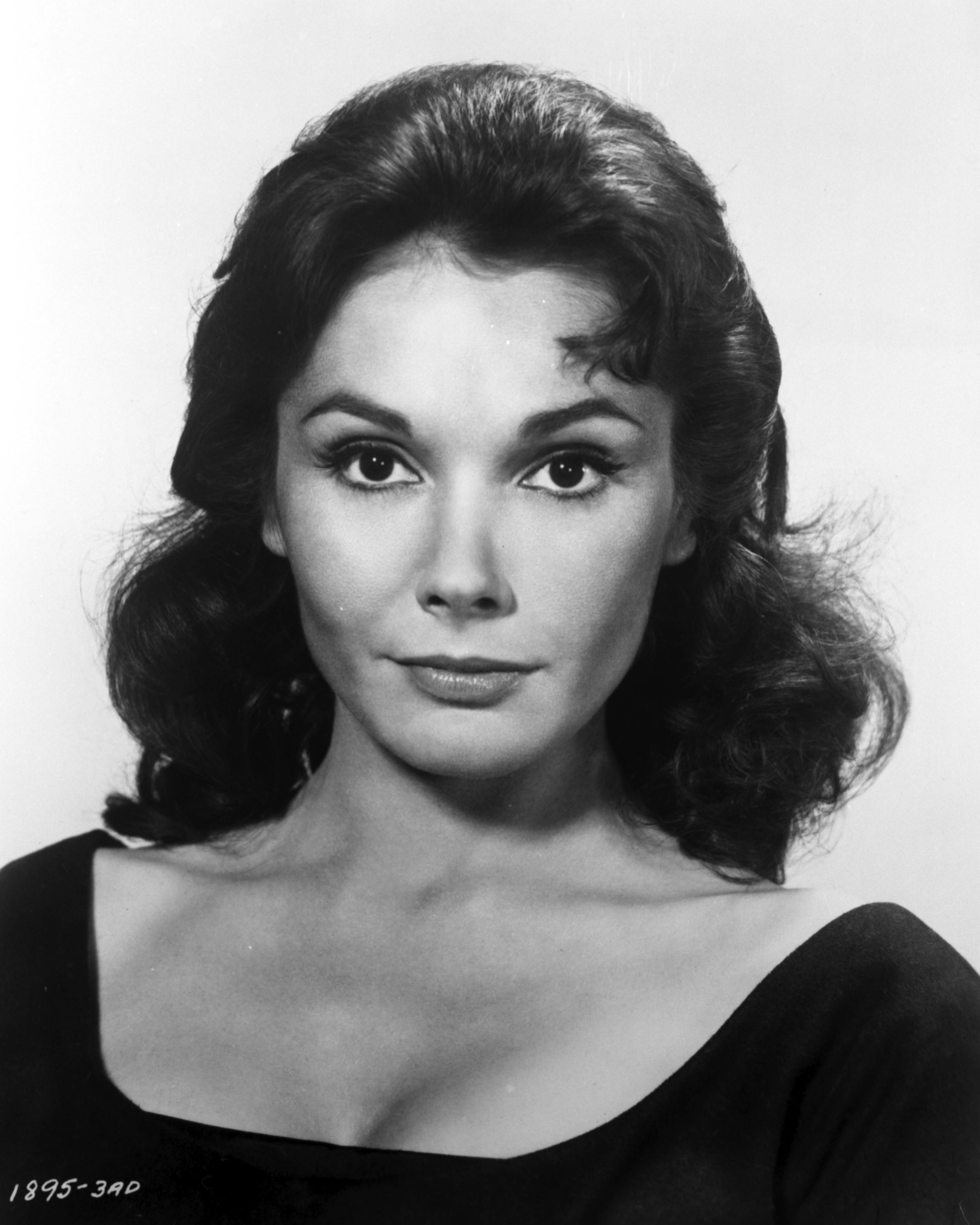
Felicia Farr, just dying to throw herself at…Andy Griffith?
 Movies ala Mark