
ATTACK OF THE CRAB MONSTERS—hard to lose with a title like that, as producer-director Roger Corman correctly surmised back in creature-infested 1957, pairing this $70,000 crustacean invasion with his equally frugal Not Of This Earth. The duo infested drive-in necking sessions and kid-packed matinees to the jingle of nearly a million bucks. That lucre would be Cormanized into the following year’s Teenage Caveman, She Gods Of Shark Reef and—lest we forget—The Saga of the Viking Women and Their Voyage to the Waters of the Great Sea Serpent. Heck, you can’t see ’em all, and we fess to missing the last two (it’s early yet), but one of our (‘our’ being me, and those like me—who are Not of This Earth) earliest Saturday monster memories is of this proto-goofy, chuckle-choked yet oddly effective cheapie. We vouch that witnessed as a little kid it made the notion of getting your head torn off underwater memorably ‘keen’. *

Guess which two will make it to The End.
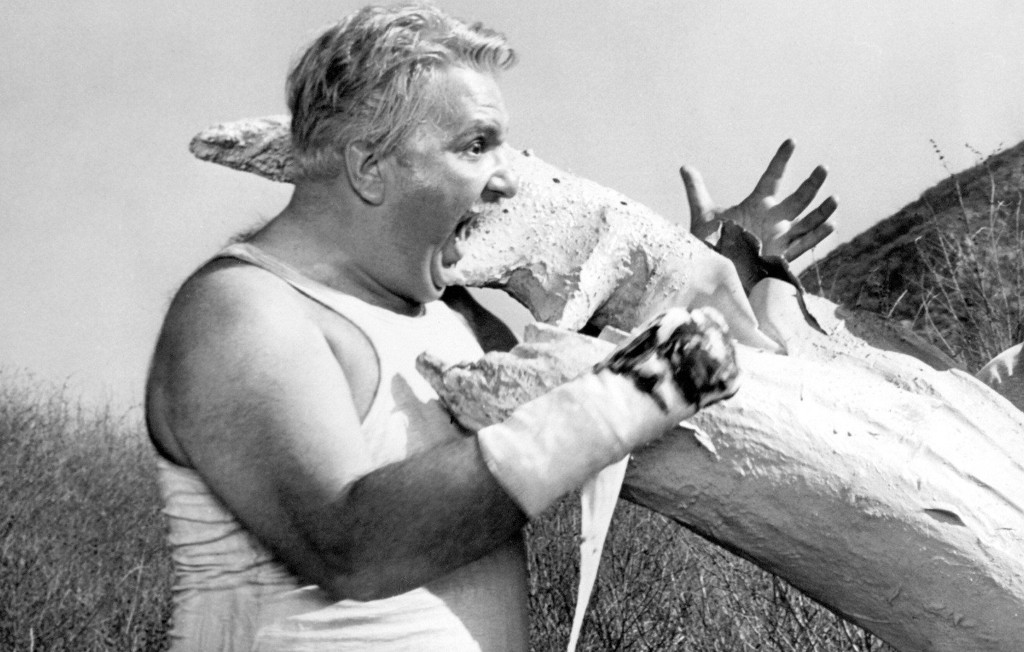
A team of scientists and sailors are trapped on a fast-collapsing Pacific island with a couple of gigantic crabs that don’t just maim mortals; they consume their thought processes and can project their voices, attributes that quickly lead tiered members of the supporting cast to their respective dooms. ‘Crab‘ wouldn’t carry the same mercury poisoning spell without the script by Corman word genie Charles B. Griffith, who also has a top-this moment as the sailor who gets his head pincer’d off. While the dialogue is asinine, the claim-our-consciousness idea is interesting, and Corman paces the execution fast enough (it’s only 63 minutes long) that if you’re forgiving and nostalgic (or were/are five years old and spookable) AOTCM succeeds against its obvious limitations—the dorkish back & forth people chatter, acting that (apart from one well-known ‘professor’) is less-than-inspired and the sublimely phony, hilariously clumsy mockups of the scuttlers: for a swell big-crab-feed, land on 1961’s Mysterious Island.

DOCTOR: “Any matter, therefore, that the crab eats will be assimilated in its body as solid energy, becoming part of the crab.” MARTHA: “Like the bodies of the dead men?” DOCTOR: “Yes – and their brain tissue, which, after all, is nothing more than a storage house for electrical impulses.” DALE: “That means that the crab can eat his victim’s brain, absorbing his mind intact and working.” DOCTOR: “It’s as good a theory as any other to explain what’s happened.” MARTHA: “But, Doctor, that theory doesn’t explain why Jules’ and Carson’s minds have turned against us.” DALE: “Preservation of the species. Once they were men; now they are land crabs.”
On the menu are Richard Garland (hero Dale’ Brewer’, suave because he wears a bandana), Pamela Duncan (biologist ‘Martha Hunter’:bring quizzical expression, don’t forget to pack swimsuit) and everybody’s favorite problem solver, Russell Johnson, as ‘Hank Chapman’, electrician and explainer. Johnson, 32, had been dutifully clocking parts for five years, but immortality lay six years in the future on another island with happier castaways. Check his bio to find a WW2 record far more perilous than facing down fake surf scavengers.

Wait ’til I tell Mary Ann & Ginger about this!
David Avedon is the fella behind the voice of ‘Hoolar the Giant Crab’. Human seafood includes Leslie Bradley (“acting” like it means something, as ‘Dr. Karl Weigand’), Mel Welles (doing a French accent that wouldn’t fool a snail), Ed Nelson (who, like Johnson, actually had a halfway decent career) and Beach Dickerson (love the name; for a quick grin, scan his credits and their character designations).
Location! Location! Location!—Leo Carrillo State Park, a beach locale north of LaLa and Malibu featured in dozens of movies; a canyon house in the Hollywood Hills’ and the ‘cave’ (actually a tunnel) in Bronson Canyon, used in a zillion flicks since the early 1920s.

* The whole ‘Attack’ gimmick was a surefire assault on curiosity and allowances: telepathic seafood made way for Attack Of The 50 Foot Woman (va-voom violates Vegas), Attack Of The Giant Leeches (a fave, we shoulder the guilt) and Attack Of The Puppet People (the answer to “C’mon, How Low Can They Go?”). The title is vital: just plain ‘Attack Of Crabs’ would have sent the wrong message to frisky teens.
A bonus for kids of yore from guerilla-shot quickies like this: they were so compact and elemental you could ‘play’ them in your room and/or backyard with a minimum of props—toy gun, transistor radio (doubles as Geiger counter), pillows to wrestle with and punch, and younger kids next door who could be delegated to die-on supporting roles (“just run there and fall down when I fire”). You had plenty of time left to “grow up”. It seemed.
 Movies ala Mark