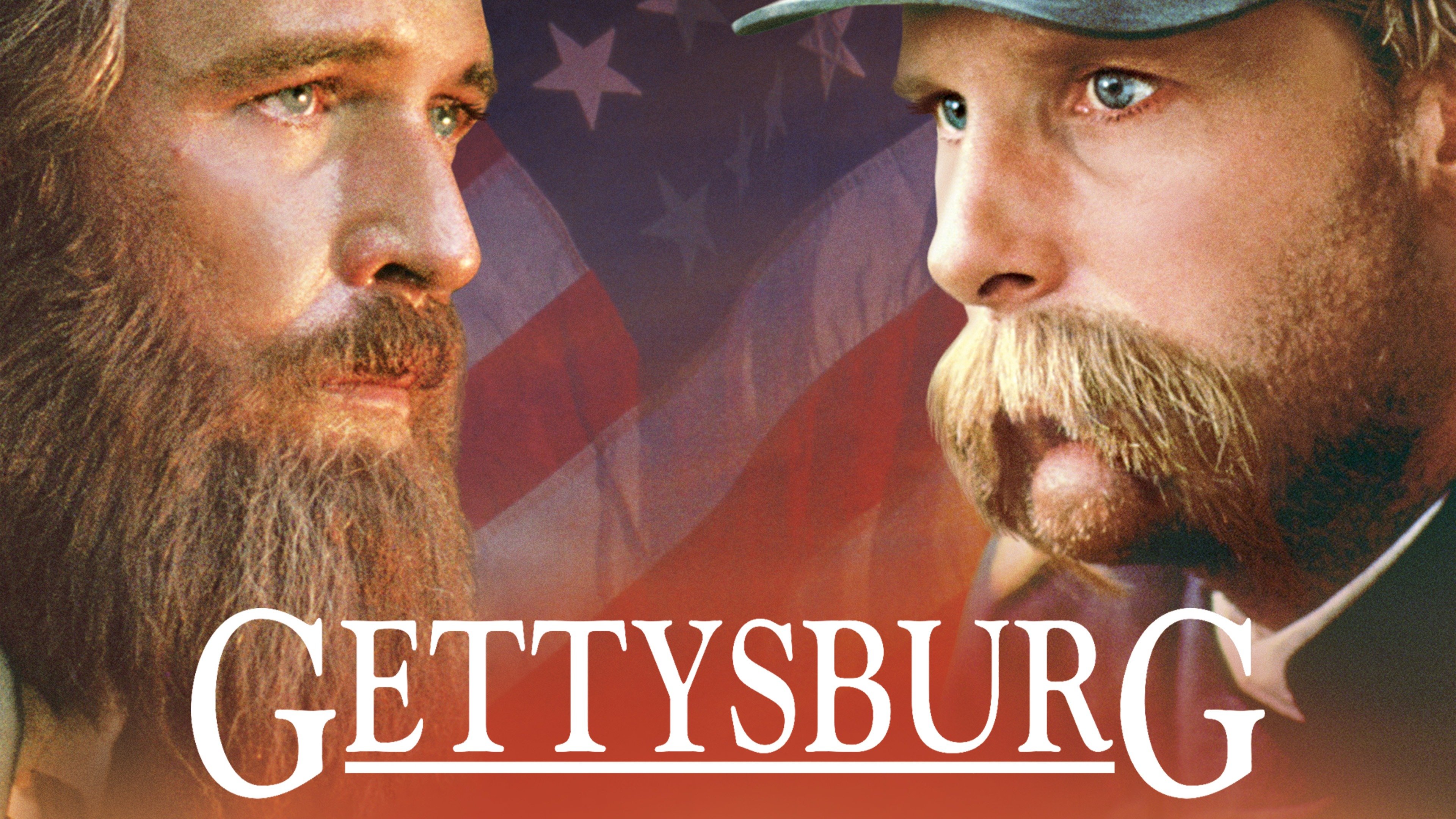
GETTYSBURG, planned as a TV mini-series event, was instead released first to theaters in 1993. The whopping four hour epic followed 19 years after Michael Shaara’s historical novel “The Killer Angels”, a 355-page Pulitzer Prize winner that ultimately sold 3,000,000 copies. Book and film examine key parts and players in the momentous 3-day American Civil War battle that raged over Pennsylvania landscapes in July, 1863.

Two years into the war, hoping to score a knockout blow, seize Washington D.C. and force an end to the conflict, the Confederate Army of North Virginia, 72,000 strong, invades the North and meets—before it wants to—the 100,000 men of the Army of the Potomac in lush countryside around a small crossroads town. By the time they stopped, 8,000 were dead, 33,000 wounded (many dying afterwards), 10-15,000 captured or missing. Littering the field with the fallen soldiers were 3,000 dead horses. The war dragged on two more years.
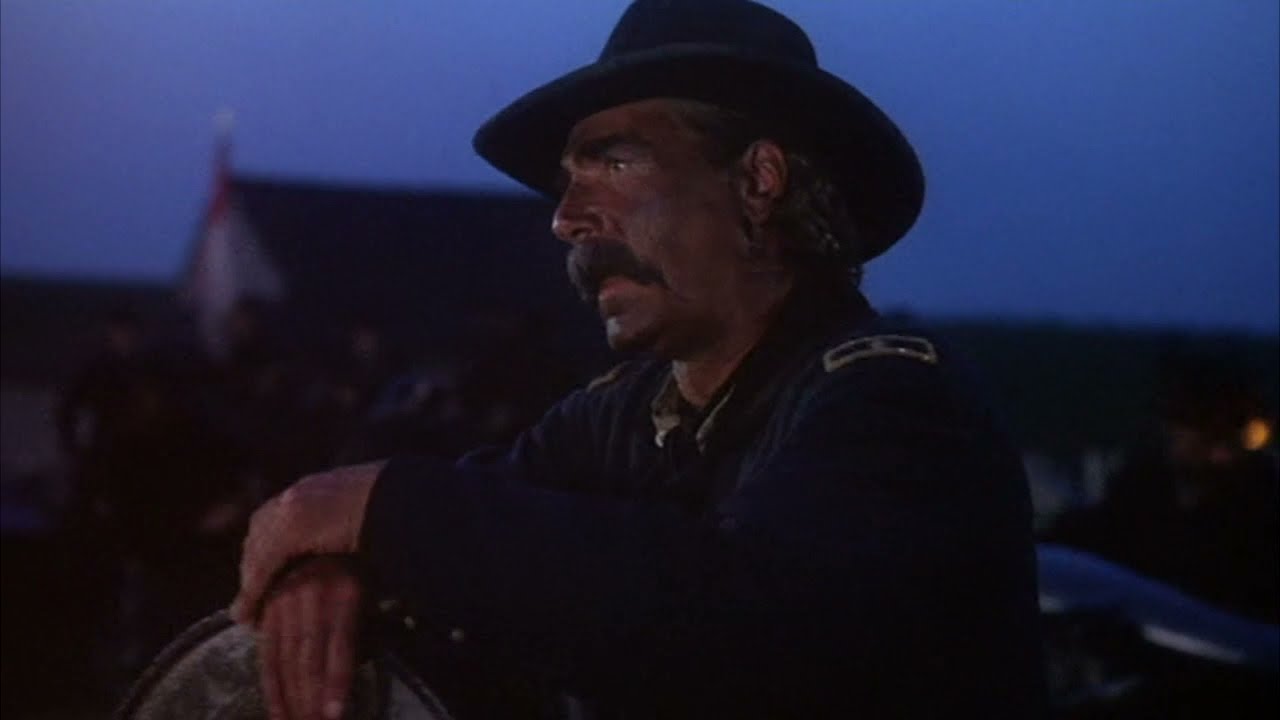
Like the book the script focuses almost exclusively on a number of the officers involved (a token fictitious sergeant speaks for the cannon fodder troops–on the Union side) and centers around three separate parts of the battle including the two most celebrated: the Yanks heroic defense of a hill called Little Round Top and the Rebs valiant, go-for-broke frontal assault forever known as ‘Pickett’s Charge’.
The running time is 254 minutes, 271 in the director’s cut. Sit back & factor in two medium popcorns, a pack of Red Vines, a bag of peanut M&Ms and a root beer float: the length presented could easily been shorn of some excess, but even at more than four hours it left out most of the actions that comprised the struggle. Six hours might’ve done it, with much of the same cast but under an equally passionate but more judicious director. That was Ronald F. Maxwell, whose previous credits were several undistinguished comedies; he also wrote the screenplay. Though epic-scale battle movies play best on a big screen, this one, despite having 5,000 Civil War re-enactors volunteering as extras, shows more of its pesky shortcomings in a larger projection. Most of it is very good, even if persistently dogged by flaws (skirmishers ahead of the main body, if you will); making an objective report is—like the battle—somewhat of a see-saw.
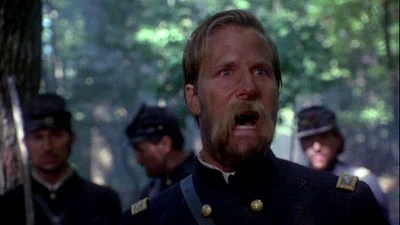
——————————————–‘Bayonets!”——————————————————-
The Script. On the plus side, there’s no phony romantic folderol and the historically accurate dialogue (better delivered by some in the cast than others) has people making impassioned cases for substantial things: honor & duty, brotherhood & justice, freedom & liberty. It’s speechy (help the modern, woefully history-averse audience grasp what all the shooting is over) but educated men in those days were given to oratory, not droll one-liners. On the downside, everyone gets a speech—or three—and some verge on sappy. Editing would’ve helped.
The Acting. Overall strong, with particularly fine work from Tom Berenger, steady and sensible as Gen. Longstreet; Jeff Daniels, smart and stalwart as Col. Chamberlain, rising to the moment; Stephen Lang, dandy as too-eager Gen. Pickett; and—going out in grand style in his final role, he died before the film premiered—Richard Jordan, in anguished intensity as Col. Armistead. Martin Sheen is not the best choice for Robert E. Lee and drew a good deal of flak: he’s got the courtly aspect down but physically just isn’t imposing enough. As flinty Gen. Buford, Sam Elliott undercuts his durable presence with a some intense overplaying that’s a growl too far. Most of the others are fine (again, everyone gets a speech, even if just a quick one) though a number of the bit players hit flat notes.
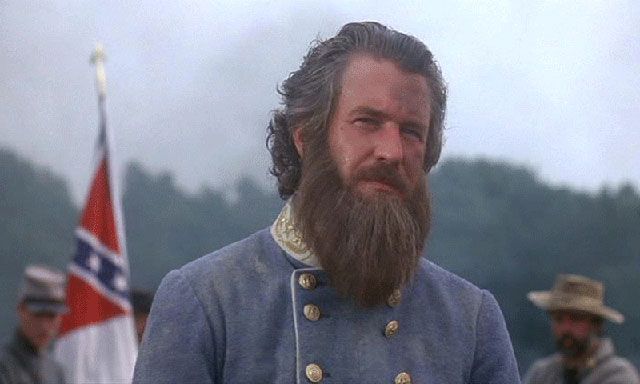
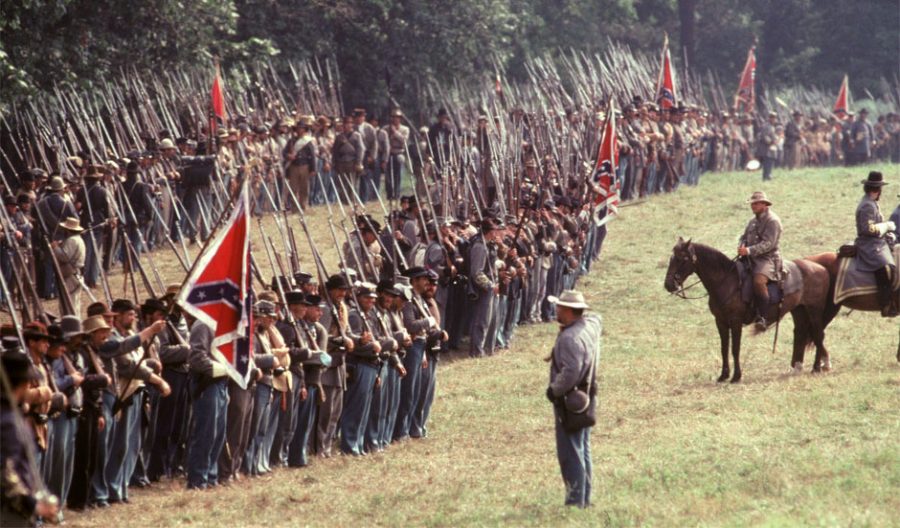
The Look. The backdrops couldn’t be better, as it was shot on location at Gettysburg Natl. Military Park and environs; Kees Van Oustroms cinematography is a plus. Authenticity galore in costumes and props. That only suffers from going cheap on makeup with a number of the obviously fake beards and sideburns (one critic couldn’t resist snarking ‘Gettysbeard’) and in the ranks of intensely dedicated reenactors: you’re asked to overlook that while the average Civil War soldier was 24, 5’8″ and 140 pounds, too many of these present day ‘troops’ look middle-aged and tip the scales north of 200—these are the heftiest ‘ill-fed’ soldiers this side of the WW2 P.O.W. nonsense Victory. More merciless Keener eyes in the assistant director slots would’ve kept the Burger King recruits in the background.
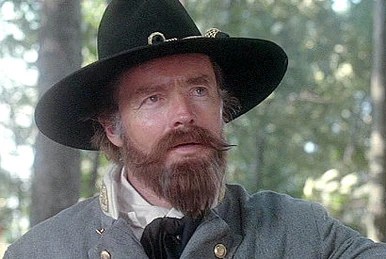
The Music Score. Composer Randy Edelman’s contribution swings between moving (the Irish interlude with the Iron Brigade is haunting) and exciting (the battle scenes) to mushy and grandiose. The direction and editing is as much as fault, since several of Edelman’s passages are allowed to swell into corny overstatement, like the scene of Reb soldiers cheering Lee before Pickett’s Charge. When that occurs you feel like a hammer is clobbering “feel emotion!” You would, more, if some scenes were trimmed.
The Combat. Hey, we’re here for the fracas, not a picnic with Ashley Wilkes. A lot of fighting, and with a few caveats it’s splendidly done, albeit sanitized so audiences wouldn’t get ill watching wholesale slaughter. Done today with CGI, the screen would fill up with countless pixelated soldiers, but the human mass arrayed here is pretty effective, and the production lucked out in having the thousands of re-enactors work not for pay but pride and privilege. Augmented by a phalanx of stuntmen, thunderous sound effects (cannon barrage, anyone?) and well-martialed choreography, the action unloads the requisite punch. The only carp is again with Maxwell and his editors, erring by using a number of the same shots repeatedly (and noticeably, which is sloppy) and going overboard during the early part of the Pickett’s Charge sequence with swooping camera moves (and overdone scoring) that reduce rather than enhance impact.

At the time, $20,000,000 was an unheard of amount to spend for a (intended) TV production. The limited release in 248 theaters prior to the small-screen broadcast grossed $12,770,000, 104th for 1993; revenue reinforcements arrived later from its television showing (a big hit) and subsequent extensive video sales.
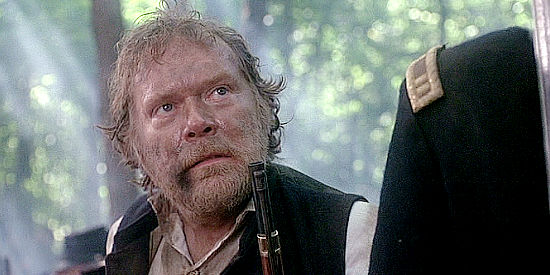
In the swarm of Blue & Gray and doing for the most part creditable work are Kevin Conway (a good guy for a change), C. Thomas Howell, Andrew Prine, Royce D. Applegate, James Patrick Stuart, Cooper Huckabee, James Lancaster, Brian Mallon, John Diehl, George Lazenby (the one time 007 is unrecognizable), John Rothman, Richard Anderson, Maxwell Caulfield, Donal Logue, Buck Taylor and Mark Moses. Instrumental in funding the film, media mogul Ted Turner secured a die-on cameo.
* Author Michael Shaara passed away five years before Gettysburg made it to the screen. His son Jeff continued his father’s work with two succeeding books, one of which became director-screenwriter Maxwell’s lavish, vastly more costly 2003 follow-up, the prequel Gods and Generals. Sadly, it was the movie equivalent of Pickett’s Charge (minus the excitement), mortally wounded by critics and non-receipts, dashing hopes for a conclusion “The Last Full Measure”. Jeff has since offered a slate of historical novels.
Maxwell: “This picture matters. It’s about something. It’s not a concoction, it’s not a deal, it’s not ‘high-concept.’ It’s really about something we all care about. It’s a self-defining moment in our history.”
The Civil War (or War Between the States, if after a century and a half you’re still stubborn) on screen: we choose this to march with Gone With The Wind, The Red Badge Of Courage, Friendly Persuasion ,The Horse Soldiers, Shenandoah, Glory and Lincoln.

 Movies ala Mark