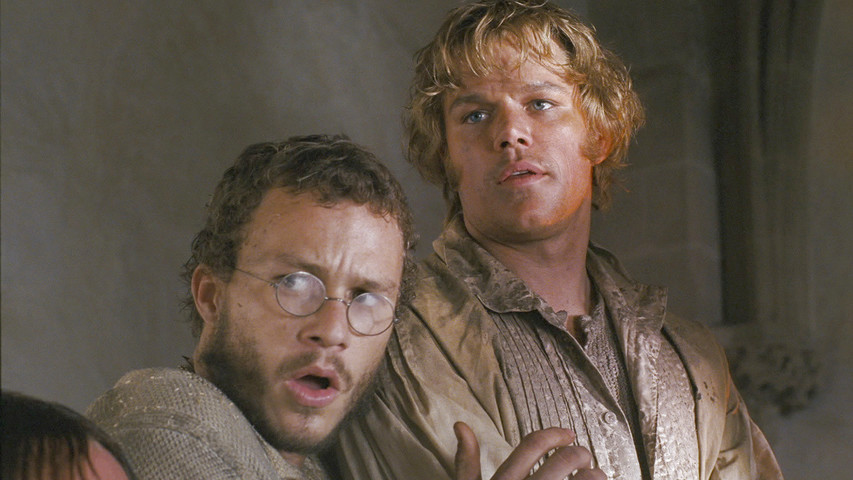
THE BROTHERS GRIMM would have a more accurate title if the second ‘m’ had been dropped, as this visually resplendent, spirit-deadening 2005 fantasy has less to do with the legendary storytellers (‘whimsically’ “re-imagined” here as con artist jerks) than it does with the capacious imagination and boundless indiscipline of director Terry Gilliam (fanboys just spit blood on their laptop screens) who, time and again, manages to self-sabotage his bulging idea basket with a penchant for in-your-face excess. For those not slavishly addicted to his persistent zaniness, convinced it’s genius cruelly boxed in by coarse commerce (gadzooks, the nerve of studios to give someone tens of millions of dollars to play with and then crassly expect a return on their investment, or a smidgen of respect when the budget reaches the asteroid belt), his movies can be an exercise in frustration, wonder at the artistic style and the sheer amount of it, impatience at repeated injections of elements designed to jab your squirm zone. *
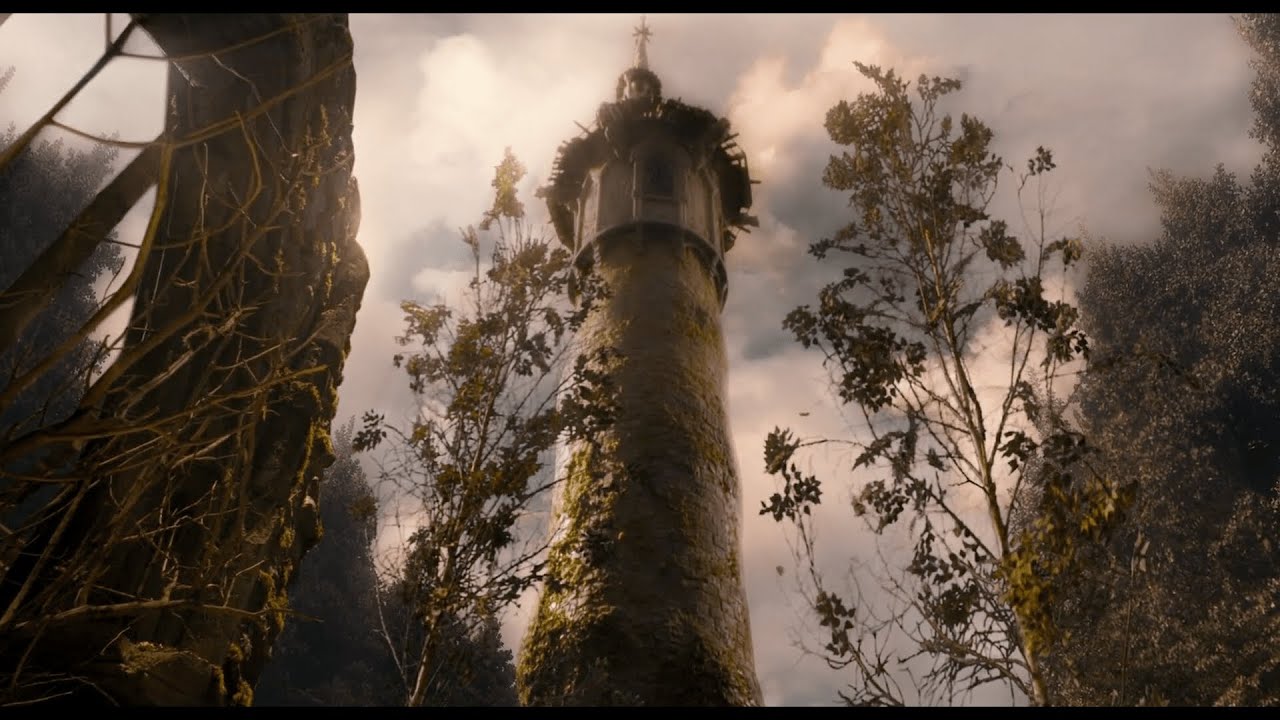
French-occupied Germany, 1810. Brothers ‘Will’ (Matt Damon) and ‘Jake’ (Heath Ledger) Grimm manipulate folklore and peasant superstitions with elaborate stagecraft to fool villagers into believing the brothers can banish witches and other creatures plaguing them. Dragooned by a French general and his malevolent assistant into investigating a series of child disappearances (a guaranteed fun topic), the fakers find fantasy afoot in the woods, and link with a hermit huntress to solve a mystery and end a curse. Buckle up for pain.

Before flaying the script, performances and tone, let’s acknowledge that this Terry trip sports marvelous production design (bravo to Guy Dyas), with laudable special effects, copious period detail in costuming, props and set decor, fine camera work and scoring, some nimble work (and badly needed laughs) from Damon, and an appealing heroine in Lena Headey. Always welcome, Monica Bellucci shows up as the evil ‘Mirror Queen’. Visually, it’s a horn of plenty.

Alas, as with every Gilliam project, the production was a battle royal between a director who would/could not be reined and studio dark lords (here the baleful Weinstein’s; talk about fairy tale goblins) wondering what fresh hell they’d unleashed. It was shot in the Czech Republic to save costs but they still churned up $80-85,000,000, and then Miramax (after a half dozen-delayed release dates) lavished $30,000,000 more to promote it. But to who? Kids? Couples? People who enjoy decibel levels rivaling full moon in a Honduran prison? People who enjoy seeing children abused? The script is credited (if that’s the word) to Ehren Kruger (who has numerous lousy screenplays to answer for) but Gilliam and Tony Grisoni rewrote much of it, so fault lines spread in several directions. For every piece that clicks, the next one has someone screaming or something ugly (thematic or actual) shoved in your face. Ledger (who otherwise scored big that year with Casanova and Brokeback Mountain) mostly flails, Jonathan Pryce gives the worst performance of his career, only to be outdone by Peter Stormare, whose aggressive mugging is as bad as anyone, anywhere, ever. Most of what’s supposed to be darkly funny instead comes across as revolting. None of the actors are helped by the terrible writing, needless complication, and wearying length: at 118 minutes a mess that might’ve played better if it was twenty shorter, 40% quieter and half as mean.

The $37,916,000 US gross (75th in ’05) was outdone internationally with $67,400,000, but all told that was not enough to cover what was expended. With Tomáš Hanák, Mackenzie Crook, Richard Ridings and Roger Ashton-Griffiths.
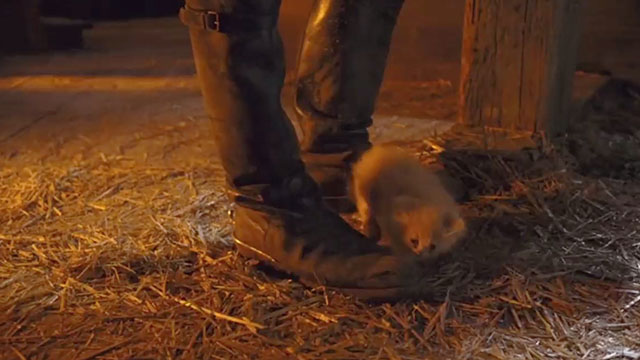
Yes, folks, this is the hilarious scene where a kitten is kicked into a shredding device
* Gilliam gang, lower your pitchforks—we like much of what he does: the guy has a 3rd eye for muse candy (for example, we direct you to his unappreciated The Zero Theorem), and it must be noted that along with an ability to fill the screen with sensory images he clearly possesses some kind of genius at selling cash-hearted studio suits on bankrolling his projects, nearly all of which after Twelve Monkeys in 1995 have lost more money than the Pentagon. As long we’re on Overkill, here’s a few more palatable Terrytoons— The Adventures Of Baron Munchausen and Fear And Loathing In Las Vegas.

 Movies ala Mark