
STOPOVER TOKYO, with its pretty location filming in the title city and Kyoto, and dose of “isn’t everyone’s exceeding politeness & cute ‘Mr.Moto’ English charming”, shows that a little fraternization goes a long way, as exampled in this 1957 stop-the-Commies espionage trifle vs. 1944’s rather more pointed Thirty Seconds Over Tokyo, which, except for color scenery and a benign tone, had everything this Cold War dog lacks in spades: good acting, direction, writing, pace and excitement. Photogenic Japan and its inhabitants come off well: everything else is pathetic. *

Joan thinking “Damn, stuck between two logs: Ken Scott and Bob Wagner. Where’s Warren?
US counter-intelligence sends undercover operative ‘Mark Fannon’ (the aptly counter-intelligent Robert Wagner) to Japan to bust up a Commie plot, one bent on wrecking the delicately cultivated USA-Nippon bromance. For Mao’s sake, can’t the Evil Red Menace let former mortal enemies make money in peace? Nyetski. Fannon meets ‘Tina Llewelyn’ (Joan Collins), beauteous Welsh airline receptionist; you don’t have to be an A-bomb scientist to figure that they’ll fall for each other (forget conveniently sudden affection, let alone colleague chemistry between knockout Joan and wood-meets-Brylcream Bobtoy) faster than agent Fannon can bust shady businessman ‘George Underwood’ (Edmond O’Brien, trapped) and become surrogate pop to an adorable orphan girl sweet enough to summon anaphylaxis.
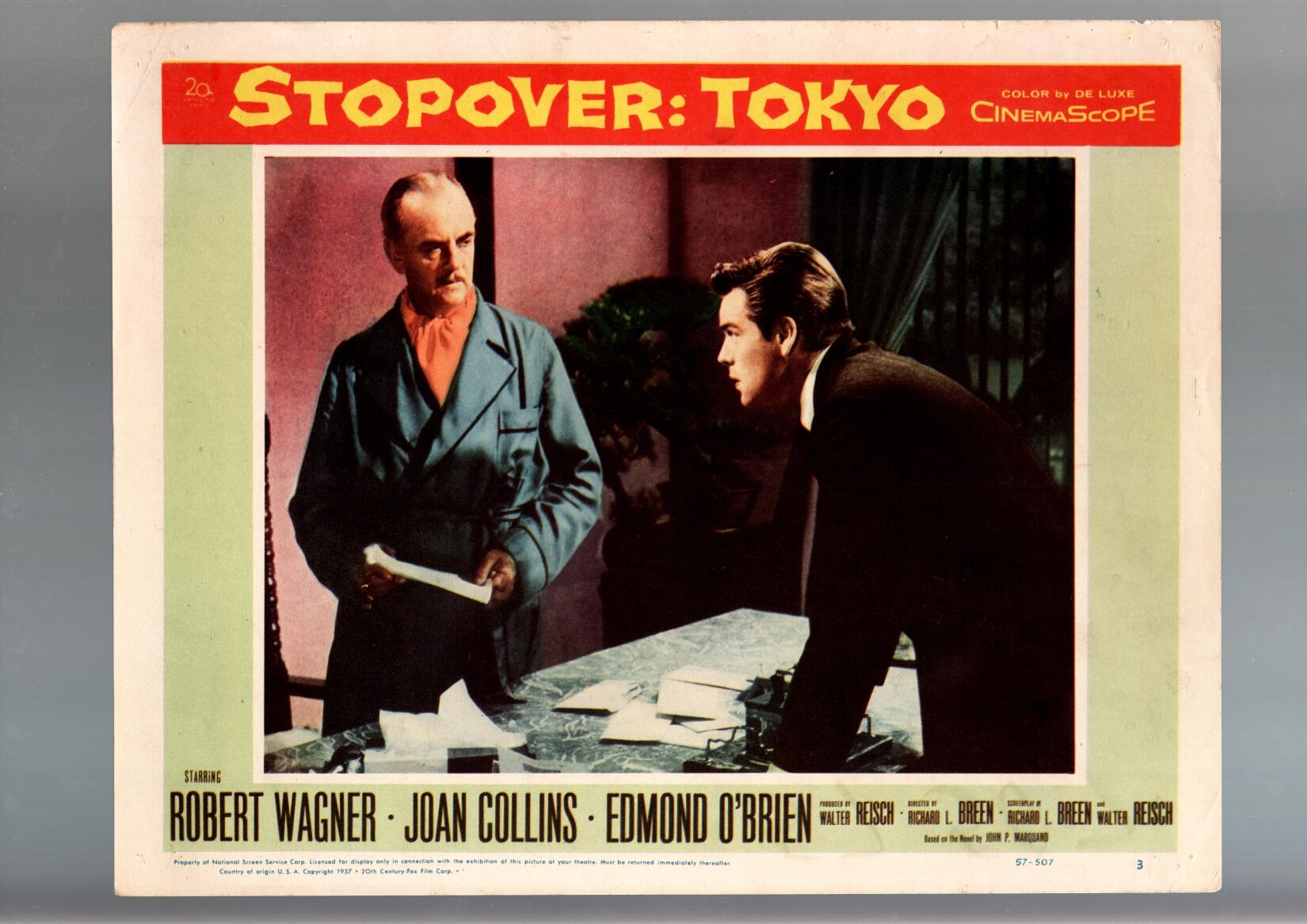
Larry Keating, acting like he doesn’t like this poseur. Or is he acting?
Based on a novel by John P. Marquand (who recrafted a ‘Mr. Moto’ story), the screenplay was done by director Richard L. Breen and Walter Reisch. Marquand was a Pulitzer recipient, Reisch had a sterling track record, and Breen had likewise notched winners (this was his only time directing) but this one is just awful. Suspense is AWOL, there’s barely any action, Collins is wasted (she does looks swell in form-fitting regional allure wear), O’Brien’s sandbagged by the writing and direction, and the supporting players are cardboard cutouts. Robert Wagner: the more you see (let alone know), the less you like. Of all the ‘pretty boys’ and ‘make ’em a star’ roll call from the era—Rock Hudson, Tab Hunter, Jeffrey Hunter, Tony Curtis, to cite a few— Wagner had the least amount of talent (okay, George Nader and Guy Madison) yet bat-mazed and schmoozed the longest career. Talk about getting away with it. He couldn’t say “Hello” convincingly.

100 draggy minutes that cost $1,055,000. Thanks to publicity that falsely indicated it would be thrilling, the lure of CinemaScope travel, and fan mags promoting teen crushes on Wagner (don’t ask) it managed to snare $3,900,000, the gross placing it #65 for the year. With Reiko Oyama (the little orphan supposed to warm our hearts will make you want to tear your hair out), Ken Scott (being groomed by Fox, he was tall—6’5″—and boring enough to make Troy Donahue seem vital), Larry Keating (in familiar sputtering mode), Solly Nakamura and Sammee Tong.

* After the post-war Occupation of battered Japan, a host of bloomed romances between surprised Japanese ladies and enchanted American servicemen and the conversion of the island nation into both a giant aircraft carrier for the Korean War and a capitalism boom zone, movies reworked attitudes to suit. Besides this limp noodle, 1957 alone produced the the hit interracial love drama Sayonara, the wan comedy Joe Butterfly and the lightweight family adventure Escapade In Japan. They’re all better than this Wagner vehicle.
The lovely Collins was all over screens that year, in Sea Wife, The Wayward Bus and Island In The Sun, and they’re all better than Stopover Tokyo.

 Movies ala Mark