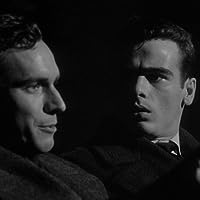
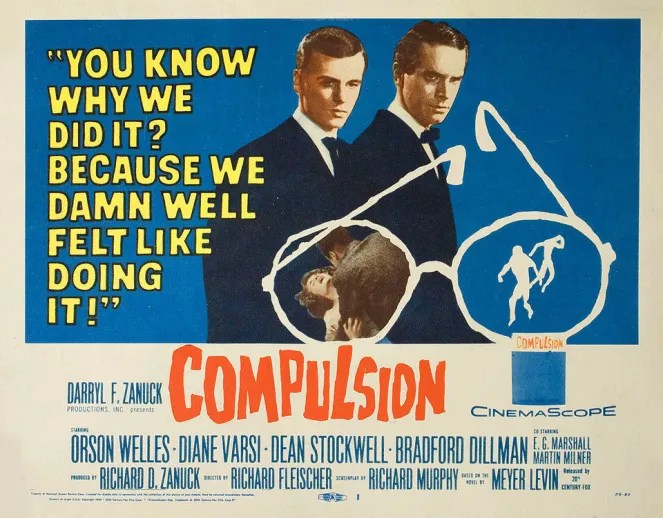
COMPULSION in its title refers to what the dictionary calls “an irresistible urge to behave in a certain way, especially against one’s conscious wishes”. In the instance of the plot that emerges as a ‘thrill murder’. That framework is then fitted in with the periodic compulsion of liberal filmmakers to mount an anti-capital punishment picture: there were several in the late 50’s—I Want To Live! (a big hit), Cell 2455 Death Row (now forgotten) and this intense item from 1959, one of the best of the defense team’s sallies thanks to its intense performances, Richard Fleischer’s taut direction and William C. Mellor’s pitiless black & white cinematography. Ironically, the single most telling line in the smart if stacked-deck script is the most emotionally true and most bracingly honest: “I hope they hang him till the rope rots!” *
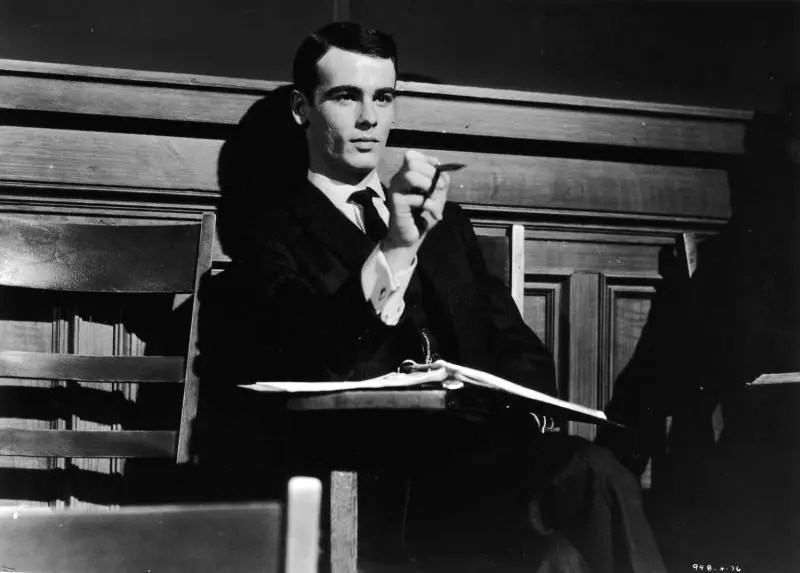
Chicago, 1924. Cuttingly brilliant, massively egotistical law students (and ‘close’ friends as the code read) ‘Judd Steiner’ (Dean Stockwell) and ‘Artie Straus’ (Bradford Dillman) commit a cold-blooded, fiendish and—they’re convinced—foolproof murder. Just for ‘fun’. Their glibness tripped up by a dropped pair of eyeglasses, family wealth seeks a way out of the noose by hiring ‘Jonathan Wilks’ (Orson Welles), famed defense attorney.

Artie Strauss and Judd Steiner are stand-in’s for 1924’s real demons-from-the-closet Richard Loeb and Nathan Leopold, and long-winded mercy pleader Wilk for the legendary Clarence Darrow. Richard Murphy’s screenplay was based on Meyer Levin’s novel (he was a classmate of the two infamous lads), often credited as the first “non-fiction novel”, followed by the pitiless-killers-are-really-sad-boys likes of “In Cold Blood” and “The Executioner’s Song”. Its gripping 103 minutes joined the year’s other homicide trial tales, the highly praised Anatomy Of A Murder and the okay The Story On Page One.

His decade as a remarkable child actor behind him, Stockwell, 23, had first played Steiner/Loeb on stage and Dillman, 27, was still fresh, with just two movies (In Love And War, A Certain Smile) and 14 various TV episodes logged. This wasn’t a particularly cozy shoot, Stockwell ticked because Dillman was cast instead of his stage counterpart Roddy McDowall (Dillman a better choice) and Welles, 53, angry over Universal’s handling of his Touch Of Evil and resentful that he wasn’t directing, basically made director Fleischer’s job a trial not by jury but fire, and brought a load of ego drama to the set. Though he rated first-billing, Welles doesn’t appear until 65 minutes into the show, but at the finish he’s allowed one of the longest soliloquies in movie history for Wilk’s summation (consider that Darrow’s took two full days). It’s both worthy and a bit much, and while its plea for a different meting of justice is meant to shake us up, it’s not nearly as unsettling as the bulk of the story covering the hateful perpetrators and their eventual self- ensnarement.
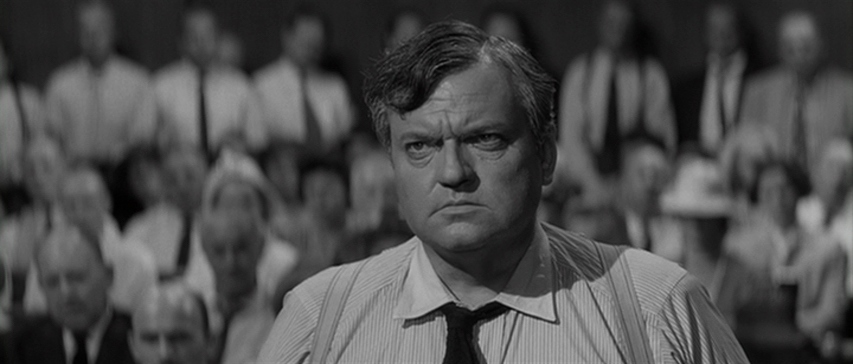
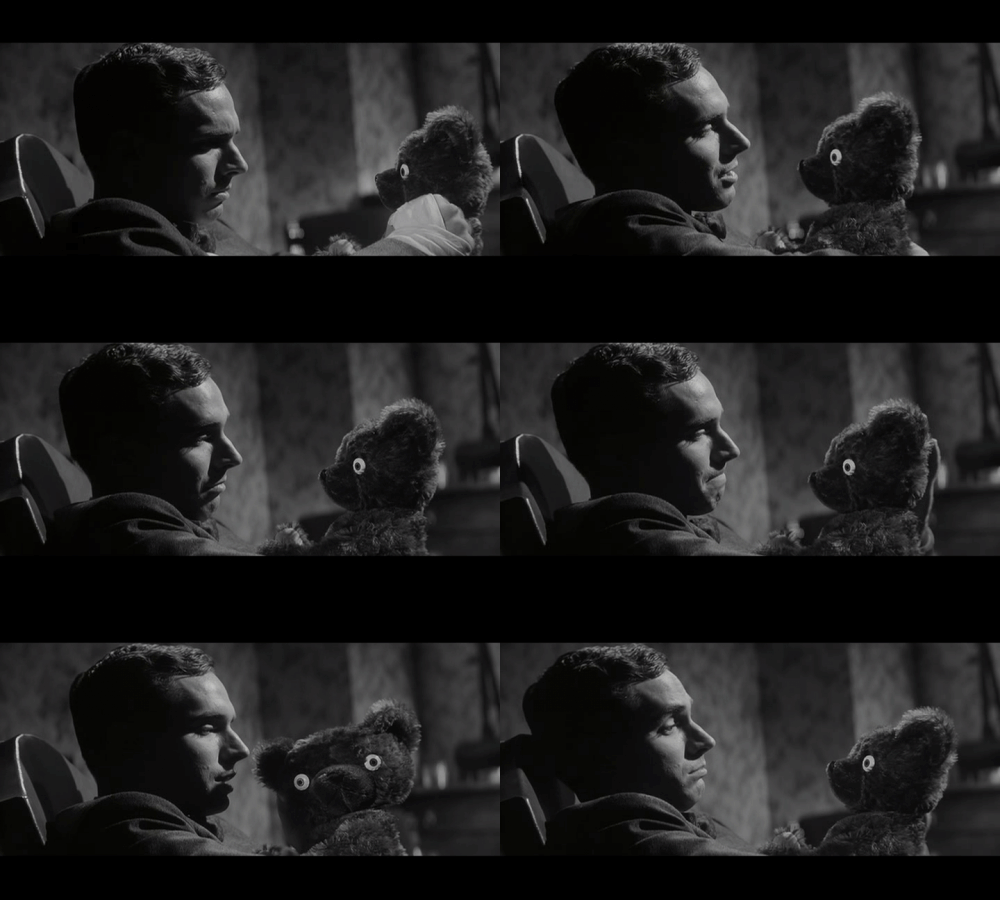
Stockwell and Dillman are stunning (Dillman’s nutty conversation with his Teddy bear is a twisted treat) and the sadomasochistic relationship between the killboys was strong stuff for the day. Reading ‘between the lines’ on this isn’t hard unless you’re denser than the average Teddy bear.

Made for $1,345,000, grossing a decent $5,100,000, placing 49th on ’59’s docket, it was out-argued by Anatomy Of A Murder at 13th, with plea-bargained The Story On Page One trailing on 85th.
Also to be judged and passing the bar: E.G. Marshall, Diane Varsi (there to ‘humanize’ Steiner: no sale), Martin Milner, Richard Anderson, Robert F. Simon, Edward Binns, Louise Lorimer, Voltaire Perkins, Gavin MacLeod, Terry Becker, Peter Brocco, Jack Raine, Henry Kulky.

* Other takeoffs on the Leopold-Loeb duo (in real life they were 19 and 18 when they pulled their depraved prank): Hitchcock’s Rope in 1949, the low-budget Swoon from 1992 and 2022’s Murder By Numbers. Director Richard Fleischer would later delve again into real-life murderers with The Boston Strangler and 10 Rillington Place.
On-set tension part of the job, Dillman doggedly dove into another murder trial drama with Welles, also directed by Fleischer, 1960’s offbeat Crack In The Mirror, while Stockwell went for Brit-Lit family anguish that year in Sons And Lovers.
 Movies ala Mark