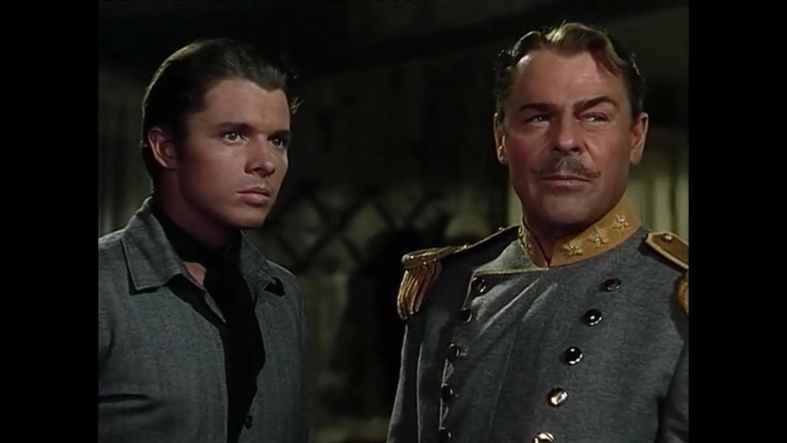
KANSAS RAIDERS, several notches down from 1950s lineup of excellent westerns, is another entry in the glee club of history-ambushing stories about Jesse James and his crew that popped up in the early part of that western-flush decade. It looks good in Technicolor, and has some viable actors, but the post-story stories of the principals are more interesting than the trite 80-minutes of ridin’, fightin’ and fact-foolin’. *

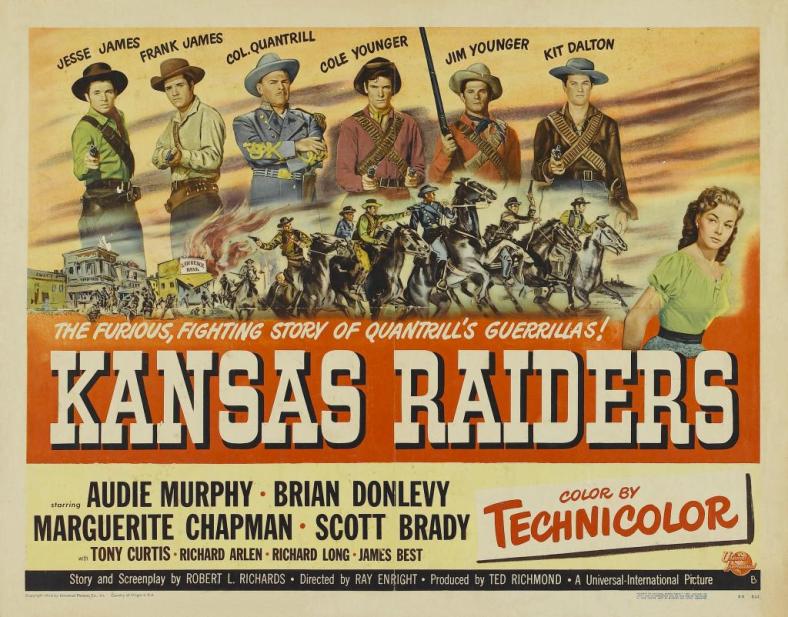
The Civil War raging away, and things going south for the South, Rebel sympathizers roamed the border states of Kansas and Missouri, battling Yankee regulars and ragtag civilian outfits. Mercy was absent, innocents were targeted. Restless young turks looking to pitch in for reasons of their own include Jesse James (Audie Murphy, 25), his brother Frank (Richard Long, 23), Cole Younger (James Best, 24), his brother Jim (Dewey Martin, 27), and Kit Dalton (Tony Curtis, 25). They join up with feared guerrilla leader William Quantrill (Brian Donlevy) and the ruinous road leads to “Quantrill’s Raider’s” notorious sack of Lawrence, Kansas. Loyalties fray, as this end of ‘The Cause’ degenerates into ‘Just Because’.
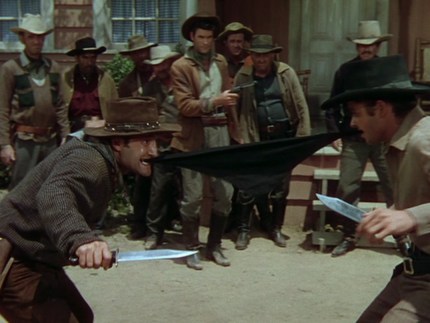
Apart from the names, the bare facts of the historical characters doing deeds at that time in that area, and the raid on Lawrence, the script is basically hogwash. The actors do well enough, and it looks good in the clean cinematography from Irving Glassberg, getting nice views of the locations at Garner Valley in California and Kanab, Utah, though they little resemble Kansas or Missouri. As with so many dustraisers of the period, the costumes and props are a good decade advanced from what they should be for 1863.
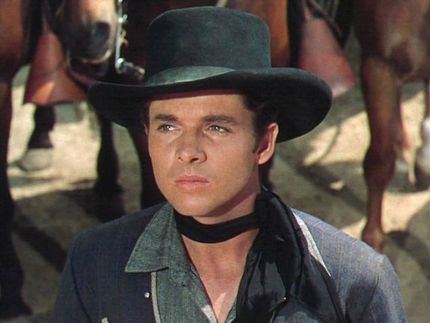
Murphy looks like a kid; it’s rather poignant that the Technicolor closeups highlighting his freckles contrast with the less-innocent flicker in his eyes. Veteran tough guy Donlevy (48 here, Quantrill only kept breathing to 27) gets the best lines, adding to his character’s hiss factor with morsels that would not go down today, like “My dear Kate, I’m too old a man to have any illusions about the constancy of women or to be seriously disturbed by the lack of it, but when your intrigues start interfering with my plans, that’s something else again“, and the definite duck & cover suicide dive of “There are some things a woman simply cannot understand.”
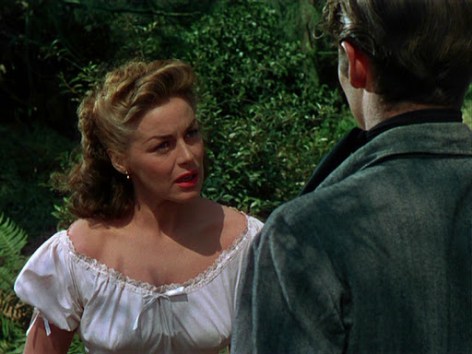
What– the hell— did you just say– to me?
Proficiently directed by Ray Enright, it’s amusing to see the youthful cast, but as a dramatic piece (let alone anything related to history) it’s minor, just a list-tick item for western aficionados and/or Murphy completists.
Also featuring Marguerite Chapman, Scott Brady (as “Bloody Bill” Anderson), Richard Arlen, John Kellogg, Richard Egan (another newcomer, 29), and George Chandler. Its shoot-’em-up of accuracy spurred a healthy $3,400,000 take that fittingly bunked 96th place for the year.
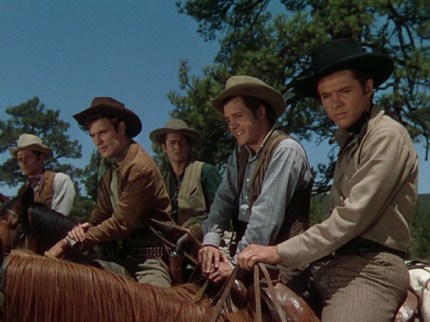
* Aside from serials, the James boys and brethren had been holstered since 1939s hit Jesse James, but starting a decade later there was flurry of fanciful tellings, including I Shot Jesse James, The Great Missouri Raid, Red Mountain, Best Of The Badmen….
Two years into showbiz, having done two bit parts and one lead (Bad Boy, playing a juvenile delinquent), 1950 was Audie Murphy’s roll-out year, after signing a 7-year contract with Universal. He did two other pictures in ’50, both westerns, The Kid From Texas (the ‘kid’ being Billy the Kid) and Sierra (with his new wife Wanda Hendrix), with Kansas Raiders the more popular of the three. Actually, more people went to see this than lined up for any of the following: Panic In The Streets, The Asphalt Jungle, The Glass Menagerie, Where The Sidewalk Ends, The Mudlark, The Men, Gun Crazy, or two of that years slew of superior westerns, Wagonmaster and Two Flags West. Maybe it was the Technicolor? His next film, on loan to MGM, was his best, but it was butchered by the studio and no one went to see it. A classic, nonetheless, it’s John Huston’s The Red Badge Of Courage.
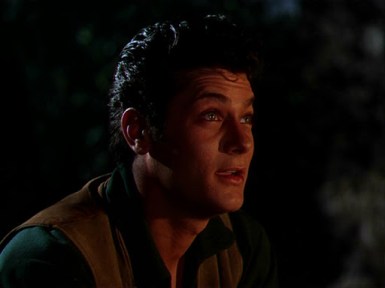
Brash hopeful Tony Curtis moved up to the next level after this flick, with his first starring gig, in 1951s The Prince Who Was A Thief. His diction would improve. 1950 was James Best’s debut year: he enjoyed a long career. His natural regional speech pattern is the most accurate in the lot. Richard Long was later more successful on TV. Of the five young actors playing the budding outlaws, Dewey Martin had the briefest run on film, but the longest life, passing away in 2018 at 94. Best went at 88 in 2015, Curtis left at 85 in 2010, Long just 47 in 1974. Having survived World War Two, Hollywood and PTSD, Audie Murphy was killed in a plane crash in 1971. He was 46.

Marguerite Chapman, 32, the sole feminine member in this oater, was a former model, and likely familiar to Murphy and the other vets, as she’d had been a major WW2 pinup, “Miss Breathless of 1943”. Her Why You Fight images are on the Net, for those of a studious bent. (recm.)
Historical Amnesia Dept.—–The man who imagined up the screenplay for this movie, Robert L. Richards, also wrote 1950s top western Winchester ’73. The year before he’d written well-received suspense items Act of Violence and Johnny Stool Pigeon. A year after, he was Blacklisted for refusing to testify to the HUAC. His wife, also a screenwriter, did fess: their marriage was a casualty. He moved to Mexico, scraping by as a carpenter. In 1961, under the pseudonym John Loring, he gave us the giant monster favorite Gorgo.
 Movies ala Mark