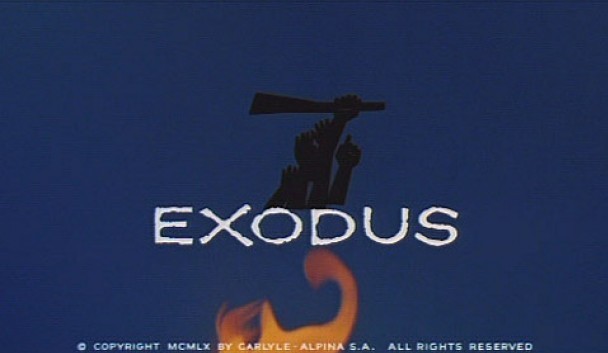
EXODUS—there is a famous Hollywood story concerning the premiere of this 1960 movie. The great satirist Mort Sahl was in the audience. At the three-hour point, he stood up and said in a loud voice to director Otto Preminger “Otto, let my people go!” Maybe Sahl had recently sat through the year’s other magnum-length Freedom epics, Spartacus and The Alamo, and felt he was spending too much of his life in the dark with strangers, or maybe it was just a case of “Enough, already!”

Mort’s aside aside, this earnest, king-sized, location-shot story of the seizure birth of Israel ends up being a 208 minute keister-buster. The famous Leon Uris bestseller was adapted into a screenplay by Dalton Trumbo (also tackling Spartacus), and the subject certainly demanded screen treatment. But impact is diluted by sprawl, Preminger’s plodding pacing, and the basic setups of several key portions. There’s a lengthy hunger-strike sequence, a lengthy incarceration sequence, and a lengthy village-evacuation sequence. They’re the only moderately tense episodes in a movie otherwise full of chatter and half-developed characters. And of course, though it was ignored at the time, today it’s bluntly obvious that the question of legitimacy is conveniently absent.
 Paul Newman, glowering throughout, is just okay as the main hero. Oddly, he smacks his tongue to the roof of his mouth, like someone unused to public speaking, so much that it becomes pointedly distracting. Newman was not fond of the film, his work in it, or Otto the Terrible. The romantic angle between him and Eva Marie Saint (a sop to WASPs?) lacks conviction. Ralph Richardson has an easy prestige passage, and Peter Lawford scores some tart lines as an antisemitic British officer. John Derek isn’t much more believable here, as an Arab with robes and a beard, than he was four years earlier, as a Hebrew, with robes and a beard, stumbling through the groundwork landgrab treatise of The Ten Commandments.
Best acting in the movie, hands down, is from Sal Mineo. He has an especially powerful scene where he is interrogated about his life in a concentration camp: it brought the gifted Sal a deserved nomination for Supporting Actor. The story’s Sacrificial Lamb is the less-than-inspiring Preminger ‘find’ Jill Hayworth, who manages to be both too sweet and inexpressive at the same time. She was considerably better a few years later in the director’s WW2 epic In Harm’s Way.

Expansive locales in Cyprus and Israel are an obvious plus. Producer Otto’s $4,500,000 canvas brought in $22,000,000 worldwide, the success stimulating American public support for Israel (that’s worked out just swell, ask a Palestinian).
Aside from Mineo, the most memorable thing about this is the truly beautiful theme music from Ernest Gold. An irate Academy, irked by the obnoxious publicity campaign drummed up for The Alamo, gave Gold’s score the Oscar that should have gone either to Dimitri Tiomkin’s much richer scoring for the Wayne epic, or maybe to upstart Elmer Bernstein for his thrilling work on The Magnificent Seven. Gold basically just does repeats of the main theme, but that haunting title track, played to a backdrop of flames during the credits struck emotional home. The pianist duo Ferrante & Teicher had their biggest success with their cover of the theme. Sam Leavitt’s cinematography was also Academy Award nominated.
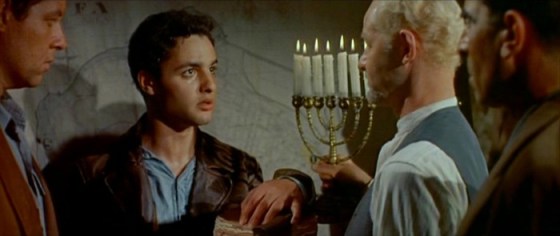
With Lee J. Cobb (bellowing as usual), Hugh Griffith, Gregory Ratoff, David Opatoshu, Felix Aylmer, Marius Goring, Martin Benson, George Maharis and in an early, uncredited bit, Paul L. Smith, who 18 years down the line would draw chills as the brutal jailer in Midnight Express.
 Movies ala Mark