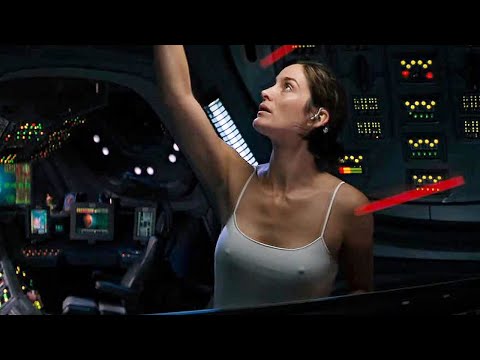
RED PLANET orbits into view with the grab-your-gravity pronouncement that “By the year 2000 we had begun to over populate, pollute, and poison our planet faster than we could clean it up. We ignored the problem for as long as we could. But we were kidding ourselves. By 2025, we knew we were in trouble. And began to desperately search for a new home – Mars.”
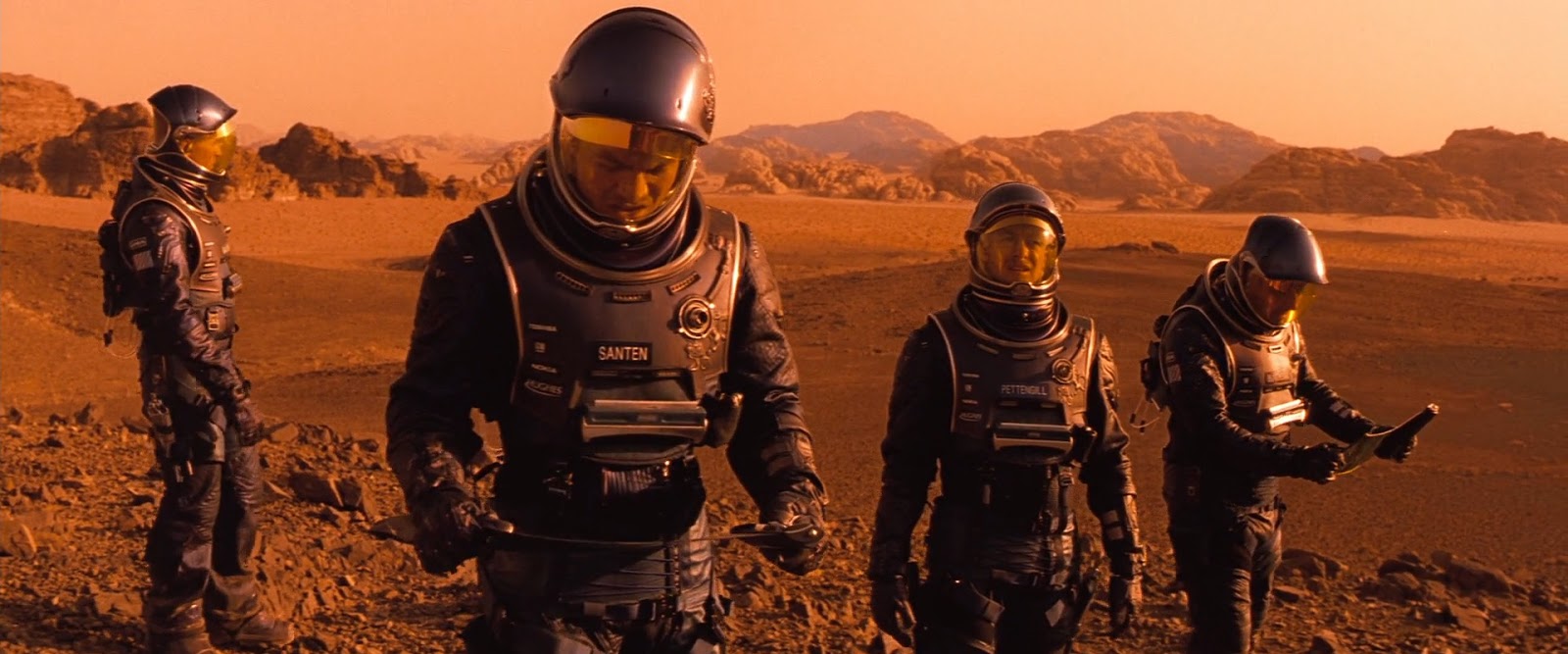
The movie, released in 2000, came & went, pretty much a falling star in the galaxy of space-borne sci-fi sagas that showered screens in the last quarter of the 20th-century and the first of the next. It didn’t do well at the time, critically or commercially, in fact was a black hole flop. We’re in the minority of spaced cadets who think the Death Star zapping it received was undeserved. Twenty-five years later, in the when-will-it-end? year mentioned in the prologue and with a lunatic proposal to man-up the barren Martian landscapes being floated by egos as perverse Emperor Palatine’s, we register an afterburner boost of enjoyment out of the show.
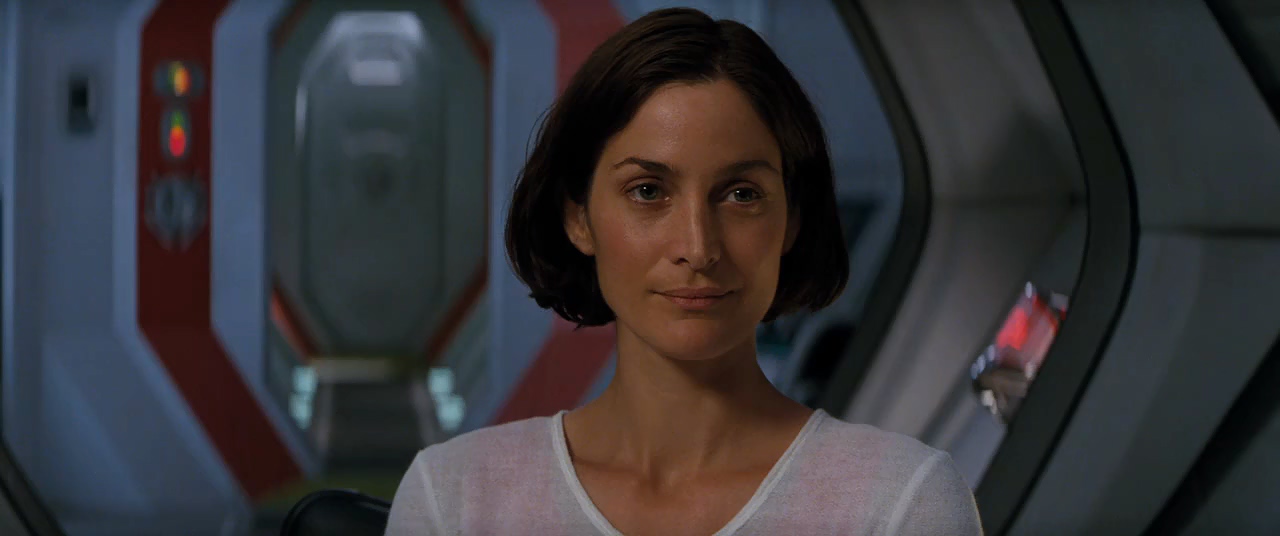
“Man’s a party animal. If he is doing okay nothing else matters. That’s not going to change.”
2056. Unmanned vehicles have already been sent to Mars to commence terraforming by way of introducing algae to produce oxygen so that humans might be able to begin colonizing our neighbor as a new home, having recklessly ruined our nest. ‘Mars 1’, crew of six, is poised to investigate the results when the spacecraft is battered by a solar flare. Five descend to the surface in emergency evacuation, while the mission commander ‘Kate Bowman’ (Carrie-Anne Moss) stays behind, hoping to restore power and save the ship. She succeeds but the landing party’s bounce & smash arrival mortally wounds one man, then in short order the others find that the survival supplies have been destroyed. Not enough, clashes of personality come to the fore, and a crucial piece of robotic machinery turns lethal. Bowman tries to coordinate a rescue scenario, time the essence.

Fun escapism, with an old-school concept, charismatic actors, neat effects, and a welcome lack of “Importance”. Though the technology is sleek and modernistic, the bristling human element recalls the feel of a 1950’s outer space adventure, a desperate trek into the perilous unknown, albeit with an extra-hot lady in command, complete with on-board attire that may be gratuitous yet is not unwelcome, go figure. Gracias, Ridley/Ripley.
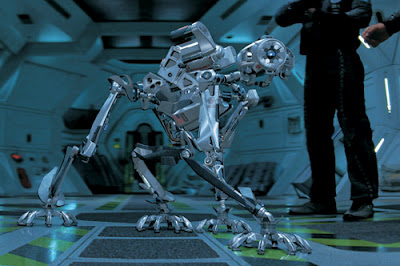
Moss serves most ably as the cool-headed commander. The boys below: laid back mechanical engineer ‘Gallegher’ (Val Kilmer), brusquely brainy bio-engineer/geneticist ‘Burchenal’ (Tom Sizemore), nervous terraformer ‘Pettengill’ (Simon Baker), arrogant pilot ‘Santen’ (Benjamin Bratt) and voice-of-reason ‘science officer ‘Chantilas’ (Terence Stamp). And ‘AMEE’, the mechanized hound borrowed from the Marines: it’s favorite trick is “kill”.

Chuck Pfarrer and Jonathan Lemkin wrote the screenplay, first-timer Antony Holland directed, shooting on spectacular locations in Jordan (Wadi Rum) and the Australian Outback (near Coober Pedy). There was behind-the-scenes kerfuffle between Kilmer and Sizemore (both behaving like jerks), and the expensive effects work set the release date back twice, with costs climbing to $80,000,000. By the time it limped into theaters, Brian De Palma’s even more expensive Mission To Mars had blocked the interest canal, with further velocity deflection from Space Cowboys, Pitch Black, Titan A.E., Supernova, even the wretched Battlefield Earth (eek!). Critics, apparently irked by having sat thru the others, savaged it, and systems failure was locked in by a $17,481,000 domestic gross, with no rescue mission from foreign bookings of $15,983,000.
Yes, the script is thin, but it looks great and the acting is fine—even if two of the man-kids didn’t get along. 106 minutes.

 Movies ala Mark