
TERMINATOR 2: JUDGMENT DAY—he/ it’s back, and they’re not alone. We’re not ready. She is, or the future would look bleaker than it…never mind. Along with directing and co-writing, this time around James Cameron produced as well, the shoot taking six months. When costs were totaled, the expenditures had upped the budget from the first film by 1500% to something between $94-102,000,000. Success skyrocketed as well: the domestic gross was $204,800,000, the #1 hit of 1991, with the full international judgment coming to a cybernetic $520,881,000. Critics saluted, and Academy Awards went to Visual Effects, Makeup, Sound and Sound Effects Editing, with nominations for Cinematography and Film Editing. *
“We’re not gonna make it, are we? People, I mean.”

Seven years after the world beheld the AI future met unlikely savior ‘Sarah Connor’, she summarized the basic plot of the steroidal sequel in its opening lines: “The survivors of the nuclear fire called the war Judgment Day. They lived only to face a new nightmare: the war against the machines. The computer which controlled the machines, Skynet, sent two Terminators back through time. Their mission: to destroy the leader of the human resistance, John Connor, my son. The first Terminator was programmed to strike at me in the year 1984, before John was born. It failed. The second was set to strike at John himself when he was still a child. As before, the resistance was able to send a lone warrior, a protector for John. It was just a question of which one of them would reach him first.”

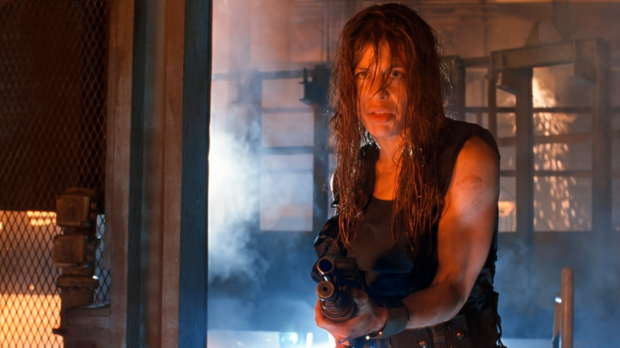
As any fan worth their artificial intelligence knows, Sarah is Linda Hamilton, now 34 and buffed into fighting trim, Sarah’s attitude honed by time spent in a mental institution, raving about the future while son ‘John Connor’ (Edward Furlong, 13) lives in a foster home. The first Terminator, good old machine-of-few-words T-800 (Arnold Schwarzenegger, 43 and intent on a massive salary increase) is back, or rather, a replica of it is, programmed this time to protect Sarah & son from the T-1000, a virtually indestructible killing apparatus made of molten metal, able to shape shift and reconstitute after repeated temporary demolitions.

Smartly conceived, smashingly directed, it works like a fever dream in every respect. The groundbreaking special effects and spectacular action sequences are enhanced by superb editing, sound, cinematography and scoring: that ‘nuke L.A.’ scene is still jarring. Hamilton’s dogged survivor and no-holds-barred battler is a vital member of Cameron’s crew of indomitable heroines who’ve graced Aliens, The Abyss, Titanic and Avatar. A major assist in the Cool Dept. comes from casting dangerous-looking Robert Patrick as the eerie T-1000. At 31, he’d had a small part in Die Hard 2 and appeared in a half dozen action cheapies made in the Philippines: this role earned him an iconic berth in sci-fi flick history. **

“It’s in your nature to destroy yourselves.”
132 or 152 minutes, depending on the edition: we recommend going for broke. Fans of the earlier movie know if John Connor makes it to manhood he would become the resistance leader in the future fight of humans against machines. His father, played by Michael Biehn in the 1984 starting gun, makes a brief cameo appearance in the extended cut. With Earl Boen, Joe Morton, Jenette Goldstein, Xander Berkeley, S. Epatha Merkerson and Dean Norris. Followed (relentlessly tracked?) 12 years later by Terminator 3: Rise Of The Machines.

* Ponder, mortals—Arnold’s salary:$15,000,000. He spoke 700 words, $21,429 per. “Hasta la vista, baby“=$85,716.
** Patrick: “I looked to animal and insect imagery to develop the lack of substance and wasted motion that my Terminator has. I tried to tap into the killer instinct inherent in animals, where they are locked onto a target and will walk through anything that gets between them and their intended target.” The T-1000 “is what broke me out big to the world, and I kind of carry it with me everywhere I go, for good or bad.” “My intention was just to be a good adversary for Arnold to match. To match and be superior in character that you would believe that I could get the upper hand on him or else the whole movie wouldn’t work. I obviously had a great deal of faith in Jim Cameron and Stan Winston and everyone involved, so that was where my commitment was, to really pull this off. I didn’t want to let him down or let anybody down but I had hoped it would be this memorable, I had an inclination it would, but I don’t think I realized what an impact it would have, and how it would change my life.”


 Movies ala Mark