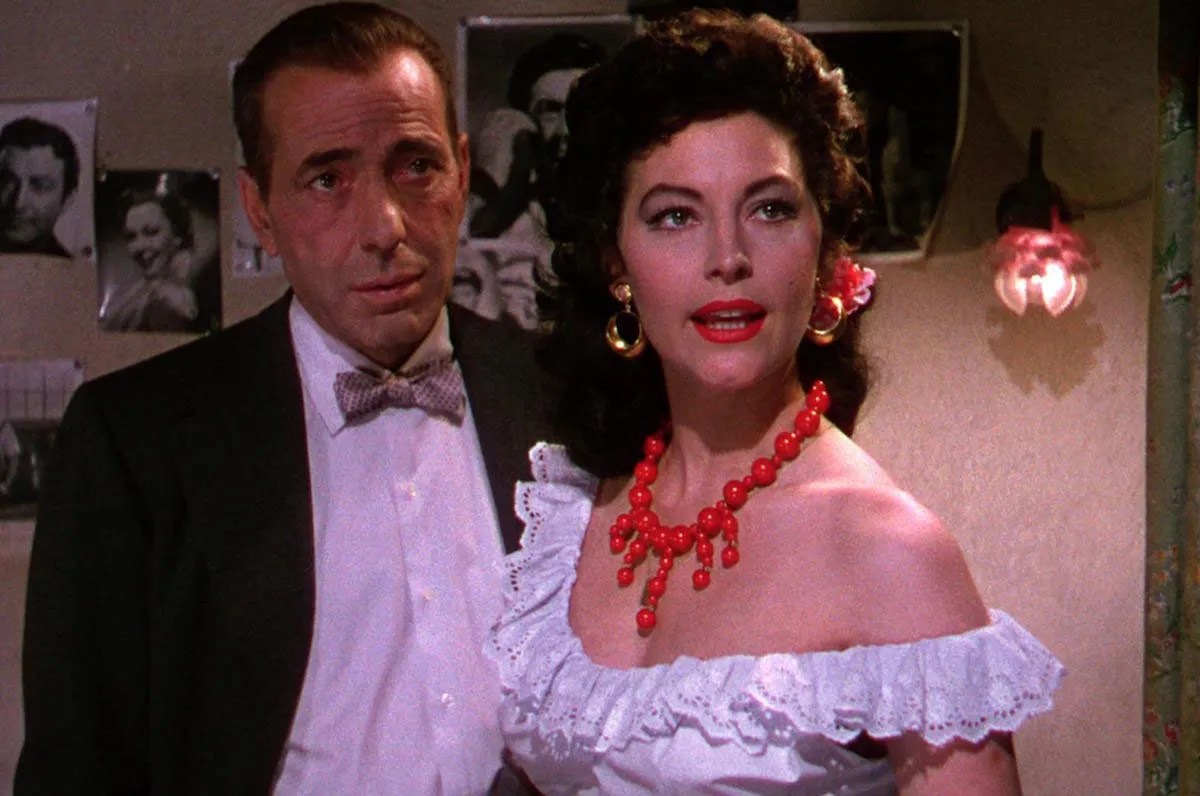
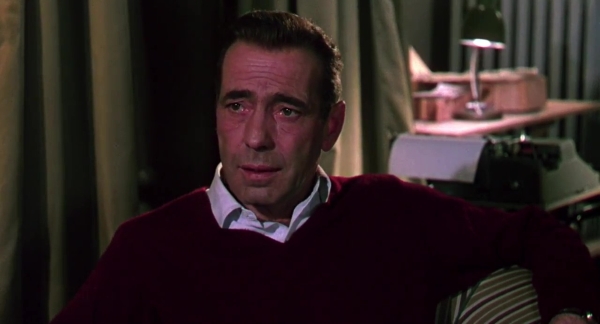
THE BAREFOOT CONTESSA—-“Nothing could have helped. The moving finger had already writ and moved on. And nothing I could do would have cancelled half a line.” So says ‘Harry Dawes’, a seen-it-all Hollywood writer/director in one of his narration overlays. He splits voiceover duty with ‘Oscar Muldoon’, a used-’em-all Hollywood press agent. Said-it-all Hollywood writer/director Joseph L. Mankiewicz managed to let alter-ego(istic) ‘Harry/Joe’ self-analyze/critique himself with a three sentence, 24-word combo synopsis/review of his (Joe’s) 1954 drama using Harry’s weary intoning: did script parentheticals read “Harry intones wearily”? Harry, Oscar and others in the story may as well have been named & addressed as their assorted ‘__-it-all’ types. The actors vie for truth-foothold supremacy with a screenplay where every other statement more complicated than “Hello” comes off like a pronouncement, a ‘pretentionment’. JLM worshipers will snipe “Heresy!” Those less triggered to genuflect might riposte “Like a baby who needs a light on in the dark, I need to be loved when I’m hiding in the dirt – and afraid.” To be intoned, wearily, while lighting up a cigarette or putting down a drink, presumably cognac or scotch. Cue reflex Academy Award nominations.
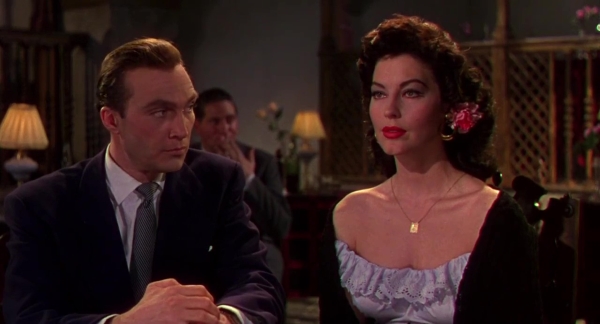
Since the show starts with the title character’s funeral in the rain, one surmises (while the narration pre-tells you) that what follows the rain won’t involve singing or much merriment, though there are some pithy comebacks slipped in around the labored speech-talk. Harry (Humphrey Bogart, 53), Oscar (Edmond O’Brien, 38) and fellow mourner ‘Count Vincenzo Torlato-Favrini’ (Rossano Brazzi, 37) take us into the meteoric rise & fall of ‘Maria Vargas’ (Ava Gardner, 31), a dancer in a Madrid nightclub who has “that something” that Hollywood is looking for: the audience nods, since they know ‘star quality’ better than math, history, where Europe is or the odds of getting within a continent of anyone as hot as Ava Gardner at 31. Harry’s super-rich bastard tycoon-turned-producer boss ‘Kirk Edwards’ (played by Warren Stevens, modeled on Howard Hughes) wants Maria; it’s Harry’s job to convince her to star in Kirk’s movies, and Oscar’s to sell her to the world. Maria, already wounded and wary, is also decent, honest and ready to skip Spain. As for The Weaker Sex, we see which one that is from the immediate behavior of most of the gentlemen.
“Once a year, on the French Riviera, one of the most beautiful seashores on God’s earth, the international set gathers the way an annual fungus gathers on a beautiful tree. It’s quite a set! It’s as if ordinary human beings, living ordinary lives, had suddenly vanished from the earth – and the world was suddenly full of butterflies shaped like people. They are all happy, all the time. Some of them are happy because they are beautiful. And some of them have to be happy because they are nothing but rich.”

Too often Mankiewicz’s musings are better when read or heard as narration than when seen recited as actual person-to-person dialogue. It’s the way he wanted people to talk as opposed to how they actually do, and in this movie it mostly comes off as artificial, calling attention to speech rather than the speaker, involvement shifting from accepting the characters to focusing on how well the actors deliver the precise yet awkward mouthfuls.
Fortunately, it’s well cast and, if not believably, at least entertainingly played. Bogart comes off best; he not only has the most likable character but many of the better lines. Despite his on-set grousing, he was having a swell year, provoking The Caine Mutiny and his final Oscar nomination, pursuing another idealized lady, a happier one, Sabrina. After quite a few of post-war leads and  co-leads, O’Brien moved into character roles with this: his sweaty, chatterbox press agent nicked him the Oscar for Supporting Actor. Mankiewicz had him play it broad (lots of shouting, like Lee J. Cobb), and it wears out: we prefer his later supporting turns, also blustery, but more enjoyable. A big star in Italy, Brazzi had been in one MGM picture, 1949’s Little Women. This role, coupled with the big ’54 hit Three Coins In The Fountain and the following year’s Summertime, cinched him for a decade-long run as the go-to heartthrob/heartbreak Italian lover for international romances (the French front manned by Louis Jourdan). Stevens, 34, does well as the cold-eyed big shot; the best part this dependable actor, sort of a Barry Sullivan type, ever had. Also very good is Marius Goring, 41, as ‘Alberto Ravano’, a happily sleazy South American playboy (modeled on the Dominican Republic’s jet-setter Porfirio Rubirosa). And of course, they all spin attitudes (and toss acres of word salad) around Gardner’s sole-baring goddess from a tenement, the living doll/sacrificial lamb of the piece. She’s okay, but it’s not one of her better performances (the stilted dialogue she’s given would tax a Meryl let alone a Maria) but she doesn’t have any trouble with the whole ‘ravishing’ angle; along with her ethereal junket Pandora And The Flying Dutchman she never looked better. As in that visual stunner, here she was blessed by cinematographer Jack Cardiff; the whole movie is beautiful to look at; shot on location in Italy, the Technicolor scenery of Portofino, San Remo, Rome and Ventimiglia is gorgeous. If you can tear your eyes away from Ava.
Along with O’Brien’s win, an Oscar nomination went to Mankiewicz for his writing, in the since-discontinued category Story & Screenplay. Being noticed goes with the territory, but Ava did not appreciate the advertising posters selling her as “The World’s Most Beautiful Animal!” The box office rank registered 28th, the domestic gross $9,400,000.

“The unholy pity of it! The one man in all of your fantasy and the one woman in all of his who could have made each other happy. And, once more, life louses up the script.”
130 minutes, with Valentina Cortesa, Elizabeth Sellars (good as Harry’s wife), Mari Aldon, Franco Interlenghi and Diana Decker.


Click to enlarge for clarity
 Movies ala Mark