
It lasts three hours… you will remember that ‘Ship Of Fools’ was better
VOYAGE OF THE DAMNED didn’t have a very successful trip to the box office in 1976, docking at 79th place with a decided list to port from leaking a hold load of money, the $5,300,000 gross against a $7,300,000 launch revealing damage below the waterline. Despite a passenger & crew manifest packed with stars, a course plotted off a factual life & death stakes story with built in tension, and distress assistance rowed-in with a trio of Oscar nominations, its running time is overloaded but undernourished, too much feeling rote rather than fresh, dutiful instead of gripping, the ocean liner setting steered to the dramatic equivalent of a barge.

May 13th, 1939. The Hamburg-Amerika transatlantic liner St.Louis leaves Nazi Germany for Cuba with 937 passengers, nearly all Jews, refugees fleeing the persecution that Hitler would shortly unleash on most of Europe. On arrival in Havana, the corrupt Cuban government, bowing to widespread antisemitism, refuses to allow disembarkation. So does the United States. As the ship returns across the Atlantic the question is whether any European countries will do more than telegraph regrets: docking back in Germany will almost certainly be followed by state-supplied travel to concentration camps.

With a few modifications, the Italian liner Irpinia served for the St.Louis (sunk in 1944), and Barcelona stood in for Havana. St. Louis, its conflicted captain and traumatized passengers were targets of venomous ideology and cruel politics, with an array of victims, villains and a few heroes. The saving grace for the movie is in the corresponding cast lineup, playing either their real-life counterparts or fictional composites representing the collective; some fare better by the material and handling than others. They deliver professionally despite wobbly navigation from the helm (direction, editing) of a vessel (script) that was insufficiently see-ready.

Shipshape—the cast is a veritable boatload of star talent, and while many—most—are there for prestige decorative filler, the standouts rate salutes. First off is Max Von Sydow, solid as the humane, duty-ensnared Captain. Lee Grant nails the most effective of the emotionally expressive parts, as a passenger psychologically disintegrating after impulsive actions taken first by her husband, then their daughter. Orson Welles does sly work as a politico fixer in Havana, dialing back from the hamming that marked some of his other late-career ‘guest’ gigs. José Ferrer excels in his brief but telling scenes as a venal, self-satisfied Cuban government official. Helmut Griem is handily adroit as a zealous, merrily mean Nazi assigned to keep tabs on the crew. Top-billed Faye Dunaway (banking a half mil) and Oskar Werner (his last film) do what they can in trope-hampered parts as an elegant couple “with a past”—and a dim future.

Hair-lopping scene = can’t fail bid for Oscar nomination
Trouble in the engine room—-the screenplay from Steve Shagan (Save The Tiger, The Formula) and Stephen Butler (mostly Brit TV) was based off the 1973 non-fiction book written by Gordon Thomas and Max Morgan Witts. Other than finding that it ran 336 pages, was well-reviewed and a bestseller, we can’t vouch for the book. The script, however, is cluttered and cliched, its pretty obvious fictional mini-melodramas between the passengers are either forced or feeble, coming off like build & explode showcase staples from TV movies, timed to register before a commercial break. The Werner-Dunaway set is dissapointing, and a meet-cute romance between plucky ship’s steward Malcolm McDowell (a good guy this time!) and fragile doe Lynne Frederick doesn’t convince. Sam Wanamaker’s overplaying as Grant’s nerves-snapped husband runs a “look at me acting!” contest with Ben Gazzara’s loud relief agency agent, who may as well have wandered in off another movie. As a director Stuart Rosenberg was hit (Cool Hand Luke) or miss (WUSA), with this not one of his better efforts, little helped from editing that scrambles loose-end subplots and over-length (155 minutes, 182 in the extended cut). James Mason, Maria Schell, Katherine Ross, Julie Harris, Nehemiah Persoff and Wendy Hiller rate about two brief scenes each, Janet Suzman and Denholm Elliott get one apiece. Lalo Schifrin’s score is okay when accenting the Havana sequences but is lost at sea on the St. Louis, numbing moments where emotions call for breathing space rather than dive bombing from the string section. *

Girl about to trust… Malcolm McDowell?
Of the Oscar bids, Grant’s for Supporting Actress was fair enough (she’d won the year before in Shampoo), but it was yet another instance of Academy stretching to put up the Screenplay and Score as well. None won. In addition to trying award band-aids to plug breaches in the budget-to-bank battle, the ad campaign rolled out posters making the somber drama look like a thrill-packed disaster opus. Finally, it also had to trail in the wake of 1965’s successful all-star Ship Of Fools, which fictionally sailed somewhat similar lanes, and coincidentally featured Werner (glum as ever but more engaged) and Ferrer (energetically pompous).
Debits taken into account, Voyage Of The Damned is hardly a bad movie, just one that is considerably less than what it could have been, given the surefire story and involved talent. The quick-fix history lesson (governments are dependably undependable) and good work from some of the principals are certainly commendable.

With Michael Constantine, Paul Koslo (his most sympathetic role), Luther Adler, Jonathan Pryce (36, feature debut), Victor Spinetti (unusual dramatic part for him), Günter Meisner (one of his numerous slimy Nazis), Donald Houston, Leonard Rossiter, Georgina Hale, Fernando Rey, Laura Gemser (how did ‘Emanuelle’ get there?) and Tom Laughlin (! unbilled blink & miss bit, for reasons we can but mull). **

* The actual death toll of 247 was upped by the script to 600, the real figure apparently deemed not “dire enough” to move an audience. One example of a similar fib-for-effect comes in the garbage ‘Vietnam western’ Soldier Blue, which saw fit to double the casualty count of 1864’s brutal enough Sand Creek Massacre. Of course, the line of fact-fudging films is long enough to be salt-grained off as “taking dramatic license”, make-believe often so bold as to be outright laughable. A good thing politicians don’t do it: just imagine if, say, a President of the United States would, oh, regularly inflate crowd sizes (or, heck, any old thing) to levels so blatantly false that only raving imbeciles would buy it? Gosh, we’d be in real trouble.
** Casting coup, couch, or combo? In a few scenes with Welles, as his ‘companion’, is Indonesian beauty Laura Gemser, 25, who had already appeared in several of her thirteen ‘Emanuelle’ frolics. As with the Poseidon‘ish poster art, the producers chose marketing strategy over subject matter sensitivity.
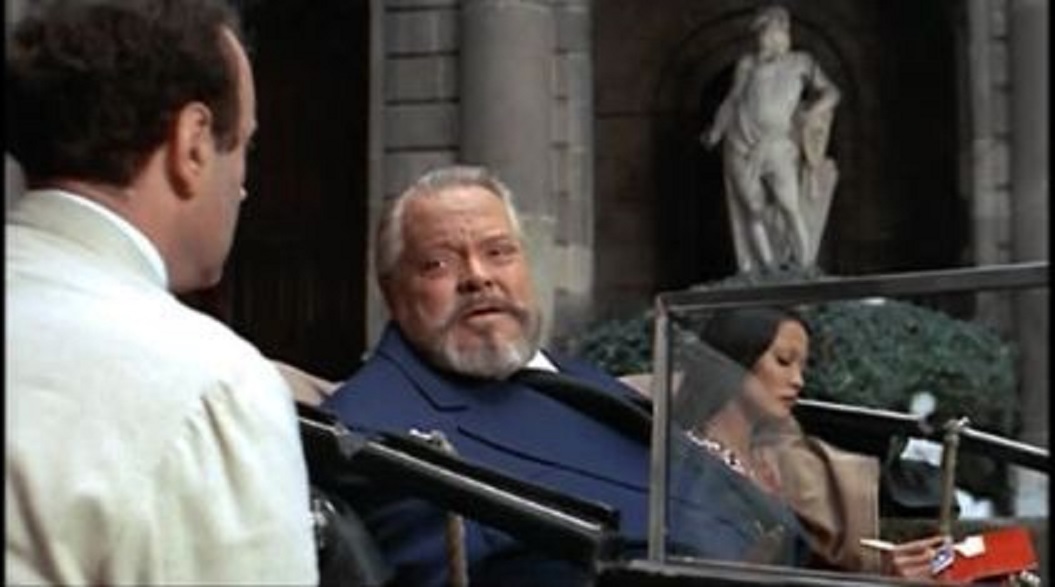
“I shall serve no 25-year-old Javan bombshell before her time.”
 Movies ala Mark