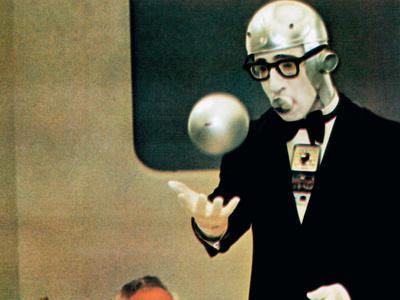
SLEEPER, Woody Allen’s contribution to funnybones in 1973 was a big hit, his fifth go as a director and second time sharing lead billing with Diane Keaton. He co-wrote the script with Marshall Brickman; they’d collaborate on three more. Made for $2,000,000, the gross of $24,400,000 placed 15th for the year. Take away three pictures (What’s New Pussycat?, Antz and 1967’s Casino Royale) that he was in but weren’t real ‘Woody Allen movies’, and factoring for inflation, Sleeper ranks as Allen’s 4th most attended picture, after Annie Hall, Manhattan and Everything You Always Wanted To Know About Sex. Maybe popularity was due to the ‘Orgasmatron’?
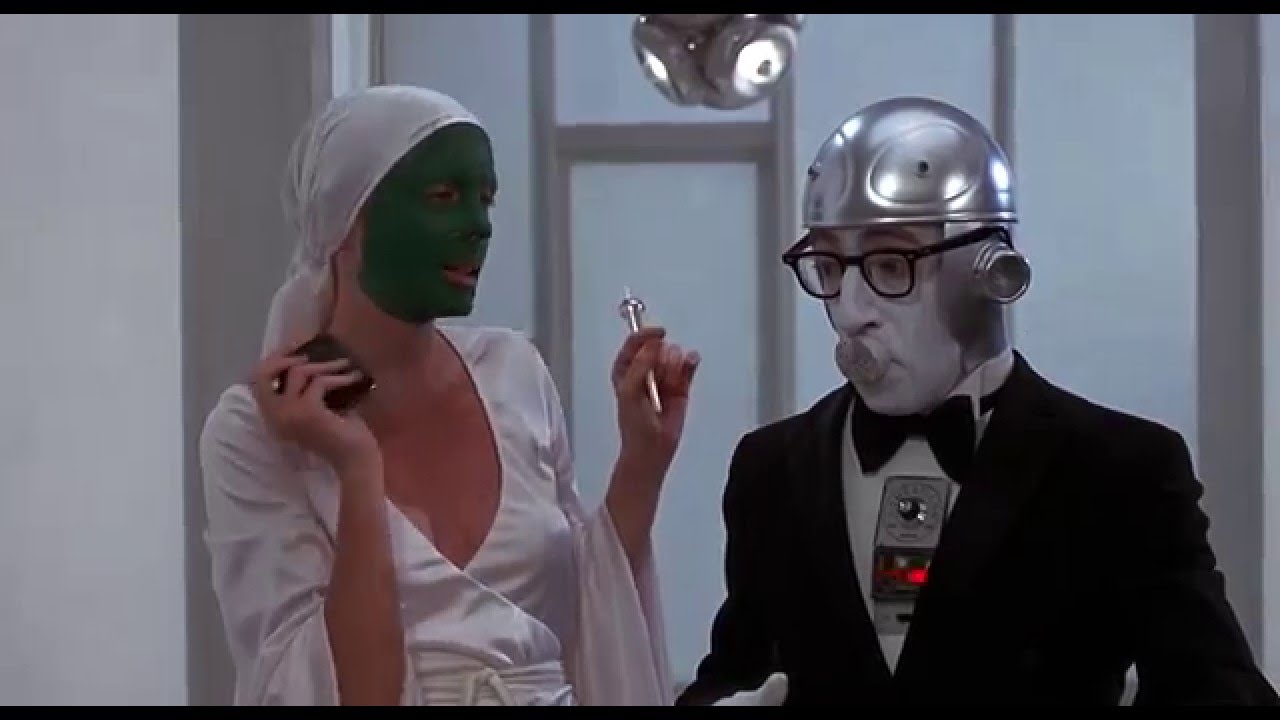
In the year 2173, scientists revive a man from a 200-year state of cryopreservation. ‘Miles Mander’ (Allen), once the owner of a health food store (the ‘Happy Carrot’) in Greenwich Village, awakes to discover the future USA is a police state (laugh while it’s still legal), and he’s soon pursued by security forces of ‘The Leader’, who think he’s part of a rebellion. He disguises himself as a robot butler, and is delivered to home service for airhead socialite ‘Luna Schlosser’ (Keaton), who he kidnaps after she discovers his identity. On the run, they fall for each other (duh), and both eventually join the rebellion.
LUNA: “It’s hard to believe you haven’t had sex for 200 years.” MILES: “204, if you count my marriage.””
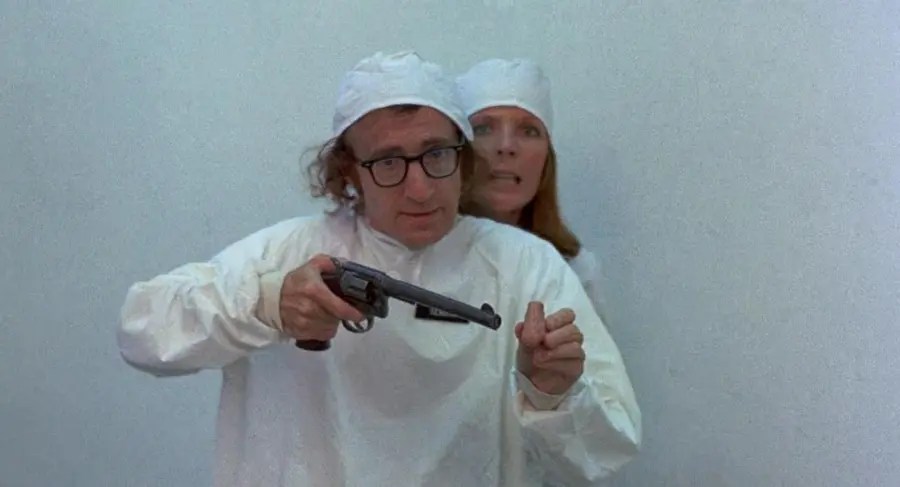
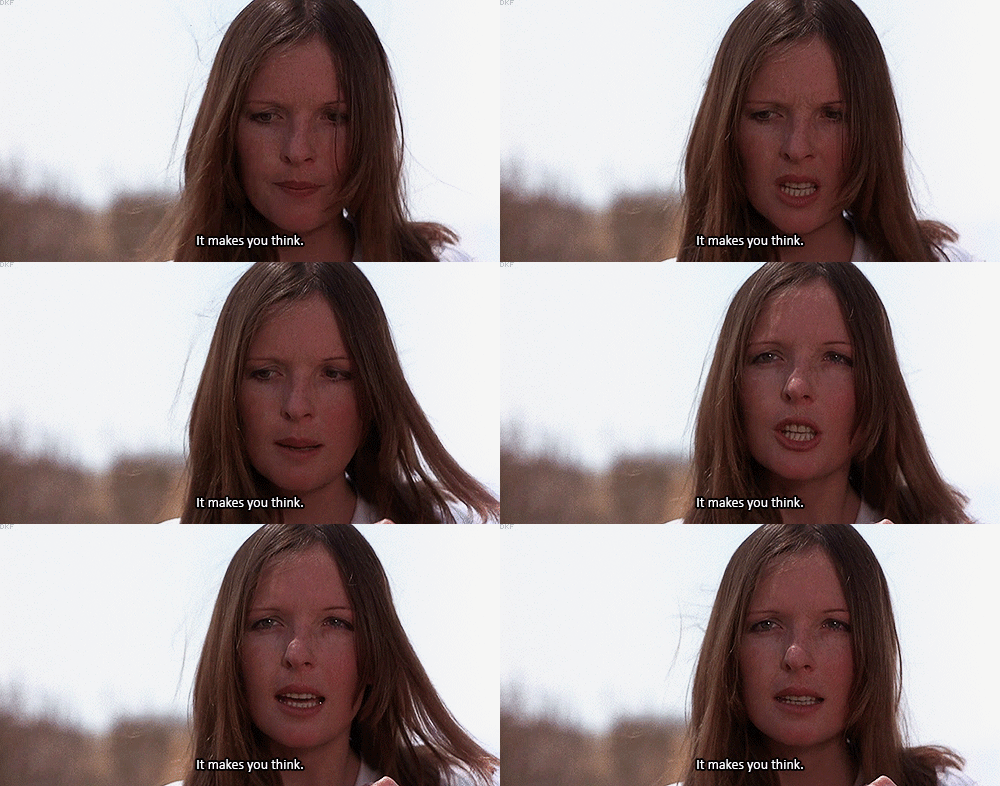
The visual design (futuristic vehicles, gadgets and beliefs) is clever, the barrage of gags (many now dated) a mix of witty and groaners, with much slapstick that ranges from deft to forced. Allen’s locked into his standard nebbish character (back then the shpilkes kvetching hadn’t been ongepatcheted to “enough already with the thing!”) and Keaton is revved up to suit, timing excellent, her charm thankfully undiminished; she does a very funny Marlon Brando impression. Every few minutes the slapstick segments are accompanied by frenetic musical backup from the Preservation Hall Jazz Band and the New Orleans Funeral Ragtime Orchestra; after the first few blaring insertions, welcome fades into earplugs territory.

There’s a lot of love out there for this movie: wish I could share it. Seeing it the first time back in 1973, in a theater with a Woody-primed audience, I thought it was just okay; a recent revisit (in honor of the treasured Diane Keaton) wore me out about a half-hour in—and it’s only 87 minutes long. I’d put this down there in the ‘no thanks’ category with Manhattan Murder Mystery and Cafe Society. That seems to be the minority view, and as we know too well “You can’t fight City Hall”. His next, also with Keaton, Love and Death, is one of my favorites. So there. *
Shot in Colorado, around Denver. With John Beck, Don Keefer, Bartlett Robinson, Mary Gregory, John McLiam and George Furth.
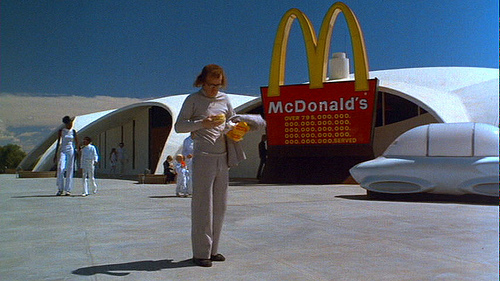
* Allen: “Well I had this idea and I went to United Artists with it and said that I wanted to make a very big, expensive film. Four hours long. It would be a New York comedy and…after two hours, I accidentally get frozen in a cryogenic machine.Then there would be an intermission…in Act 2 I wake up, and it’s New York 500 years in the future.” Wisdom prevailed.
Interviewed during the filming Woody compared his style to that of a fella named Bob: “Hope and I are both monologists, and as characters we both think we’re great with women, and we play as both vain and cowardly. Hope was always a super schnook. He looks a little less like a schnook than I do. I look more schnooky, more intellectual. Both of us have exactly the same wellspring of humor. There are certain moments when I think he’s the best thing I’ve ever seen. And I do him all the time. Sometimes it’s everything I do not to actually mimic him.”
 Movies ala Mark