
THE BRIDGES OF MADISON COUNTY—Meryl Streep. In a sensitive drama. Okay, fine. With Clint…Eastwood? Uh, sure. Wait, we’re not done—he’ll direct it, too? The public loved the book it was based on, critics scorned it, so hope and doubt came at the project from each quarter. From the Smirks Don’t Constitute Smarts file, naysayers had their crow shot, baked and served with only their bile to wash it down when their 1995 collaboration turned out quite well, pleasing fans of the novel and surprising those who had jeered at it.
“I don’t want to need you, ’cause I can’t have you.”
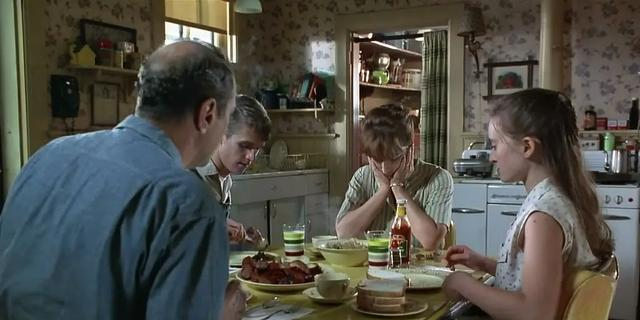
At the Iowa farmhouse they were raised in two adult siblings find letters, photos and momentos their just-deceased mother ‘Francesca Johnson’ (Streep, 45) left in a safe deposit box, unveiling that she once had a brief romantic idyll with another man while she was married to their late father. While ‘Carolyn (Annie Corley) and Michael ‘(Victor Slezak) deal with the stunner news and reflect on their own less-than-satisfying marriages, the bulk of the story is told in flashback to 1965. Francesca had stayed behind when her husband, farmer ‘Richard Johnson’ (Jim Haynie) took their kids on a four-day trip to the state fair.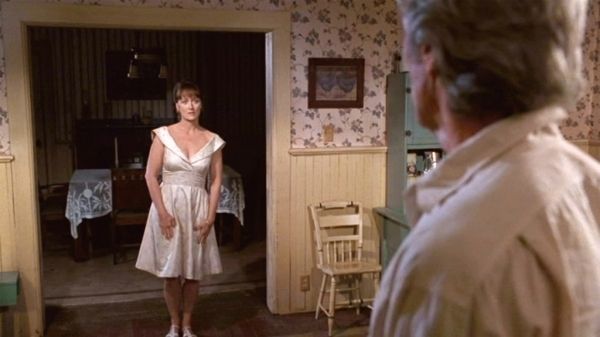 Brought over as a bride from WW2 Italy, she adapted to marriage, motherhood and the Midwest but her surface serenity conceals longings for passion and purpose that the security of a comfortable home, a kind but uninspiring husband, mundane parenting and the provincial local community don’t supply. A passing stranger stops to ask directions. ‘Robert Kincaid’ (Eastwood, 64) is a photojournalist for National Geographic, in the area to shoot pictures of the scenic local bridges. Simple, pleasant conversation leads to her going along with Robert for a few hours while he works. That spurs meeting again, then dinner, and at some mutual point a line of friendliness is crossed into intimacy that feels not just stimulating but profound. Now what? Both are sincere, each are missing something in their lives. They’re serious, mature people, with different paths and situations. But now what?
“I’m a loner, but not a monk.”

Robert James Waller had put academia aside to whip out a romance novel (in eleven days), his first, a love & sacrifice ode that may not have set intelligentsia alight but plucked enough heartstrings among the open and lonely to stay on the NY Times bestseller list for 164 consecutive weeks, and ultimately sold 50,000,000 copies worldwide. It drew/draws lots of snootiness from highbrow reviewers, and neither star cared for Waller’s writing style. But as savvy filmmakers they both saw dramatic possibilities in the raw story, liked the screenplay adaptation from Richard LaGravenese (The Fisher King, The Ref, The Horse Whisperer) and weren’t so wedded to their own personas, egos and attitudes about this or that to pass up a creative challenge and the opportunity to work together and make something of value. Steven Spielberg, Sydney Pollack and Bruce Beresford had lined up to direct the property before Eastwood stepped in. His handling, brought in for $22,000,000—under budget and four weeks ahead of schedule—made $71,517,000 in the States/Canada, #21 in ’95, and did a good deal more abroad, $110,500,000. On camera he held his own with the world’s foremost actress, delivering one of his best performances, certainly his most relaxed, but whatever he orchestrated in calling the shots it served to provide Streep yet another bravura, lived-in role, every look, gesture or line, however minute of fleeting, grounded in truth, cinching her an Oscar nomination for Best Actress, only her eighth in that category. Nothing to it. *
Beautifully lensed by Jack N. Greene, his ninth of thirteen collaborations with Eastwood. With Michelle Benes. 134 minutes.

* Meryl: “His set is the quietest I’ve ever worked on. But it didn’t feel still; it felt full…at full attention. Maybe it’s an actor’s ultimate revenge once he becomes the boss that everything is subservient to that little fragile thing in the center, the spontaneous moment, the thing, as Clint says that “only has to happen once”…I felt respect for the process, the simplicity of it when it was working right, the pared-down motions of what was necessary, and only what was necessary, to make the story seem like it was really happening.”
What he did worked: fitting into her astounding body of work, once again thru artist’s alchemy she became who she was playing. The difference the right script can make vs. where it came from can be illustrated and draw smiles from the initial reactions both she and Eastwood had to the book. She’d described it as “a crime against literature” and he’d joked that “For an actor to say that stuff you might have to do it during a saloon scenes when he looks like he’s had about ten beers.”
From our un-lofty perch—haven’t read it, won’t get around to do so and don’t care a fig what the critics say. We do like the movie.

 Movies ala Mark