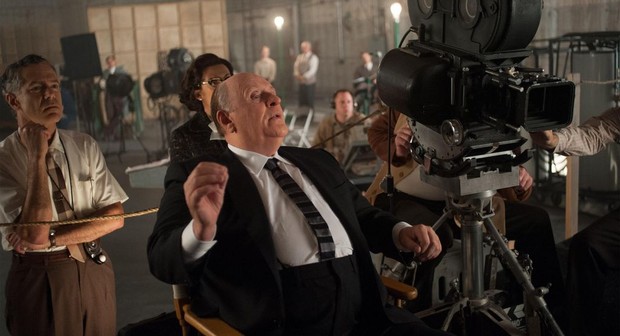
HITCHCOCK, entertaining, well-acted, specious stuff & nonsense faction about Alfred Hitchcock and the creation of his 1960 classic Psycho. If you’re reasonably cognizant of history and movies (the subject of this 2012 entry being part of both) and how the latter almost always deals with the former—primarily as drama with facts attached as selling points—then you may enjoy this as a watch & dismiss trifle, like a fancy piece of chocolate, and about as sufficient for nutrition. If, however, you’re under the impression you’re seeing The Truth about a complex, creative, influential artist and man and getting the insider lowdown on a vital piece of his work and the time, place, business, and people involved…then I have a Victorian house on the Universal Studios Tour that I’d like to sell you.
“Beware, all men are potential murderers. And for good reason.”
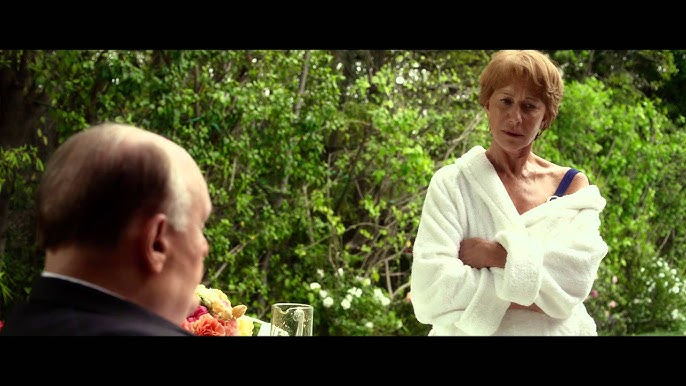
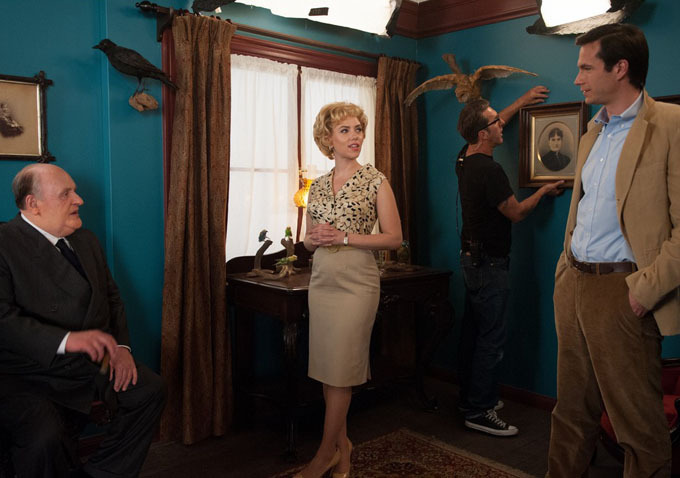
It’s 1959, and famed director Alfred Hitchcock (Anthony Hopkins, 74) has racked up another masterpiece with the thrilling North By Northwest. Seeking something fresh and daring, he opts to go the horror route (horror, like sci-fi, a disrespected genre at the time), his template of choice a Robert Bloch novel based Ed Gein, murderer—and total depraved lunatic. Alma Reville (Helen Mirren, 66), Hitchcock’s beloved and witty wife and creative colleague, assists him as he takes a financial and reputational risk preparing and making what will ultimately be released in September of 1960 as Psycho, a genuine shocker. Personalities in the mix include Janet Leigh (Scarlett Johansson), Vera Miles (Jessica Biel) and Anthony Perkins (James D’Arcy).
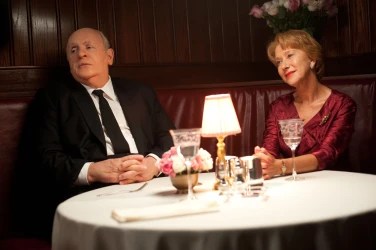
Directed by Sacha Gervasi (The Terminal), made for $15,700,000, applause went to the acting, and an Oscar nomination came around for the Makeup & Hair Styling. Patronage in the States was weak, just $6,009,000, 142nd place) and the total global gross stopped at $27,040,000.

John J. McLaughlin (Black Swan) based his screenplay on Stephen Rebello’s detailed book “Alfred Hitchcock and the Making of Psycho”. The book received a lot of praise (someday we’ll get around to it), but exactly how much the screenwriter and director deviate from it we can’t say, only that they did, and presumably, unlike the movie it’s more insightful and not error-ridden. *
There’s amusing catty patter between Alfred and Alma that, while speculative, generally seems plausible given their respective wit and their lifelong closeness/support/adjustment as a loving couple and creative collaborators. Giving long-overdue public recognition to Reville and her importance to her husband, intimately and in his work, is laudable. The expected name dropping, personality tiffs and production mechanics are acceptable biofodder— to a point. Alas, not content with the compelling basics to be mined from the book and copious Hitchcock lore, Gervasi and McLaughlin invent a subplot with a fictional screenwriter, ‘Whitfield Cook’ (Danny Huston, on smarm drive), trying to tempt Hitch-itched Alma to do more than help him on a script he’s writing. Not enough to gin that up, the filmmakers go way out to lunch by having Hitchcock getting imaginary guidance from the 100% belfry-batted Gein (played by the always arresting Michael Wincott). Please. The whole business with Hitchcock going semi-berserk directing the ‘shower scene’ is simply insulting. Character assessment or character assassination?

Johansson, Biel and D’Arcy do their best to suggest chipper Leigh, resigned Miles and nervous Perkins but it’s hard to shake that they’re essentially playing an advanced game of dress-up. Mirren comes off a tad better than Hopkins, by default, since Reville’s face and manner isn’t familiar to the public. Hopkins is excellent, smartly going for interpretation rather than impression. Yet even with the impressive makeup and his adept capture of Hitchcock’s voice and carriage, the imprint ghost of the real Alfred is hard to dismiss for those old enough to recall him. True, viewers less familiar (with him, the era and old Hollywood) will be less picky, but then again without the benefit of remembrance/nostalgia/research to stir into the appreciation, they may wonder what all the fuss was over in the first place.
With Toni Collette, Michael Stuhlbarg, Richard Portnow, Kurtwood Smith and Ralph Macchio. 98 minutes.
* From an interview with Stephen Rebello: “The book is almost a documentary film in print form, a strictly factual account, with lots of first-person recollections and no dramatic license taken, but told in a compelling, entertaining, page-turning style. I was also hired to write three or four drafts of the screenplay and lots of revisions of specific scenes and moments. Much of the material I unearthed for the first time in the book was so rich, funny, revealing and unique that I knew that readers would miss certain ‘scenes’ and ‘characters’ if they weren’t in the movie based upon it. So, I developed them dramatically and thematically in very visual film terms. I tried valiantly to get that material – its tone, scope and seriousness into the screenplay. It was like rolling a boulder uphill with a straw. Films are a collaborative medium, and a director makes a movie his or her own. I sorely miss many of the scenes I wrote that focused on how Hitchcock’s genius, his contradictions, his demons played out on the set while he was filming Psycho. Apparently, many critics and audience members had also been expecting and hoping for many more of those kinds of scenes in Hitchcock.”
A diplomatic way of saying it could have been better.
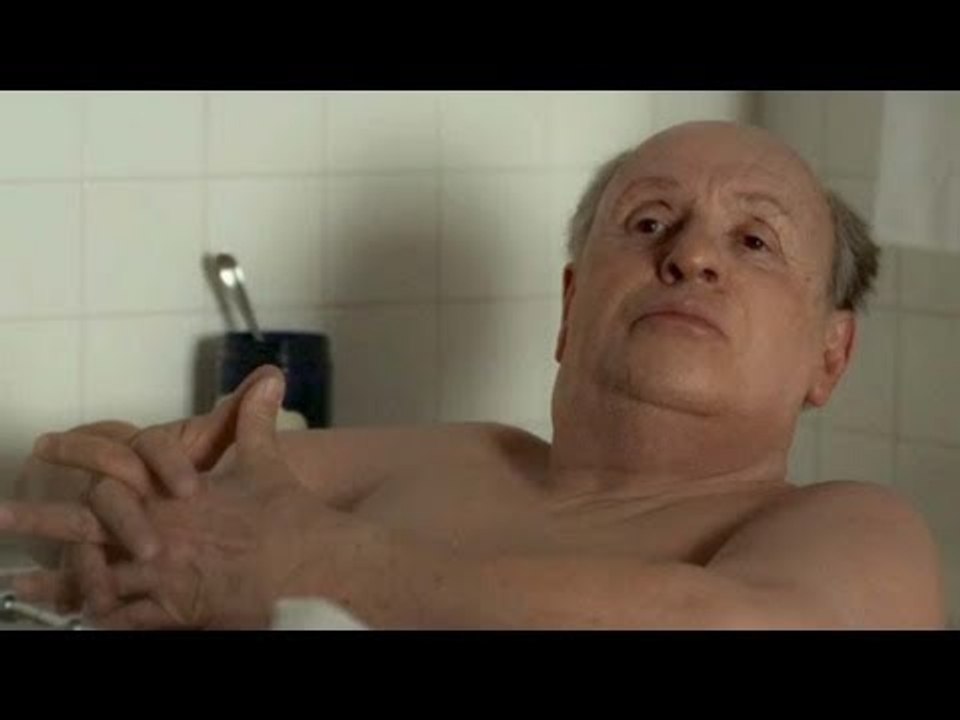
** History ala Hopkins —-the great Sir Anthony has given us Richard the Lion Heart (The Lion In Winter), David Lloyd George (Young Winston), Lt. Col. John Frost (A Bridge Too Far), Frederick Treves (The Elephant Man), Lt. William Bligh (The Bounty), Frank Doel (84 Charing Cross Road), C.S. Lewis (Shadowlands), Dr. John Kellogg (The Road To Wellville), Richard Nixon (Nixon), Pablo Picasso (Surviving Picasso), John Quincy Adams (Amistad), Ptolemy I Soter (Alexander), Burt Munro (The World’s Fastest Indian), Daniel Webster (Shortcut To Happiness), Freddy Heinekin (Kidnapping Freddy Heinekin), Pope Benedict XVI (The Two Popes), Nicholas Winton (One Life), Sigmund Freud (Freud’s Last Session) and King Herod (Mary). And that’s just feature films! On TV he’s been Charles Dickens, Georges Danton, Bruno Hauptmann, Yitzak Rabin, Capt. Christopher Jones, Adolf Hitler, Paul of Tarsus, Count Ciano, Guy Burgess, Donald Campbell, Joel Filartiga and Vespasian. And these are just the once-living historical humans—there’s also Titus Andronicus, Hrothgar, Odin, Quasimodo, Othello, Lear, Pierre Bezukhov, Van Helsing, Hannibal Lecter—and Methusela.

 Movies ala Mark