
ARSENIC AND OLD LACE was a hit in its long-ago day, first on Broadway, then in cinemas when it was released in the fall of 1944. A lot of people—mostly older—adore this vintage chestnut, and the play has been repeatedly revived. Two pairs of my best friends, people I’ve shared countless laughs with over many comedies, love it. I’m glad for them, honest, for having fun that for most of 118 minutes eludes me on this one. I faintly recall liking it as a kid (back when the mammoths trod), but more recent viewings draw just a few stray chuckles, and mostly kept-to-myself thoughts of “I bet that was funny at the time.” But laughs? Nope. Darn it to the succotash that suffers, I like the idea, and am a definite fan of the actors, the director, writers, cameraman and composer. The show does leave me with a smile, but it’s the polite kind that’s frozen on your face. Your honor, we’re taking the fifth: maybe bringing one along would’ve helped when watching.

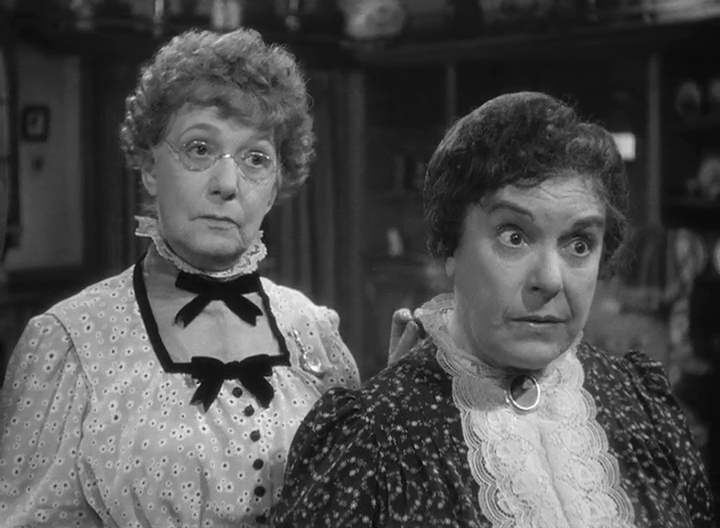
Brooklyn. Halloween. Theater critic ‘Mortimer Brewster’ (Cary Grant, 37) has just married neighbor ‘Elaine Harper’ (Priscilla Lane, 26) but before they honeymoon each has to break the news to their families. Not an issue with hers, but his relatives, those in-house and one about to drop by, are a different breed: they’re crazy. Biddy aunts ‘Abby’ (Josephine Hull, 64) and ‘Martha’ (Jean Adair, 68) are sweet as elderberry wine except they have a naughty habit of spiking the vino with arsenic, cyanide and strychnine and serving it to lonely bachelors—to end the poor fellows “suffering“. Mortimer’s mortified to discover a victim (their 12th), and at first thinks it may have the doing of his younger brother ‘Teddy’ (John Alexander), who is deluded, believing he is Theodore Roosevelt. Then baleful older brother Jonathan (Raymond Massey) surprise arrives. He’s a disfigured serial murderer, accompanied by ‘Dr. Herman Einstein’ (Peter Lorre), a boozy plastic surgeon who is effusively polite but casually complicit in Jonathan’s growing kill count. Mortimer frantically tries to keep his sanity while simultaneously protecting his aunts and Teddy by getting them sent to an asylum, outfoxing suspicious policemen and escaping the wrath of his maniac older brother, shielding it all from a perplexed Elaine.
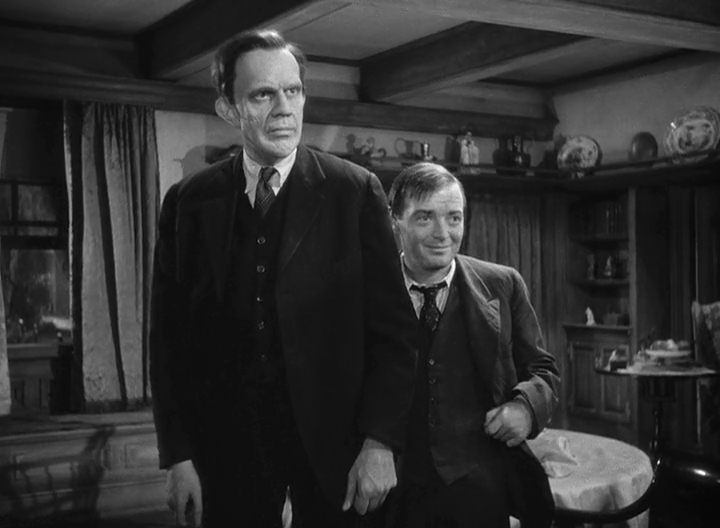
Frank Capra directed, with a script that Julius J. & Philip G. Epstein adapted from the play by Joseph Kesselring (no relation to WW2’s fearsome German Field Marshal) which ran 1,444 performances on Broadway and 1,337 in London. Adair, Alexander and Hull repeated their Broadway roles. Massey replaced Boris Karloff, whose contract forced him to stay with the play; Massey’s makeup suggested Karloff’s appearance as the Frankenstein monster. Produced by Warner’s for $1,164,000, with studio aces Sol Polito manning the camera and Max Steiner composing the score. Along with the major parts, other ace actors on hand include Edward Everett Horton as a shrink and James Gleason and Jack Carson as cops trying to figure out exactly what’s up at the Brewster residence.
“Look I probably should have told you this before but you see… well… insanity runs in my family…it practically gallops.”
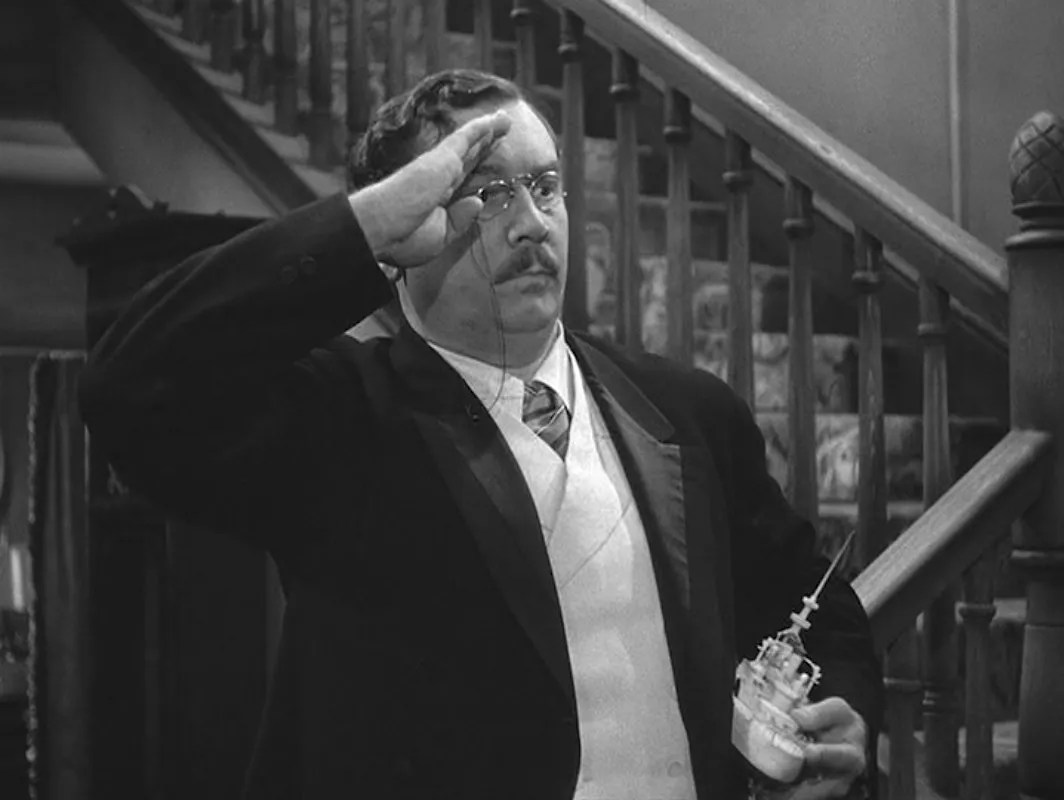
Great setup, top talent in front of & behind the camera. Yet key pieces don’t fit, and the handling repeatedly fails to make them do so. His skills and charm pulled off many a hit, but Cary himself acknowledged the occasional dog (The Howards Of Virginia, Night And Day, Kiss Them For Me) and he regarded this as his worst performance, one in which he was unhappy throughout by being pushed by Capra to ‘go big’. He’s forced from Scene One on, so ceaselessly loud and rabbity it comes off like someone fried on coke doing an impression of Cary Grant. The stage idea of Karloff having fun “playing Karloff” dies with Massey, not an actor attuned to a light touch, his Jonathan is so sinister it unbalances the farcial gimmick. Alexander can’t be faulted for his playing of Teddy as Teddy but two rushes upstairs after bellows of “CHARGE!” would suffice—seven run the gag down San Juan Hill into the swamp. Usually adept at precision mugging, Carson is also tasked to overdo it. Lane is colorless. Grant pleaded for retakes but the studio nixed it when Capra went off to enlist after Pearl Harbor.
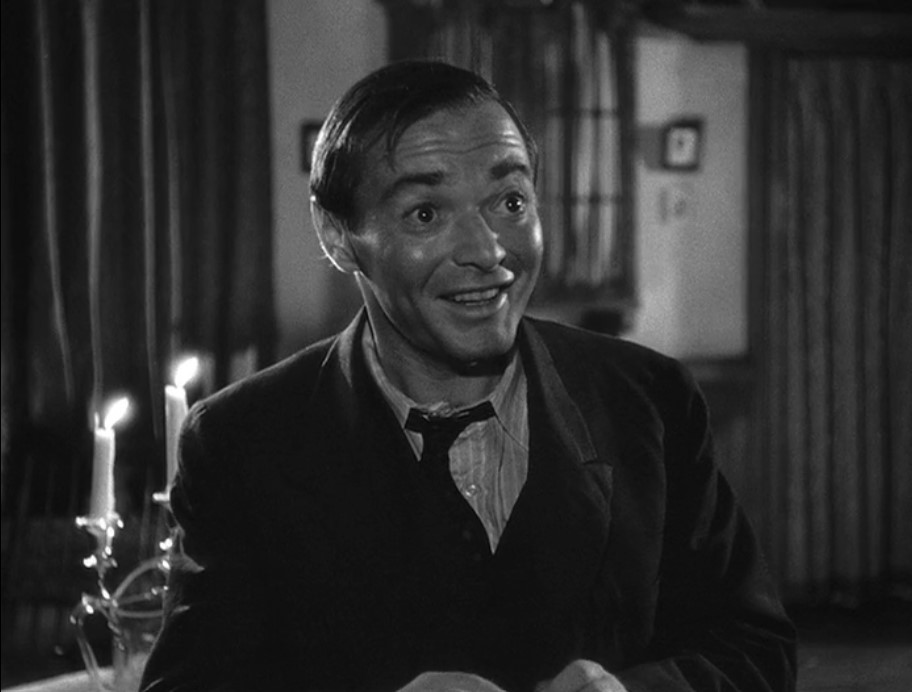
On the positive end, Hull and Adair are dandy as the blithely merry dispensers and Lorre does a fine comic turn, playing in a low key register as Jonathan’s amiably bumbling partner. Polito’s cinematography nails some effective closeups (especially of Massey), and Steiner’s score is subtly spooky.
With Grant Mitchell, Edward McNamara, Garry Owen, John Ridgely and Charles Lane.

* Stage actresses Adair and Hull only made a handful of movies, respectively five and seven, Hull nicking a Supporting Actress Oscar for another daft aunt in Harvey. Alexander appeared in 31 features, with a good deal of TV work. With the play still running while the movie was filmed in 1941, release was delayed until 1944. By then Capra was fully involved in the war effort, making documentaries, not returning to direct a feature until 1946 with It’s A Wonderful Life.

 Movies ala Mark