
BUTTERFLIES ARE FREE was first done as a play. It ran 32 months and 1,128 performances, closing a few days before the movie version landed on screens in July, 1972. Leonard Gershe (Funny Face) adapted his single set, two-hour chamber piece into screenplay form, changing the New York City setting to California. Milton Katselas directed, opening up the literal staginess from the confinement of two adjoining apartments to allow for some San Franciscan exteriors, and also tightened the running time to 109 minutes. 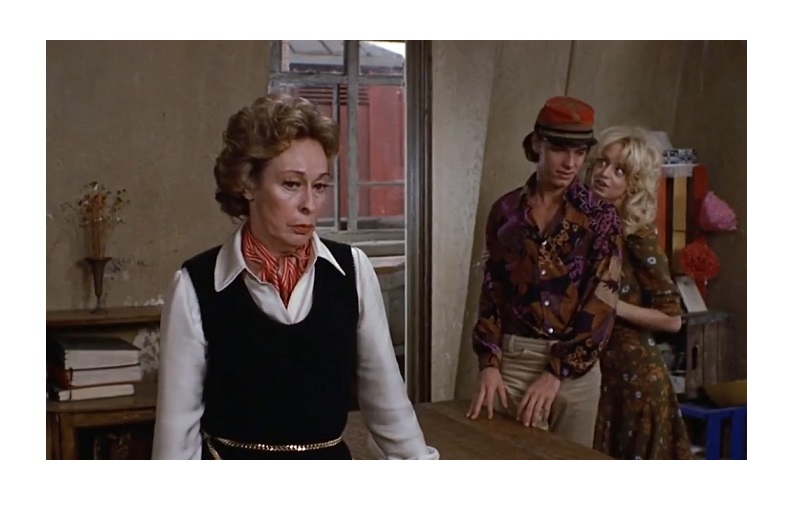
“Just because you love someone doesn’t necessarily mean you want to spend the rest of your life with them.”
San Francisco. Five years after the ‘Summer of Love’ there’s still enough of the freely distributed variety around, some of it fluttering into a pair of aged, barely furnished apartments. Chirpy, nineteen year old vagabond ‘Jill Tanner’ (Goldie Hawn) and her sack of boho threads are a paper-thin wall away from ‘Don Baker’ (Edward Albert), a year older, with hopes of getting notice as a singer-songwriter. His pad has a few more perks, mainly a cool bed beneath a skylight. Jill’s quick impulse introduction finds an openly friendly response from the guileless Don, and faster than you can say “Young, the 70s, San Francisco” they’re enjoying the skylight and its immediate environs. That Don happens to be blind doesn’t faze live-and-let-go Jill, and he’s a genuinely decent guy (who also happens to be good-looking and musical—like that would help (cough)…
Then his mother shows up, and take-the-high-ground ‘Florence Baker’ (Eileen Heckart) could teach a class in Acerbic Suffocating Interference. A case of Boy meets Girl meets Mom from Hell Hillsborough.
 Obvious staginess—confined, all dialogue, sympathy for malady built-in to the deck stack—is dispelled by the superior work from the three leads (the two supporting players have next to nothing to do). At 26, still elfin enough to convince as a flighty flower-child, Hawn added this flippantly frisky, effervescent yet elusive character to her growing collection of wins (Cactus Flower, There’s A Girl In My Soup, $), the expected cuteness flavored with some extra spice and bite.
Albert, 20, had appeared uncredited in 1963’s Miracle Of The White Stallions and debuted at 12 in the barely seen 1965  oddity The Fool Killer, but he was billed “and introducing” here and delivered a beautifully calibrated performance conveying Don’s openness, kindness and dignity along with some hard-earned wariness, bitterness and hurt. He’s able to pull off a song—“Butterflies Are Free”, written by Stephen Schwartz, later lauded for Godspell, Enchanted and Wicked—that could’ve been treacly and make it plaintive and sweet.
At 52, Eileen Heckart had done tart work in films since 1956 (including hits Bus Stop and The Bad Seed and the overlooked Heller In Pink Tights) but was mostly a stage and TV figure. Having prepped for this part by doing it hundreds of times on Broadway, she topped her film career with the casually sarcastic, manipulative yet ultimately pitiable Mrs. Baker, who cares so much it hurts—others, and herself. She walked off with an Oscar for Supporting Actress, justified against serious competition from fresh faces Susan Tyrell in Fat City and Jeannie Berlin in The Heartbreak Kid.

Besides Heckart’s win, nominations were tacked on for Cinematography (absurd—while The Godfather was left out!) and Sound.
FLORENCE: “How long were you married?” JILL: “Six days.” FLORENCE: “And on the seventh day you rested?” JILL: “No, I split.”
With Paul Michael Glaser (29, he’d also been in the play) and Mike Warren. The $1,200,000 production cost was vaporized by audience acceptance totalling $20,500,000, 1972’s 19th most popular picture.


 Movies ala Mark