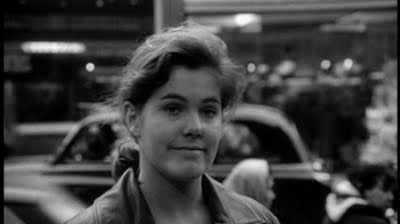
GEORGY GIRL splashed into 1966 on the third wave of the ‘British Invasion’ kicked off by the Fab 4 and 007, a piece of the ‘Swinging London’ subset of ‘bird’ watchers that year that included Alfie and Blow-Up. Boosted by the deceptively cheerful title tune which quickly became a major pop hit, marketed as a breezy comedy, erroneously reviewed as such (it still is, a fresh herd mooing on cue) it caught the zeitgeist and became the year’s 12th most popular picture, right behind that randy “What’s It All About?” bloke Alfie. Margaret Forster, author of the novel “Georgy Girl”, co-wrote the script with playwright Peter Nichols. *
“For God’s sake, Georgy, you don’t expect me to have a meal with you if I can go to a party, do you?”

London, the mid-60’s. Twenty-two years old, bright and outgoing ‘Georgina Parkin’ (Lynn Redgrave, 23) enjoys teaching music to kids but otherwise has no social life. Consistently told by family and friends that she’s unattractive, she adds to the accepted abuse by self-sabotaging her appearance with frumpy clothes and a dowdy hairstyle. Her slim, sex-charged flatmate ‘Meredith’ (Charlotte Rampling, 20) is a modish scamp, whose loopy, casually irresponsible boyfriend ‘Jos’ (Alan Bates, 32) delights in teasing/mocking Georgy. Not enough, Georgy’s father (Bill Owen) berates her, when he’s not slavishly kowtowing as manservant to wealthy ‘James Leamington’ (James Mason, 56) who’s known Georgina since she was a child: his once fatherly attitude has turned uncomfortably suggestive. The circular pressure-cooking situation becomes an even stickier wicket when a pregnancy enters the already strained arrangement.
“It’s hideous! I want it adopted immediately!”

The performances are excellent, the characters mostly deplorable. Boldly for a young actress at the time Redgrave tamped down her ‘look’ (she was pretty, with a dazzling smile’) to inhabit the ‘plain’ Georgy, and she beautifully conveys the hopeful, hapless, battered yet resilient survivor who’s a walking pincushion for the cruelties of others more worldly yet less evolved. Clothes, makeup and performance not enough, the blunt direction and into-the-pores camerawork do their best to make her look bad. She rightfully earned one of the movies four Oscar nominations; as Best Actress she went up against her own sister Vanessa (for Morgan), but no-one was going to walk away with the statue against Elizabeth Taylor’s career-topping frump-harridan ‘Martha’ in Who’s Afraid Of Virginia Woolf? Rampling, with only two bit parts (A Hard Day’s Night, The Knack…and How To Get It) and one minor co-lead (Rotten To The Core) attacks Meredith as akin to a voracious vampire, empty but for bile, her scalds tossed like a pint of acid (not the healing kind). Bates ably does what he was scripted and directed to do but shallow Jos is so insistently annoying you hope he gets squashed by one of London’s double-decked tourist buses. First-billed but with the least screen time of the four principals, Mason’s deft touch with bemused asperity nicked him an Oscar nomination (he didn’t think it deserved) as Supporting Actor. The other Academy Award noms went for Song (groovy!) and Cinematography (gag).
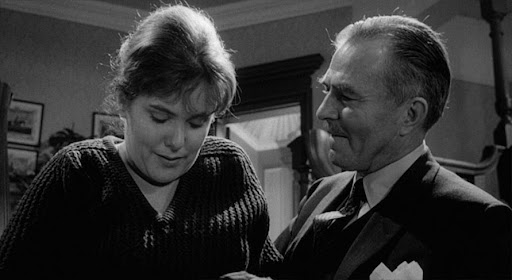
The comedy in this “lighthearted” (??) heart punch is pitched to either deep black or sheer silly; neither fit with the downbeat dramatic elements and off-putting people. As a comment on the pain of loneliness & rejection and/or the callow/shallow times (that never change) it would have resonated better if played as either straight drama or ribald joke, but shuttling between poles requires a keener touch than Girl gets. A year prior, Silvio Narrizano did well directing the thriller Die! Die! My Darling! but here his pace is graceless, and the ‘madcap’ bits are ridiculous. The bleak black & white cinematography done by Kenneth Higgins accentuates the distress and a blaring score from Alexander Faris makes more racket than The Blitz. The actors save it. Done for just $400,000 it caught the vibe and grossed a whopping $19,000,000. Besides the equally pessimistic but more enjoyable Alfie and Blow-Up, Brit-route ’66 was travelled by Morgan, The Family Way (excellent, with a grown-up Hayley Mills) and Fahrenheit 451.

With Claire Kelly (Georgy’s unhelpful mother), Rachel Kempson (Redgrave’s mum, playing Mason’s wife–“She was a beautiful woman…beautiful. Tolerant. Civilized… and about as exciting as a half brick.”) and Denise Coffey (Georgy’s friendly neighbor, an actually nice character who was somehow allowed in,a guppy among barracudas).

* Margaret Forster, 1938-2016, published the 176-page “Georgy Girl”in 1965, the second of her 26 novels. She also wrote nine biographies/histories, and four memoirs. Peter Nichols, 1927-2019, her co-scenarist for Georgy, wrote 19 plays, one of which became the 1970 movie A Day In The Death Of Joe Egg, with Alan Bates and Janet Suzman.
Silvio Narrazino’s subsequent directorial efforts shot downhill on a bobsled: Blue, Loot, Redneck, The Sky Is Falling, The Class Of Miss MacMichael all flatlined. Why Shoot The Teacher? has its fans: don’t look at me.
Lynn: “That was a once-in-a-lifetime giant role for a character actress. I knew there wouldn’t be many of them, that I’d be the supporting clown for the rest of my life if I didn’t get out of that situation.” “I couldn’t have had a better start than with James. From the very first day on the set, he treated me as an equal, never patronizing, but always ready with advice and encouragement if you seemed to need it. They kept pulling the plug on the film because they said that James and I and Alan Bates didn’t add up to much at the box-office, but in the end, we got it made because of James’  enthusiasm for the quirkiness of the story, and the chance it gave him to go back to his Yorkshire accent. He took very little money for it, and we all thought it was just going to be a low-budget release, so when it became such a huge success, it was all the more lovely for those of us who’d always had faith in it.” “Georgy is quite ruthless really. So it is an immoral story, but George was such a survivor that people identified with her.”
Charlotte: “Before Georgy Girl, I’d played zany British girls—fun parts. I played my character in Georgy Girl with verve and style and wit, and I thought she was fabulous, but people thought she was a monster. I was hated after that film, but I realized that these kind of women were much more interesting to play than the little, pretty, soppy ones. Possibly my looks—my face—didn’t really attract those kinds of roles. And it was from then on that I knew I would need to seek out women who really had something to say and not court, in any sense, popularity or love.”
Redgrave and Rampling went forth. The Seekers (1962-2022) drew further and lasting affection with “I’ll Never Find Another You”. Worldwide they sold 50,000,000 records.

 Movies ala Mark
One of my favourites. Such a shame that Lynn never really seemed to reach the career heights of her sister. This is one of her best films. I also love her in Girl With Green Eyes.
Charlotte steals the whole thing in my opinion.