
NORA PRENTISS, noirish ‘tainted love’ melodowner from 1947, didn’t impress self-lofted critics at the time, but it scored well enough at street level to rank 54th for the year, the take of $6,000,000 canceling out the $1,487,000 tab.Though the script drummed up by N. Richard Nash fetches a risk too far, any excuse to watch Ann Sheridan is justified. While advertising pushed the sex-bait angle for Nora, with 32-year-old Sheridan’s studio-established nickname of “Oomph Girl” still roaming at large, her character in this cobweb of deceit isn’t a predatory spider-lady but a victim, one of several, of circumstances and choices spun out of control.
“Dr. Talbot was a fine man, lived in the same house on the same street year after year. Everyone admired him, looked up to him. But something happened. He did something. Something that gave you a hold over him. What was it? What was he hiding? What did he do? What was it?”
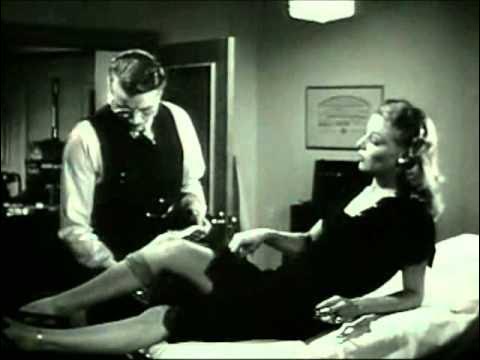
‘Dr. Richard Talbot’ (Kent Smith) is successful and respected in his San Francisco practice, twenty years married, two adoring teenage kids, a house overlooking the Golden Gate Bridge. Straight-laced into dullness, he’s also henpecked into the coop by buzzkill wife ‘Lucy’ (Rosemary DeCamp). When a truck-pedestrian close call has him checking the almost-clobbered ‘Nora Prentiss’ (Sheridan) he finds out she’s more than okay; her frank, close-to-flirty manner ruffles him enough to follow up with an unofficial house call, dropping by to catch her lounge act as a singer in a nightclub. When Lucy and the kids are away for a few days, Richard goes out on the proverbial limb (he’s already had a good look at Nora’s limbs) and he and Miss Prentiss go on a date. One gesture leads to another, just like a pebble can provoke a landslide. Handbasket + ticket = destination.
RICHARD: “I don’t know what’s happened to me…” NORA: “I happened to you, that’s what!”

Smoothly steered toward its fate-ordained destination by director Vincent Sherman, the sleepwalk to disaster coated in the black & white sheen of James Wong Howe’s cinematography, the accumulating tension heightened by Franz Waxman’s full-bodied scoring. Costume designer Travilla, besides coming up with expected snazzy outfits for the leading lady, went gonzo on the boxy hats sported by Sheridan and DeCamp. *
“It would take more than a drink to improve my outlook, but it helps.”
As ever, Sheridan exudes honesty, her relaxed appeal and casual skill helping carry the storyline over implausibilities, even when some conveniently rushed courtroom material near the end gets preposterous. Prentiss isn’t a femme fatale in the standard noir mode, a sly trickster whose surface hotness barely covers a icy spirit, but instead a straight-shooter with talent, loyalty and depth, a real challenge tempting enough to get a compass-cracked guy to blackmail himself.

Smith, 39, was always dependable but he lacked the excitement factor to secure leading man status; this fall-from-grace physician who goes from steadfast and professional to pitiable and then pitiful is his most interesting role and contains his best, most intense performance.
RICHARD: ” I could never prove my innocence. You know that. They’d never believe me. If a man commits one crime, it’s easy to suspect him of another. Besides, I am guilty of killing a man. I killed Richard Talbot.”
111 minutes, with Bruce Bennett, Robert Alda, John Ridgley, Wanda Hendrix, Robert Arthur, Harry Shannon, James Flavin, Douglas Kennedy and Herb Caen. 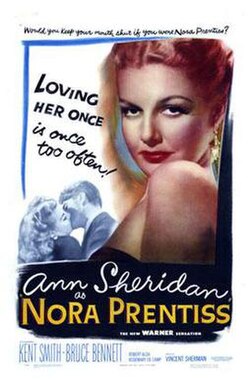 * Lauded costume genie William Travilla (1920-1990) was always billed with just his last name, which shows up in many credit scrolls, mostly for 20th Century Fox, notably several with Marilyn Monroe. Being bemused by the array of skyscraper hats in Nora Prentiss led to finding out a little more about the “look” fathering gentleman. https://sovain-official.com/blogs/journal/william-travilla


 Movies ala Mark