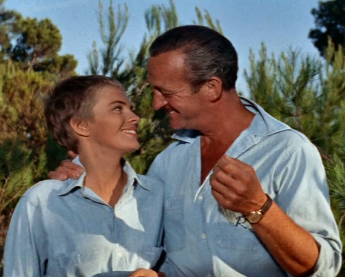
Thanks dad…I mean, Ray-MO…
BONJOUR TRISTESSE, the 1958 movie version of Francoise Sagan’s novel (1954, 160 pages, written when she was 18) was directed & produced for $1,500,000 by Otto Preminger. A success in France, a dud in the States with hissing reviews and a $2,400,000 gross stranding at #94 among 165 feature releases. An arch exercise in chic cynicism, this great-looking yet spoiled cabbage falls into the “so bad it’s good” category, a SPIG best enjoyed with a catty companion so you can share derision invited by the writing and acting. Endured alone, search the CinemaScope frame for retina candy—coastal scenery, vintage cars, Jean Seberg’s bod—to help keep sleep at bay. *

Dancing in a Parisian nightclub with one of her disposable flings, 18-year-old hedonist ‘Cécile’ (Seberg, 19) has her cosseted conscience pricked by “Bonjour Tristesse”(“Hello sadness”), a self-pity ditty chanteused across by sultry Bohemian legend Juliette Greco. As Cécile luxuriates in her despondence, the cinematography of Georges Périnal (Rembrandt, The Four Feathers) flashbacks from black & white to color as the girl/woman/naif/Venus fly trap/heroine? recalls ‘last summer’ on the Riviera. Cécile and her widower/playboy papa ‘Raymond’ (David Niven, 47) idyll away their self-centered bonhomie at a swank house above the sea in St. Tropez. Raymond has his current plaything in cheerfully vacuous ‘Elsa’ (Mylène Demongeot, 22) and Cécile explores amour with ‘Philippe’ (Geoffrey Horne), a somewhat more serious law student. Then ‘Anne Larsen’ (Deborah Kerr, 36) arrives at the villa (in her gleaming white 1955 Sunbeam Alpine Roadster convertible) and the comfy cavorting spree conspiratorially shared by father and daughter turns into the cul de sac of consequences. Raymond gets ‘serious’ about Anne, and Anne puts a kibosh on Cécile’s dalliances. Something or someone has to go. Enter a cliff, stage left.
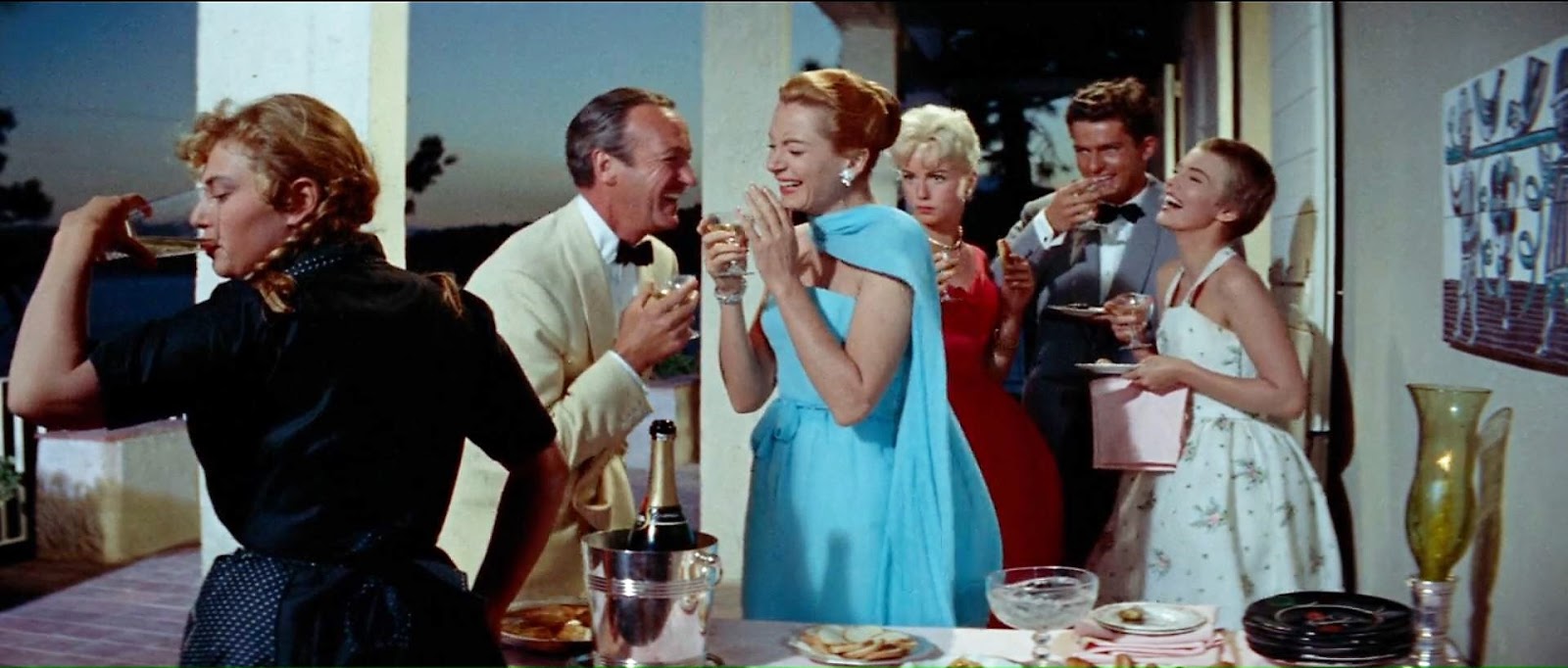
Single smartest bit, with the maid taking advantage of the blithering to quaff champagne she could never afford on her own
Not one to shy from controversial subjects, Preminger could bullseye targets (Whirlpool, Anatomy Of A Murder, In Harm’s Way) or miss by kilometers (River Of No Return, The Court Martial Of Billy Mitchell, Skidoo) with a lot of stops in between. Apart from the can’t-lose atmospheric milieu of sun-kissed settings this one is as forced as a press conference. He was his usual ogre on the set, tormenting his ‘find’ Seberg mercilessly, and succeeding only in getting a less-real performance than that he’d browbeaten out of her raw inexperience as Saint Joan. Maybe dubbed in French, it was a different story: Francois Truffaut described Seberg as “the best actress in Europe”. Oui, sure, and which country enshrined Jerry Lewis as a genius? She’s camera-catnip without doubt, and has stray moments when her facial expressions register, but her line readings are mostly terrible. Demongeot is exuberant, but her awkwardness with English merely highlights how un-French everyone else is. Horne, 24, whose supporting gig in The Bridge On The River Kwai landed him this, isn’t any better: Preminger lacked David Lean’s touch, let alone patience, earnest Horne is about as comfortable with dialogue as Troy Donahue.

Even the pros are stranded. Niven was basking in the glow of Around The World In 80 Days and Kerr was fresh off a two-fer, the winning Heaven Knows, Mr. Allison and very popular An Affair To Remember. They’re better than the kids, of course, but even they can do little against the cross-Atlantic headwind of Arthur Laurent’s script, chatter alternately ‘deep’ (i.e. vague) or so artificial you wonder if he’d ever heard people actually talk. Not helping anyone is that post-dubbing is obvious. Add a ‘wild’ seaside party that screams “staged!”
The actors are attractive, ditto the scenery. It’s well scored by Georges Auric, and the neat titles marked another plus for innovator Saul Bass. With Walter Chiari, Martita Hunt (she’s good, as ever), Roland Culver, David Oxley, Eveline Eyfel and Tutte Lemkow. 94 minutes.

* Sagan’s novel, her first of twenty, was what is typically described as “a sensation”. France was rocked, it was banned by the Vatican (surprises never end) and upon reaching the States (trimmed of some heat) went to #1 on the NY Times Bestseller List. The USSR used it as anti-West propaganda and being caught with it in South Africa could land you in prison. Sex, bad. Her second novel, “A Certain Smile”, was also filmed in ’58. It did better box office (61st) nicked a trio of Oscar nominations and a hit tune for Johnny Mathis. Sagan was not fond of that picture, and understandably; beyond scenic values it’s so resoundingly bland it makes Bonjour Tristesse seem like Raiders Of The Lost Ark.
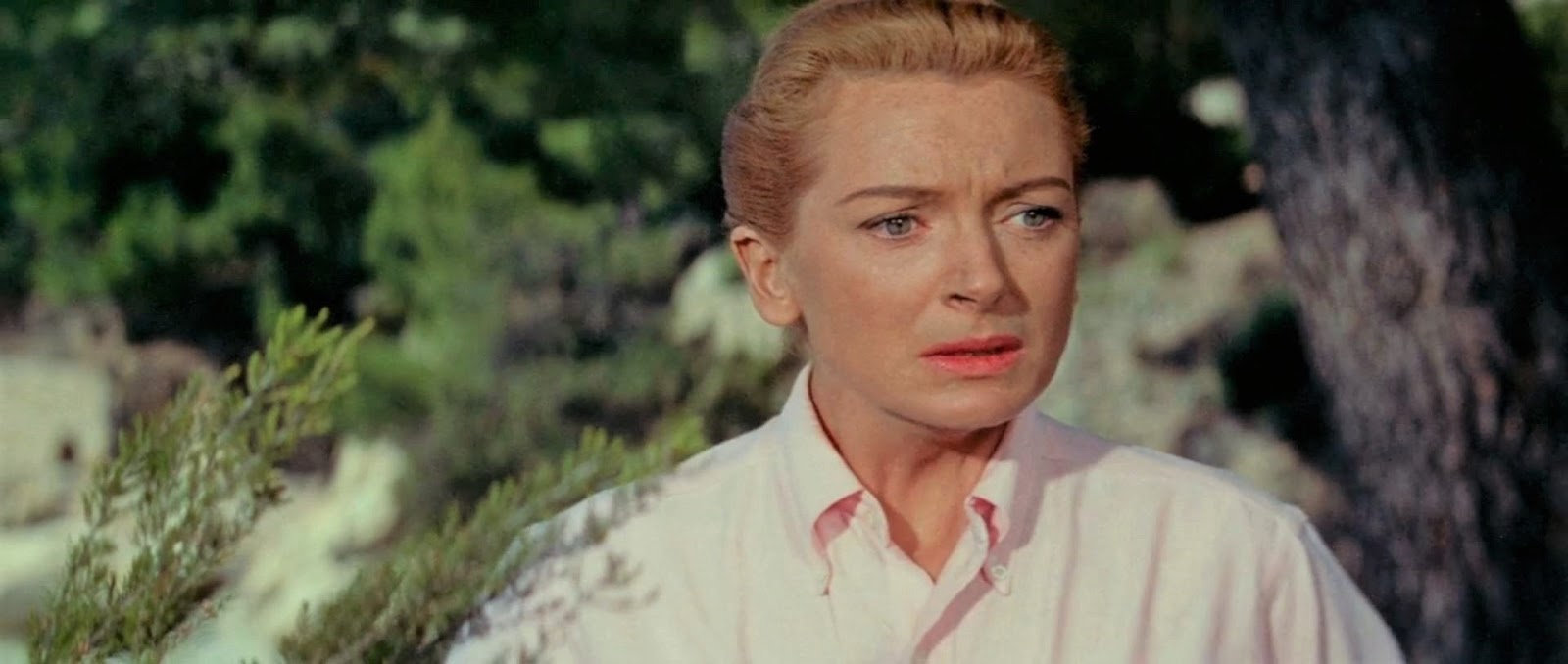 Demongeot, on Niven: “He was like a lord, he was part of those great actors who were extraordinary like Dirk Bogarde, individuals with lots of class, elegance and humour. I only saw David get angry once. Preminger had discharged him for the day but eventually asked to get him. I said, sir, you had discharged him, he left for Deauville to gamble at the casino. So we rented a helicopter so they immediately went and grabbed him. Two hours later, he was back, full of rage. There I saw David lose his British phlegm, his politeness and class. It was royal!”
 1958 gifted Niven and Kerr with Separate Tables ; he won an Oscar playing another self-deceiver, she drew a nomination, her third of six. Seberg survived the basting of her acting and the brutality of Preminger, rebounding in 1960 with Truffaut’s Breathless. Otto the Terrible recovered with Anatomy Of A Murder. Bonjour Tristesse was remade in 2024.
And no, je dois avoue, camarades, this rustre américain de banlieue hasn’t read “Bonjour Tristesse”, and the often excruciating movie version didn’t goad me to do so. That’s not due to harboring some particular prejudice toward author, subject and certainly not the setting, but given the rapidly diminishing minutes one has left we’d rather see St.Tropez (from a bus since I couldn’t afford to stay overnight—let alone ‘summer’—there) than ‘experience’ it thru the musings of a teenage hedonist from another age. So I’m shallow. But honest. Mme. Sagan had a knack for writing about phonies—living among them a cruel advantage—and one thing is a certain smile: they’re as prevalent as mosquitoes and about as welcome. C’est la vie.
 For the petit bourgeois heck of it, we checked St. Tropez rates. For one night in a one-star (€15 croissant not included) you could do a safari in Botswana. And not feel like killing yourself afterwards.
As long as we’re being mean (like the characters in the movie, so all’s fair) let’s selfishly toss in a personal peeve that rankled moi throughout watching Bonjour Tristesse. Cécile has a maddening habit of constantly referring to her father by his first name (add Seberg’s mangle of ‘Ray-MO’), a coy affectation that drives me, if not up a wall, then in blind self-defense toward the nearest bottle of Absinthe. Once upon a mattress M ala M had a, well, let’s be gallant and call it a brief, ill-considered ‘thing’, with a lady who indulged in that name-droppy pretend-you’re worldly bullshite about everyone she knew, or ever had (“Oh, and then Eugene & Stefanie came by after Lawrence and Ted called and…”) —not caring a iota that you didn’t have the faintest clue who the hell any of these people were or how they related to whatever the errant subject at hand was in the first place. Yeesh…


 Movies ala Mark