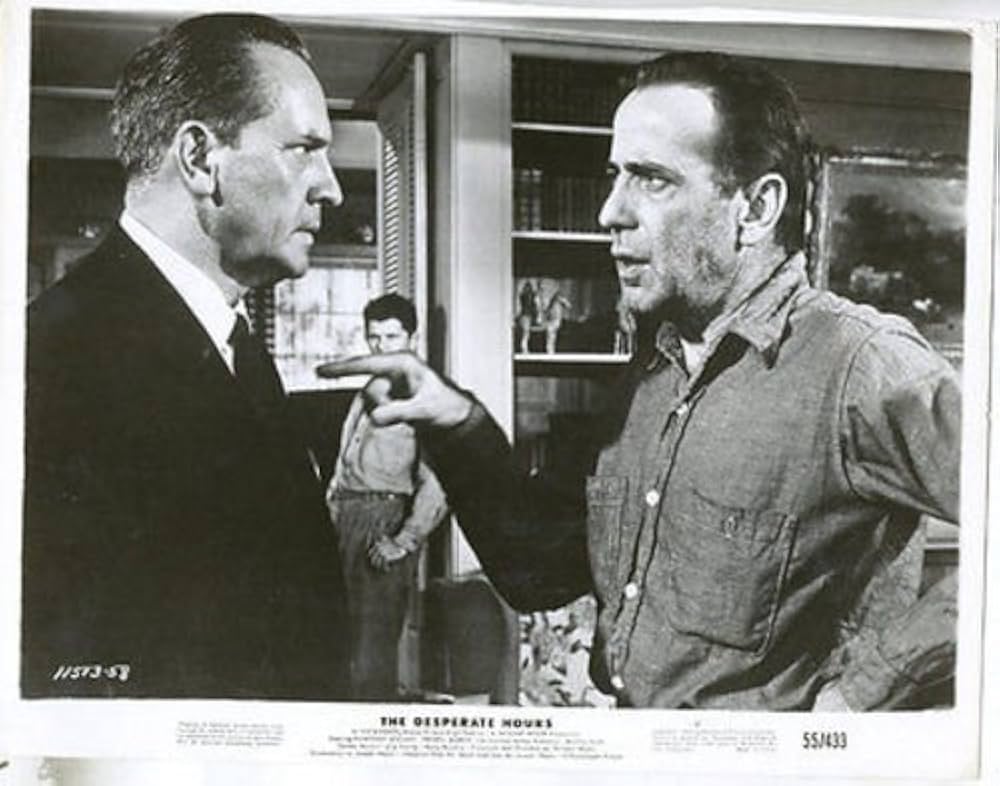
THE DESPERATE HOURS runs eight minutes shy of two, in a star-powered 1955 nail-biter directed & produced by William Wyler, one of the early examples of what is now (regrettably) a crime sub-genre, the home invasion drama. The year before the territory was visited in Suddenly, a good lower-profile thriller marked by a taut performance from Frank Sinatra. That one was centered around political assassins; here the imperiled family plot dealt with escaped convicts with no motive past fleeing a cell or ‘the chair’.
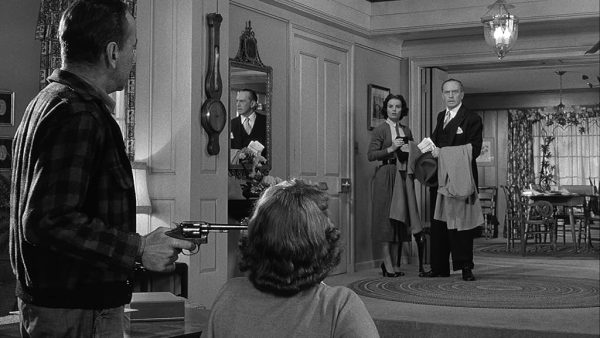
In a well-to-do Indianapolis suburb, the ‘Hilliard’ family are held hostage in their home by a trio of hardened convicts who broke out of prison and have seized the house to use as a hideout while the leader waits for his moll to show up with some cash. The state and local police have deduced that the hoods are somewhere in the area but exactly where and how to catch them are unclear and debatable. What’s certain is that the men are dangerous beyond any doubt.
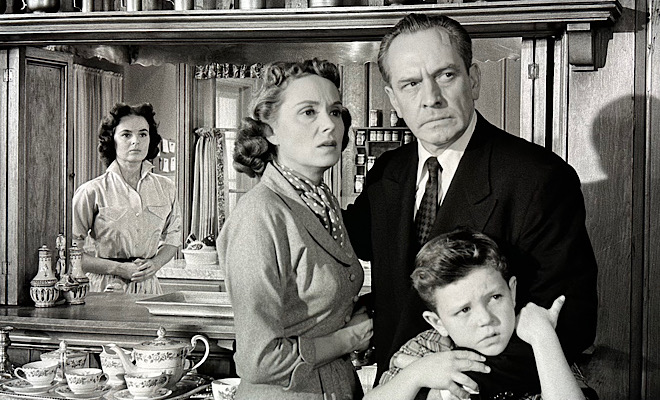
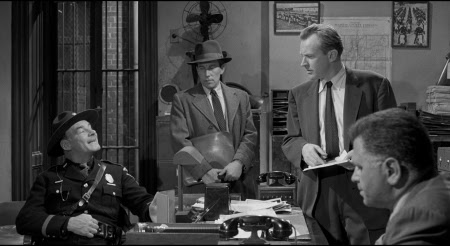
The thugs: vicious career felon ‘Glenn Griffin’ (Humphrey Bogart), his younger brother ‘Hal’ (Dewey Martin) and brutal oaf ‘Sam Kobish’ (Robert Middleton). The family: father ‘Dan’ (Fredric March), wife ‘Ellie’ (Martha Scott), teenage daughter ‘Cindy’ (Mary Murphy) and young boy ‘Ralphie’ (Richard Eyer). Leading the lawmen is ‘Deputy Sheriff Jesse Bard’ (Arthur Kennedy). While the authorities scramble and quarrel, a battle of wits wages in the hijacked residence. The Hilliards are cornered but resourceful, the criminals armed and remorseless.
Gripping from start to finish, with excellent work from everyone in the cast (Wyler once again drawing the best from his actors), sharply lensed by cinematographer Lee Garmes (Nightmare Alley) in appropriately grim black & white.
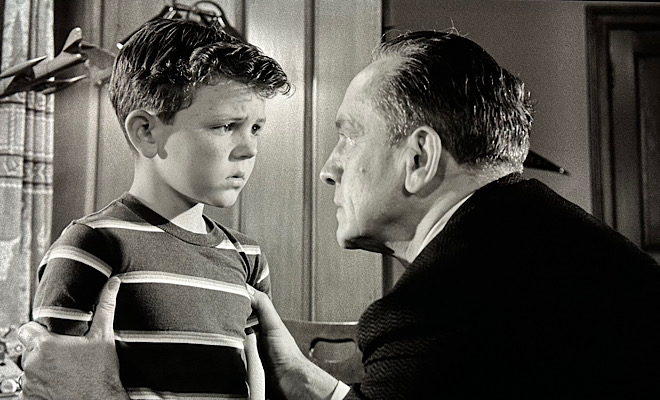
In his next to last film, Bogart, 54, revisits his villain days of the 1930’s and shows that he may have noticeably aged but had lost none of his forcefulness; the shrewd, calculating and utterly ruthless Glenn Griffin is one of his most memorable and believable bad men. The stalwart sincerity of March, 57, gives him his most formidable opponent since Edward G. Robinson in Key Largo (or maybe Katherine Hepburn in The African Queen). Robert Middleton’s gross, childishly mean cohort heightens the threat level: I recall seeing this as a child on TV and being creeped out by him. Richard Eyer, 9, once again proves that he was maybe the most intuitive child actor of the decade. Lead cop Kennedy is flanked by ever-ready minutemen Whit Bissell, Ray Teal, Ray Collins and Bert Freed.
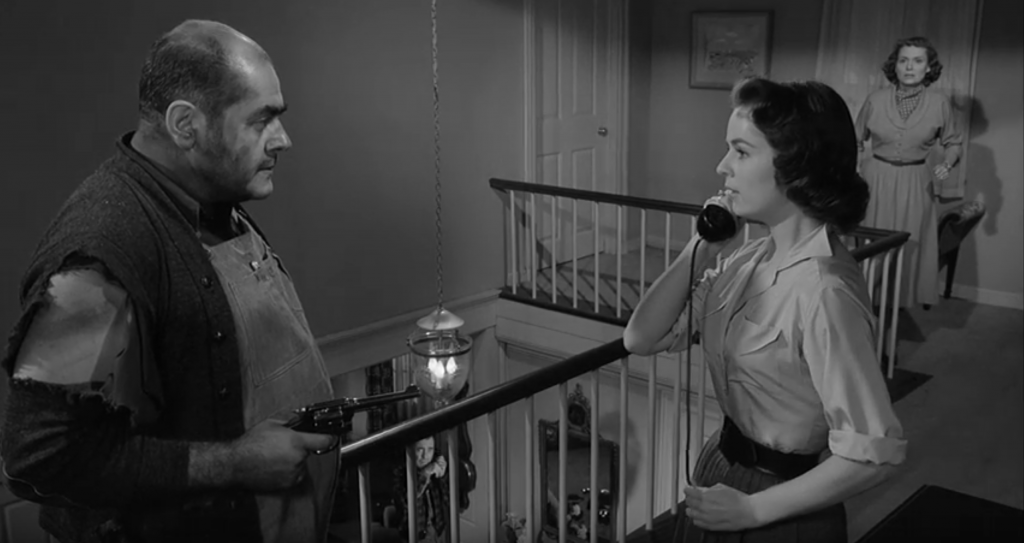
Joseph Hayes wrote the screenplay based on his own novel and play. The production budget is reported as $2,388,000. Earnings of $7,100,000 secured spot #41 at the box office. Cine-crooks were extra nasty that year, witness Bad Day At Black Rock, Violent Saturday, The Phenix City Story, Kiss Me Deadly, and in the juvie-punk ranks Blackboard Jungle.
With Gig Young (as Murphy’s puzzled boyfriend), Walter Baldwin, Alan Reed, Beverly Garland, Burt Mustin, Joe Flynn, Ann Doran, Don Haggerty, Helen Kleeb and Simon Oakland (feature debut). 112 minutes.
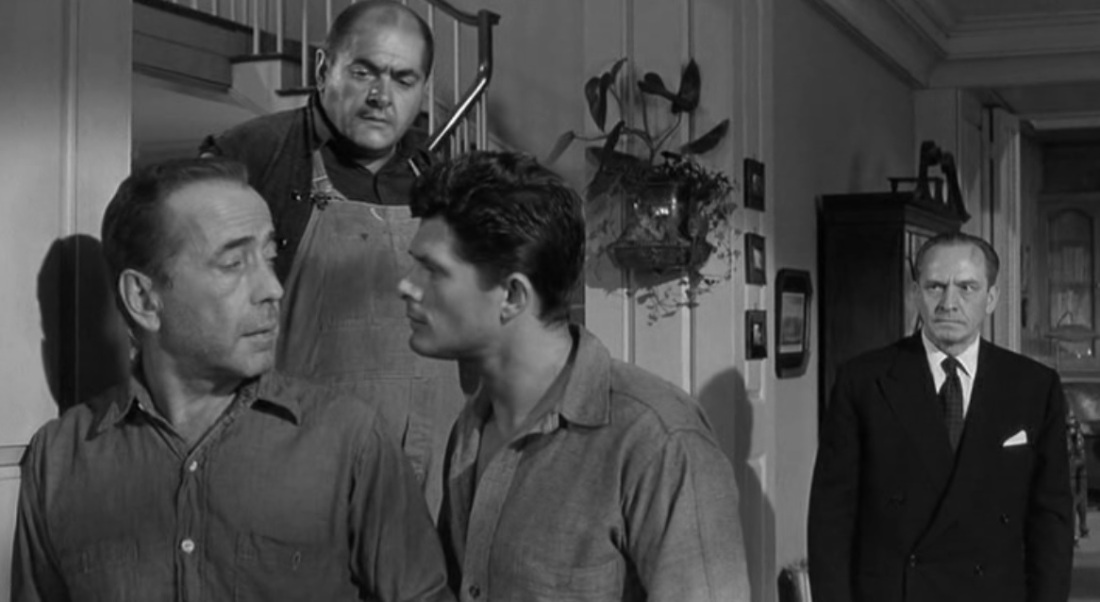
* Choices—‘brothers’ Bogart and Martin had a 23 year age difference, and Gig Young was 17 years older than ‘girlfriend’ Mary Murphy. Though this was a better movie, Bogart’s other pictures that year drew larger audiences, the middling adventure The Left Hand Of God, and the comedy We’re No Angels, where he and escaped convict pals Aldo Ray and Peter Ustinov also ‘invaded’ a family setting, but it was played strictly for laughs. Wyler was impressed enough by little Richard Eyer and burly Robert Middleton that he cast them in his next production, the winner Friendly Persuasion. In that excellent Civil War drama Middleton got to play a nice fellow for a change. Oh, that Hilliard house looks familiar–it was later used on Leave It To Beaver.

 Movies ala Mark