
FLAP flailed in 1970, thumped by reviewers, crushed at the box office. Revolt was in the air on many fronts, not least over the plight of the descendants of America’s original settlers. The AIM (American Indian Movement) activism took to the streets to stir mainstream consciousness. Protest occupations of Alcatraz Island (19 months) and Mt. Rushmore (two months) were joined by a spit-take Thanksgiving ‘seizure’ of Plymouth Rock and a replica of the Mayflower. Easily riding a trend, movies took up the war cry with large-scale revisionist westerns: the satiric Little Big Man, unnerving A Man Called Horse and wretched Soldier Blue. Loping after those genre epics like a ragged rez dog was a boisterous saga of home front resistance starring Anthony Quinn as booze-blooded Army vet ‘Flapping Eagle’, guided by esteemed British director Carol Reed. Yes, contemporary reservation life in the USA—done as a comedy. What could go wrong?

The US Southwest, an Indian (non-specific tribe) reservation. Flap and his cronies break from drinking, brawling and plying the local bordello to make a quixotic stand against a highway being carved thru tribal territory. Flap & friends resistance includes wrecking a bulldozer, crashing a helicopter, fighting with a brutal local cop and eventually marching on the nearby city to reclaim it. Pride & principal meet power & politics, sticking it to The Man years before casinos counted coups in cash.
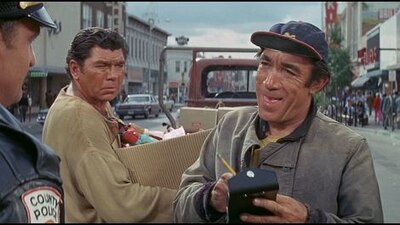
Clair Huffaker (Flaming Star, The Comancheros, Rio Conchos) wrote the script, adapting his 222-page novel “Nobody Loves a Drunken Indian”, a title not destined for marquees. For some reason Carol Reed, venerated for Odd Man Out and The Third Man, chose to follow his hit musical Oliver! (Brit urchins in London slums of the 1830’s) with a rattletrap comedy in a place and about situations where the setting was current and the conditions less than humorous. Ignoring the critical and commercial fate, let alone the cringing crassness, of 1968’s Stay Away, Joe (a low point for Elvis and everyone involved) the production forged ahead, gulping huge drafts of Warner Brothers money—one source cites the budget at $10,000,000, another $14,000,000—queuing a Darling Lili-sized quicksand trap when the receipts trickle stopped at $1,800,000 on spot #112 for the year.

Timely meets Tone Deaf. Quinn, 54, in the midst of a long string of duds (including more that same year, R.P.M. and A Walk In The Spring Rain) brings his lusty man-of-the-Earth style to Flap, but by this point he was running earthiness into the ground. His latter-day braves are skin-toned across by Claude Akins (at least he was part Cherokee), Tony Bill (atrocious), Victor Jory (game) and Rodolfo Acosta (good even in a lousy part), their capering witless until the low-bar humor takes a right turn into serious at the end with what amounts to Flap’s Last Stand. A subplot with the hookers tosses in Shelley Winters at her most nails-to-blackboard level.
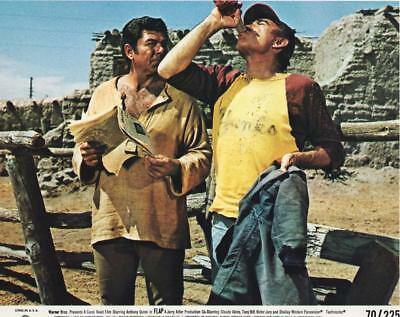
The score from Marvin Hamlisch doesn’t help, but the movie is well photographed by Fred J. Koenekamp (Patton, Papillon, Islands In The Stream) at New Mexican locations in Santa Fe, Albuquerque, Madrid, Puye Cliffs (Santa Clara Pueblo) Santo Domingo Pueblo and Acoma Pueblo.
One good line: “Are you questioning the honor… of the United States government?” 106 minutes, with Don Collier, Victor French (vindictive cop), Anthony Caruso, Susana Miranda, William Mims, Rudy Diaz, Nadia Sanders, Alan Carney, Robert Foulk.

 Movies ala Mark