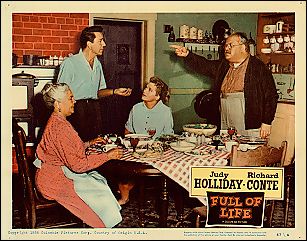
FULL OF LIFE, a 1956 domestic comedy/light drama directed by on-the-rise Richard Quine, was written by John Fante, who adapted his 161-page novel to fit into 91 minutes of screen time. He and Quine had to make some adjustments to appease the Production Code, because the storyline revolves around the topic of—hold the reality-offended breath—pregnancy. How did they think movie audiences were germinated? Beyond the ‘troublesome’ subject (which, if you think for perhaps two whole seconds, relates in one way or another to pretty much everyone on Earth) the naturalistic little item birthed another showcase for the warm Judy Holliday, gave Richard Conte a break from playing hoods and introduced Italian operatic bass and buffo star Salvatore Baccaloni in his first American film. *

Science researcher ‘Emily Rocco’ (Holliday) and husband ‘Nick’ (Conte), a struggling writer, are expecting their first baby. The L.A. based couple add sudden home repair problems to their concerns when part of their kitchen floor collapses. Nick’s father ‘Victorio’ (Baccaloni) is a brickmason; they visit the in-laws (Italian immigrants who live in Sacramento) to ask ‘Papa’ for help, though it galls Nick to do so because of his old man’s irritating attitudes and behaviors. But Emily and Papa hit it off and the wine-fond nonno-to-be comes back with them to Los Angeles to fix the hole in the floor. His ‘help’ includes pushing his religious ideals (he’s an ardent Catholic) on the non-practicing couple—she’s agnostic, Nick is lapsed—adding to the “who-wears-the-pants?” friction between father and son. Meanwhile, the due date for a bambino/bambina steadily approaches. Emily deals with the constant discomfort, outmaneuvered Nick tries to write and bullish Victorio practically takes over. Enter ‘Father Gondolfo’ (Joe de Santis), the local priest.
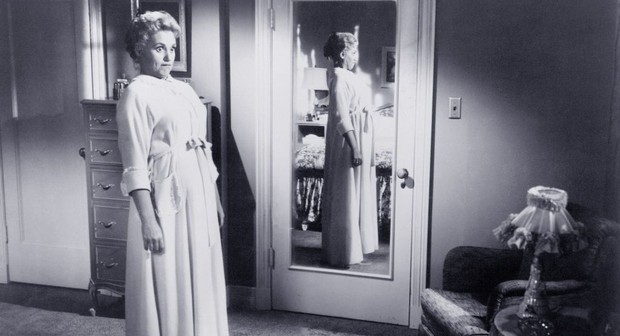
Author/screenwriter Fante based the Papa character on his own father. The ethnic comic appeal of Baccaloni and the ‘charm’ of the abrasive character might factor into enjoyment quotient, and while Conte is okay he isn’t the best fit for light domestic humor. Wisely, the script and direction go for smiles rather than laughs, and Holliday’s sweet brightness holds it together, plus Emily is brainy rather than ditzy. This neglected production is the least seen of her eight films, and it’s not a star-centered vehicle; she and the two men get equal amounts of play. Though the religion angle is present, it isn’t pushed as a fix-all to the audience but instead comes off as matter-of-fact given the background of the elder Rocco—and 20% of the population. What was definitely unusual for the day was in the presentation of pregnancy in a much more honest fashion. That’s a no-brainer today, but movies of mid-50’s would more readily acknowledge labor strikes than labor pains. Were both more sly Commie plots? Desegregation, clean water, seat belts—and now we have to ditch the stork? What’s next, a Catholic for President?
George Duning composed the nurturing music score. With Esther Minciotti (Mama Rocco, fond of fainting over Papa’s blusters and benders), Silvio Minciotti, Eleanor Audley, Amanda Randolph (the maid), Richard Bull, Jester Hairston and Betsy Jones-Moreland. The $3,700,000 take took spot #91 in 1956.
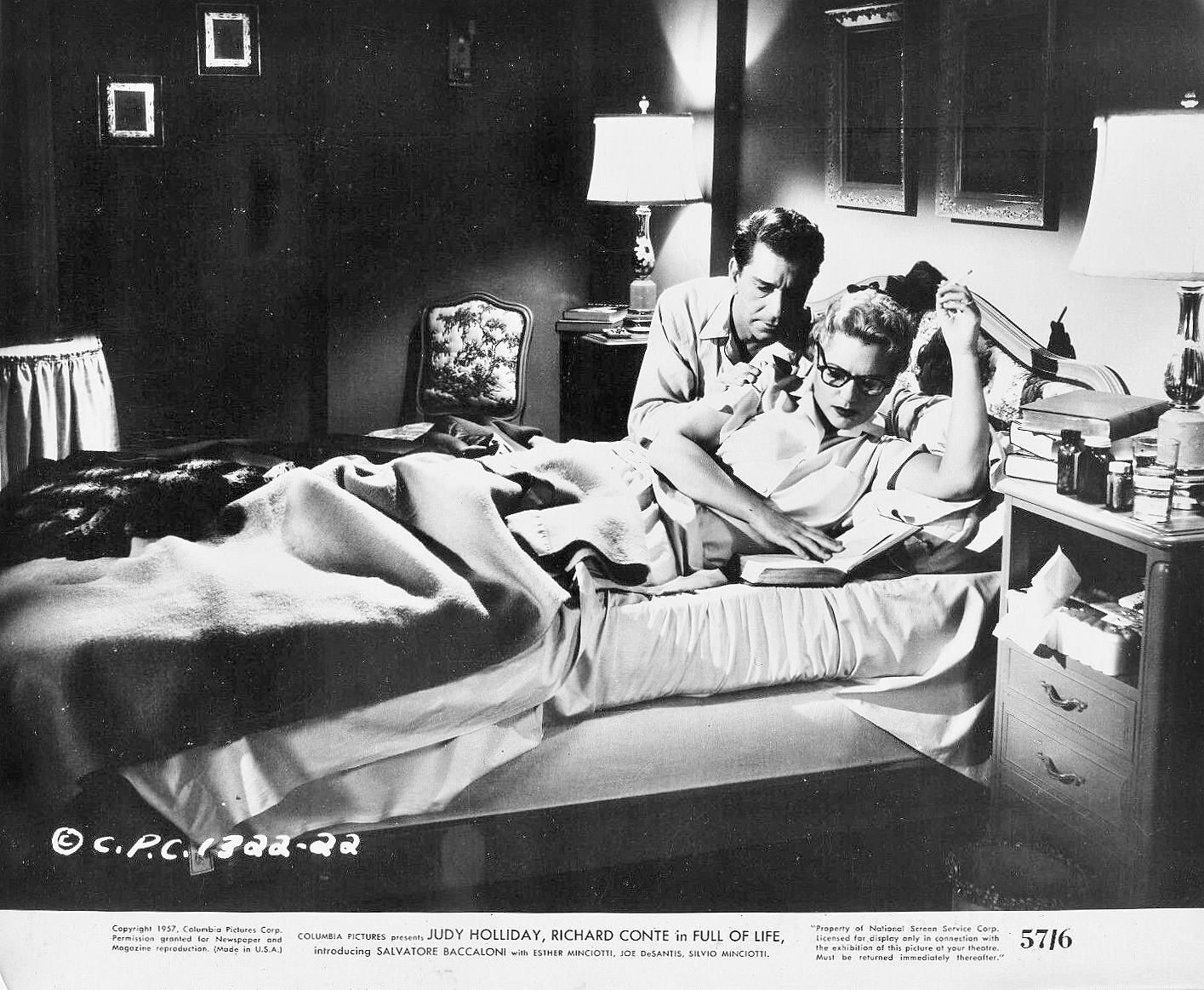
* Holliday and director Quine scored a bigger win that year with The Solid Gold Cadillac. This was Conte’s only role in ’56, after grinding out seven in 1955. Baccaloni made four more American movies, including the 1961 hit Fanny. As for the morality gargoyles at the Production Code, their nattering on the script was that “It plunges into the details of pregnancy with very little discretion and little exercise of good taste”, furthermore hissing the “seemingly innocuous title becomes unbelievably vulgar in its connection with the story. It refers to the huge stomach which the girl has in the latter stages of pregnancy, which the husband flippantly calls, ‘her white balloon.'” Gracious me, all this pearl-clutching, smack dab in the midst of the Baby Boom-booming.
 Movies ala Mark