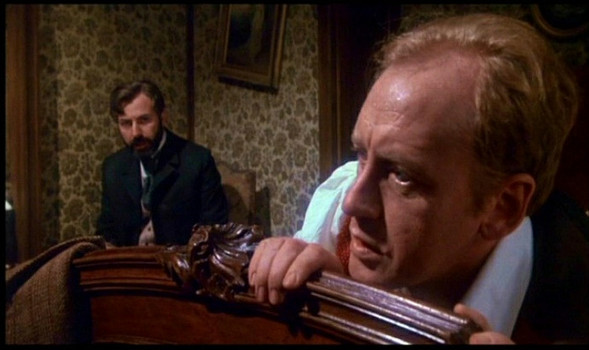
THE SEVEN-PER-CENT SOLUTION was directed by Herbert Ross, on a run of eight hits in a row, with Nicholas Meyer basing the screenplay on his own bestselling novel. The $5,000,000 production did okay at the box office, drew Oscar nominations for Screenplay and Costume Design and earned applause from critics. A revisionist take on Sherlock Holmes from 1976, it was filmed in England and Austria. *

London, 1891. ‘Dr. John Watson’ seeks help for his friend and associate ‘Sherlock Holmes’, whose drug habits (cocaine) have turned him delusional, and likely to hurt himself or others. After being approached by perturbed mathematics professor ‘James Moriarty’, harassed by Holmes as some sort of master criminal, Watson spirits Sherlock off to Vienna and the care of Dr. Sigmund Freud. Freud’s novel approach to treating psychological trauma might bring Holmes back to reality. In the midst of the cure, the recovering sleuth and his loyal aide investigate a kidnapping with far-ranging implications. Freud tags along to keep Holmes steady and assist in the time-sensitive and likely dangerous deduction mission and damsel rescue.
Dear Europe: Is re-armament really the best way to go?
The script takes Holmes ‘habits’ from the novel and extrapolates into logical progression, the idea of destructive addiction at least as relatable to contemporary society (the 1970’s and beyond) as is modern casual substance experimentation for pleasure. Like many another, the movie has strengths and weaknesses.

Dr. no, thanks
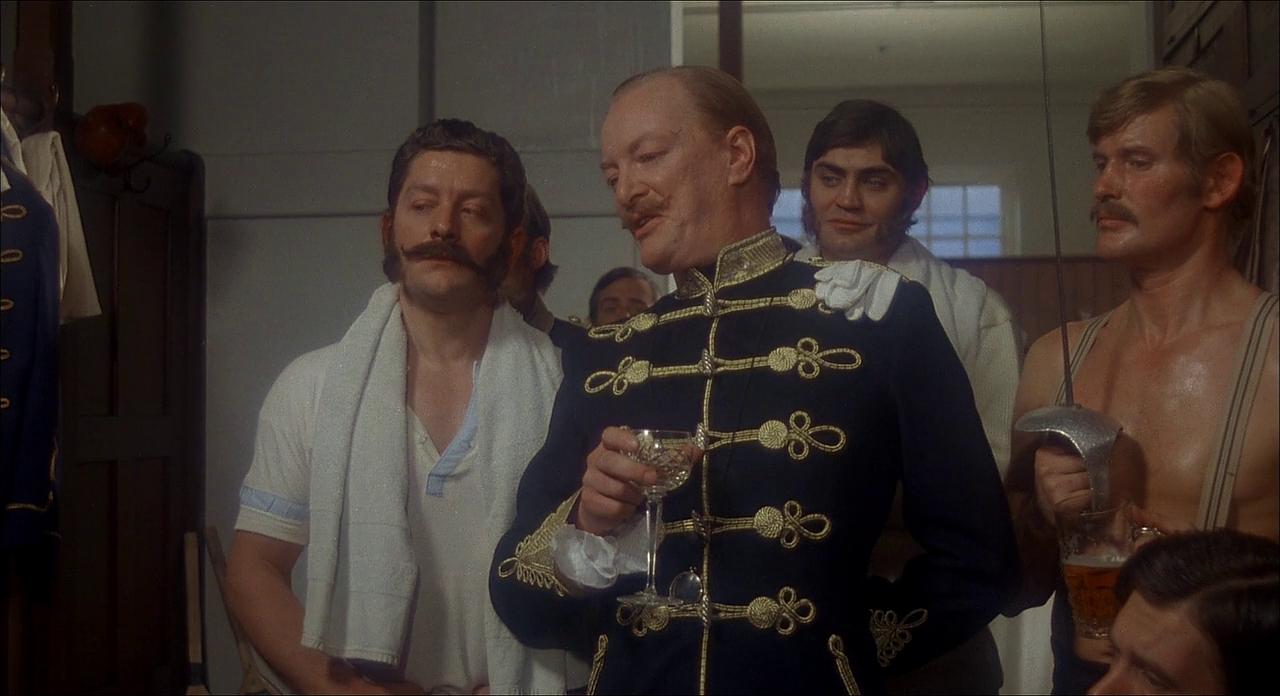
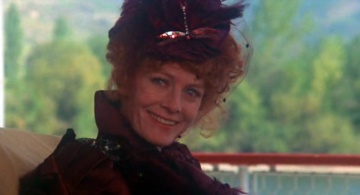
The chief attributes are found in two of the three lead performances, one key supporting actress and in Meyer’s keen writing. Holmes is played by Nicol Williamson, burning with his customary full-metal energy. Alan Arkin does a splendid job as Freud, equally intense but wisely in a low key, with no cutesy comic touches ala a ‘Viennese doctor’ accent. In a secondary part as ‘Lola Devereaux’, a traumatized kidnap victim with her own—forced—drug misery, Vanessa Redgrave and her uniquely penetrating eyes bring needed poignancy into the swirl of verbal gymnastics and theorizing. Color in smaller roles comes from Laurence Olivier (as a deceptively meek Moriarty) and Jeremy Kemp as the pompous ‘Baron Karl von Leinsdorf ‘, one of those lineage-spawned popinjay dastards in dire need of a good skewering. John Addison provides a lively music score.
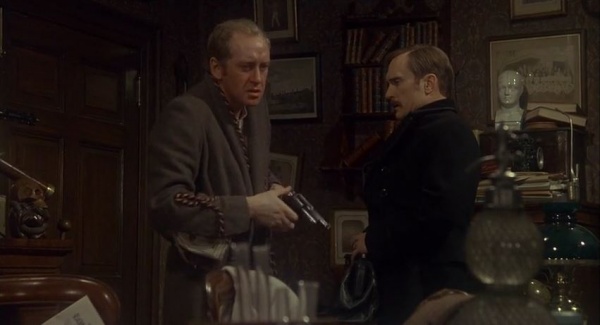
While the salute-worthy ingredients win out, greater success is mitigated by definite marks in the debit roll. Robert Duvall as Watson is a miscasting blunder; his go at a Brit-inflected accent forced and never convincing; every time he speaks you’re reminded “Hey, it’s Robert Duvall pretending to be English”. As Watson’s wife, the consistently underutilized Samantha Eggar is wasted in a few add-a-star moments. The detox segment (are those ever entertaining?) is drawn out too long and, apart from some absurdly risky stunts, the silly train journey action wrapup is a wash. Ross’s wavering direction can’t decide whether this is all to be taken seriously or meant as a half-spoof, and beyond the costuming, little sense of the period comes across, even with extensive location filming.

Box office in North America was $11,800,000, 56th in ’76. 113 minutes, with Charles Gray (as ‘Mycroft Holmes’), Joel Grey (as a weasel), Régine (as a madam), Jill Townsend and Georgia Brown.

* Nicholas Meyer, who turned to directing in 1979 with Time After Time, followed his bestseller with four more Holmes novels, widely spaced over 45 years; none yet made into films.
 Movies ala Mark