
STARDUST MEMORIES is the Woody Allen movie with the rep/rap as the one with the dynamite opener that then fizzles out into a damp cloud of repetitive indulgence. Critics sniped and audience patience snapped over his 1980 offering; ranked 70th at the year’s box office, it was his first money loser—$10,389,000 grossed after a $10,000,000 cost—and the first one that almost aggressively challenged his fan base and aroused notable hostility from reviewers. Revisited decades down the analyst’s couch it fares a mite better—that opening is still a classic—when/if you accept the prodigious auteur’s explanation that he wasn’t courting pity (‘woe is me and my celebrity’) but homage (to Fellini’s 8½), and the fictional character he played—a comedy film director—was not him.

SANDY: “I don’t want to make funny movies any more. They can’t force me to. I…you know, I don’t feel funny. I look around the world and all I see is human suffering.” MANAGER: “Human suffering doesn’t sell tickets in Kansas City.”
Lauded moviemaker ‘Sandy Bates’ (Allen, 44) has won success and admiration for his comedies, but he yearns to branch out and do serious dramatic work as well. Battling studio execs, the relentless press, fawning critics and omnipresent fan fervor, Sandy reflects on his life, his loves and his work.
GIRL IN AUDIENCE: “I understand you studied philosophy at school.” SANDY: “Uh, no, that’s not true. I-I-I did take – I took one course in existential philosophy at, uh, at New York University, and on, uh, on the final… they gave me ten questions, and, uh, I couldn’t answer a single one of ’em. You know? I left ’em all blank… I got a hundred.”
Ah, the kickoff: sitting in a train car filled with grotesque losers, Allen’s character observes a car on the opposite track, headed the other direction, filled with great-looking, wildly happy people. One of the blessed crowd is emblematic catch-or-perish beauty Sharon Stone, 21 in her debut. Life,unfair, satisfaction, elusive, it’s a tragicomic masterpiece in miniature. There are funny lines scattered around the rest of the script, but Allen’s insistence of way too many instances of obnoxious people in close-up hectoring mode brings up fewer smiles and increasing revulsion as Sandy careens thru meetings and imaginings. The black & white camerawork that did the trick in Manhattan just makes everything in this one look glaring and intrusive. The theme—I have too much and yet I have too little—is weight enough without 89 minutes of jabbing the point with excessive visual assault and ceaseless racket. A lack of sympathetic characters hurts as well.
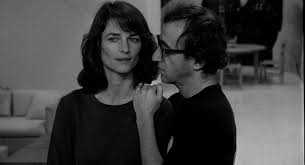
On the receiving end or firing line: Charlotte Rampling (looking as unhappy as a refugee), Jessica Harper (mousy mewling), Marie-Christine Barrault (the best, nearest reality performance), Tony Roberts, Anne De Salvo, Amy Wright, Daniel Stern, Laraine Newman, Louise Lassser, John Rothman, Leonardo Cimino, Brent Spiner (30, feature debut), Cynthia Gibb (16, debut), David Lipman, Candy Loving, Judith Crist.
 Movies ala Mark