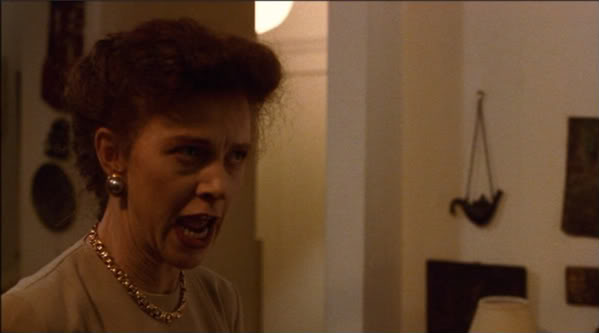
HUSBANDS AND WIVES, searing comedy-drama from 1992, was Woody Allen’s 23rd feature film as a director, 25th as a writer, 23rd as an actor. It was also the last of thirteen that co-starred his partner Mia Farrow; their decade long relationship dissolved in public acrimony before this was released.
“See, I will always have this penchant for what I call kamikaze women. I call them kamikazes because they, you know they crash their plane, they’re self-destructive. But they crash into you, and you die along with them.”
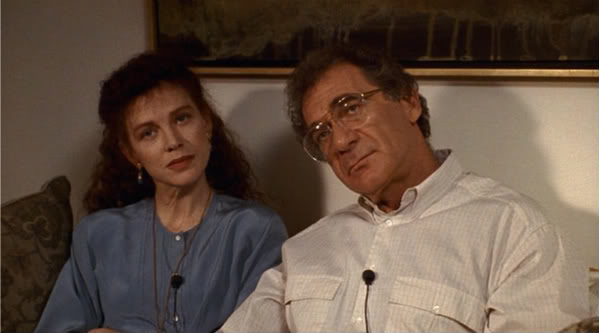
Jack & Sally. Gabe & Judy. Jack & Samantha. Sally & Michael. Gabe & Rain. Michael & Judy. Gabe. When ‘Jack and Sally Simmons’ (Sydney Pollack and Judy Davis) go the civilized grown-up route and in person tell longtime close friends ‘Gabe and Judy Ross’ (Allen and Farrow) that they’re separating, the partnership ball starts a wobbling roll toward tenpins in several lanes. High-strung Sally loses whatever cool she possesses when Jack goes dallying with ‘Sam’, a younger knockout (stunner Lysette Anthony, 28) who’s an aerobics instructor and astrology spouter. Judy introduces wounded, skittish Sally to ‘Michael’ (Liam Neeson, 39, about to break big), her shy, single and eligible co-worker. Against his better judgement college writing professor Gabe is drawn into something that flashes ROCKS, DEAD AHEAD! with young student ‘Rain’ (Juliette Lewis, 18, hitting stride), who hops with rabbit rapidity from one fixation to another . Then tables (astrological?) turn again. For the better, or just the more comfortable?

GABE: “Boy, I’d hate to be your boyfriend! He must go through hell.” RAIN: “Well, I’m worth it.”
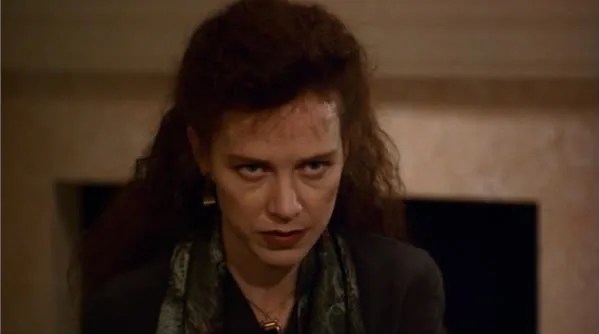
“What happened after the honeymoon? Did desire grow or did familiarity make partners want other lovers? Was the notion of ever-deepening romance a myth along with simultaneous orgasm? The only time Rifkin and his wife experienced one was when they were granted their divorce.”

Oscar nominations came for Screenplay (Allen’s 10th of an extraordinary, unmatched sixteen nominations, with three wins) and Davis as Supporting Actress. She lost to Marisa Tomei for My Cousin Vinny. Made for $20,000,000, it died at the box office with a North American gross of just $10,600,000, 96th place in 1992, ranking 26th among Allen’s brood, at about the halfway point. Critics rank it as one of his best: we agree. **
108 minutes, with Benno Schmidt (good moments as Judy’s hapless ex), Ron Rifkin, Timothy Jerome (sympathetic as Sally’s crossfire-caught date), Blythe Danner (barely used, like Claire Bloom in Crimes And Misdemeanors), Cristi Conaway, Bruce Jay Freedman.

* Davis: “I think it’s a great film. Except for the bits I’m in. I was slightly over the top. There’s that golden rule that you don’t want to see the acting. And I thought I could. The director just let me go. We can’t blame Woody Allen for that one.” Nope, take a bow, Judy, you were marvelous. She lost out on the Oscar to newcomer and surprise winner Marisa Tomei for My Cousin Vinny. Years of morons have gotten their keyboardgasms raking Marisa over the coals. We won’t join that pissyfit pile on: she’s not only a major fave, sexy, smart and adorable but like Davis is a wonderful actress who did a great job in that likable comedy. But Davis was phenomenal. Her after-the-ball observation: “It’s like you’re getting ready to go to Cinderella’s ball. And then, when you lose, it’s like you wake up and realize you’re not Cinderella.” Well, we sure can’t say what that feels like, thanks for asking, but we imagine it’s gotta be a drag.
** Allen: “…Judy Davis is probably the best movie actress in the world today.” Up there, for sure.
Allen, per Neeson: “He combines this mixture of masculinity and intelligence. He is a superb actor and is a ‘real person’. There is never a trace of fraudulence about him at all. He is authentic, in every gesture and in every word.” Concur.


 Movies ala Mark