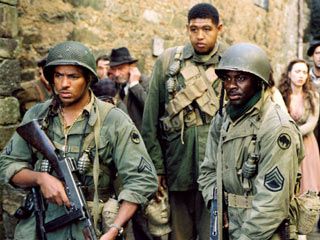
MIRACLE AT ST. ANNA—Spike Lee Goes To World War Two, tackling (with all the delicacy the act suggests) a spoiled durian of a script by James McBride, based on his novel. The book melds historical fiction with magic realism and perhaps its language weaves a successful spell over the 257 pages. But in concert with Lee’s ham-upon-fist direction, spell evaporates into a 160-minute battle to stay awake, let alone be convinced or moved. Sometimes his grenade-hurling at a topic hits the bullseye (Do The Right Thing, Clockers, 25th Hour, Inside Man) but on this potentially juicy target he lobbed a $45,000,000 stink bomb. *
Flashbacking from a startling public murder in New York City in 1983 to Italy in late 1944, where the killings are wholesale and continuous. The trigger man from the opener is shown as a young US Army soldier, a member of the segregated 92nd Infantry Division, one of the few outfits in which African-American’s served as combat troops rather than in supply or auxiliary capacities. Separated from their ambushed and decimated company are college-educated ‘Sgt. Stamps’ (Derek Luke); Nuyorican ‘Cpl. Negron’ (Laz Alonso), an interpreter as he speaks Italian as well as English and Spanish; out-for-himself hustler ‘Sgt Cummings’ (Michael Ealy); and ‘Pvt. Train’ (Omar Benson Miller), king-sized innocent. Taking up temporary refuge in a village, they bond with the residents, but then the war around them intrudes in a 4-way crossfire of loyalties and objectives: German SS troops, anti-Fascist partisans, pro-Fascist die-hards and advancing American forces. A postwar wrapup back in the States deals with the trial of the shooter seen at the offset.

Other than being well photographed by Matthew Libatique (Tigerland, Iron Man, Black Swan), shooting in Italy (Tuscany), New York City, Louisiana and the Bahamas, the script, acting, editing and direction are all over the cluttered map. The action scenes are noisy and bloody but light on accuracy, the tonal switches—sentiment to humor to sex to bigotry to philosophizing and back—jarring, the pace ponderous. Too often the dialogue rings modern (bring in the young & restless–didn’t work) rather than what you would hear in the mid 1940s, the ‘bro from da hood’ jive from Ealy’s character maddeningly bogus. The phony romantic angle (with Valentina Cervi as a conveniently available villager) belongs elsewhere. Toss in Alexandra Maria Lara doing an absurd turn as infamous Nazi propagandist ‘Axis Sally’. Terence Blancherd’s score makes sure every point is reiterated. Lee can’t get out of his own my-way highway, and the undisciplined, cliched, overlong movie (uh, try to decipher the ‘miracle’) blew a chance to tell an honest story about an overlooked chapter of the war and some of the neglected participants involved.
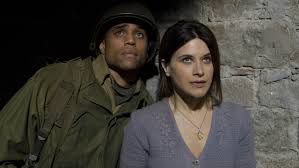
Reviews: mostly dire. Box office: disastrous. $7,658,999 in North America, a crippling 151st place, and only $1,404,716 elsewhere. It later earned $10,100,000 from disc sales.
On hand in various locales and time frames: Matteo Sciabordi, Pierfrancesco Lavino, Kerry Washington, Walton Goggins, Joseph Gordon-Levitt, John Turturro, John Leguizamo, Omero Antonutti, Sergio Albelli, D.B. Sweeney, Christian Berkel, Colman Domingo, Michael K. Williams.

* Spiked punch: the ever-combative director’s WW2 misfire (certainly well-intended) is not quite as phony as his Vietnam-set claptrap, Da 5 Bloods, though at least that one does feature a ripping good job from Delroy Lindo.
Author/screenwriter McBride did a good deal of research on the part of the Italian campaign (a costly grind for soldiers on both sides and a nightmare for civilians—see Two Women, for example) and the film does include a re-enactment, on a reduced scale, of the infamous SS massacre of 560 villagers at Sant’Anna di Stazzema, filming the sequence on the actual location. But the half-cooked stew of ingredients & anachronisms, platitudes & attitudes around it mainly serve to trivialize rather than memorialize. With more swearing and gore, Lee’s film is as hollow as 1968’s awful Anzio. When the National Association Of Italian Partisans called it a “travesty of history”, Spike’s defensive comeback was “I am not apologizing…(there’s a) a lot about your history you have yet to come to grips with.” Spoken like a true cosseted multimillionaire. Balls don’t mean brains.

 Movies ala Mark