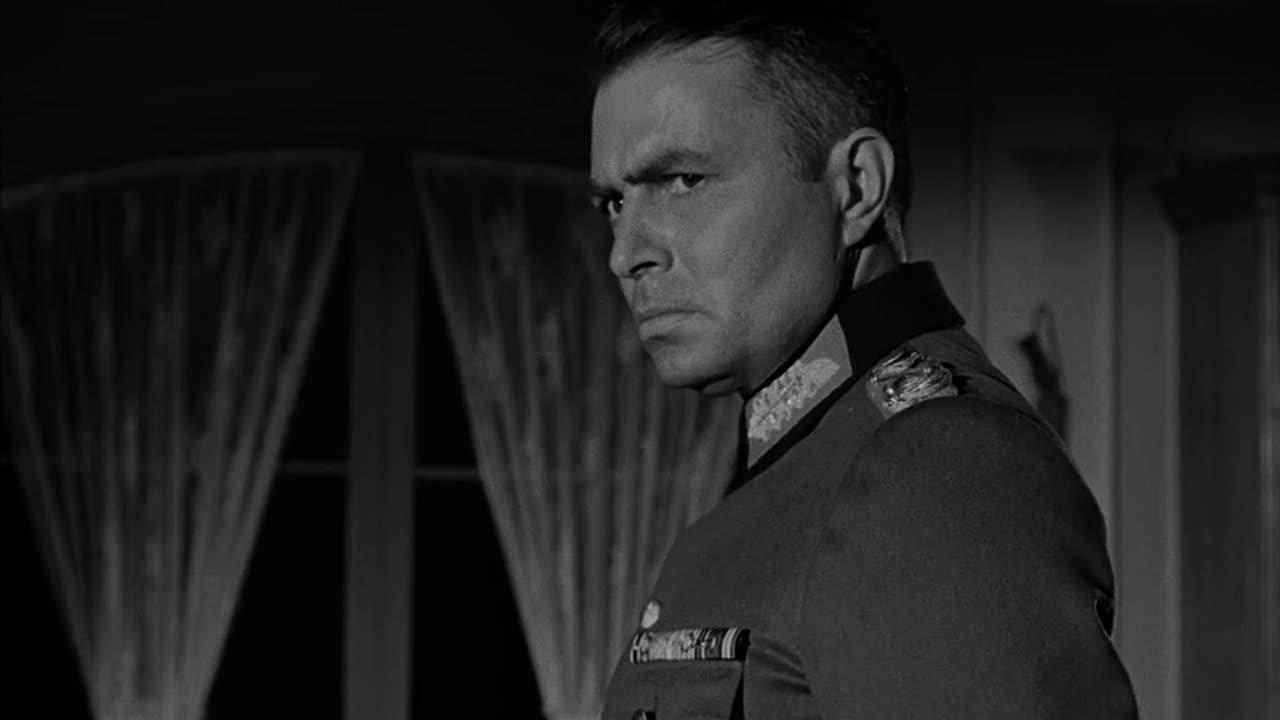
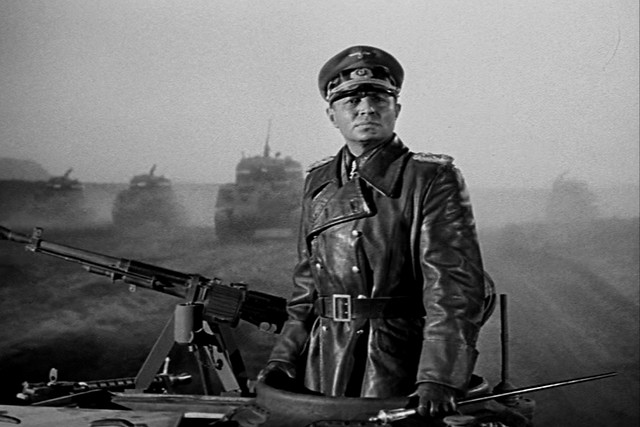
THE DESERT FOX: The Story Of Rommel makes for a good documentary-style quick study of a partial but crucial piece of the career of one of the Second World War’s key military figures, a winner on the (thankfully) losing side. Released in 1951, among the year’s 18 war movies, this was awarded straightforward direction from Henry Hathaway and a fairly well-balanced script by Nunnally Johnson (also producing), based on former British officer Desmond Young’s book “Rommel: The Desert Fox:” Young (1892-1966) appears briefly in the film, as himself but dubbed by Michael Rennie, whose sturdy, mellifluent voice also provides the narration linking the episodic plot. The tight 88 minutes are dominated by James Mason’s superb interpretation of the title warrior, a feared and respected enemy who ultimately emerged as an unlikely hero. It also succeeds as one of the post-war war stories that allowed portraying former enemies with a degree of humanity, a necessary part of the reconciliation process that eventually arises out of what one of Rommel’s foremost foes famously decreed the “blood, toil, tears and sweat.” *
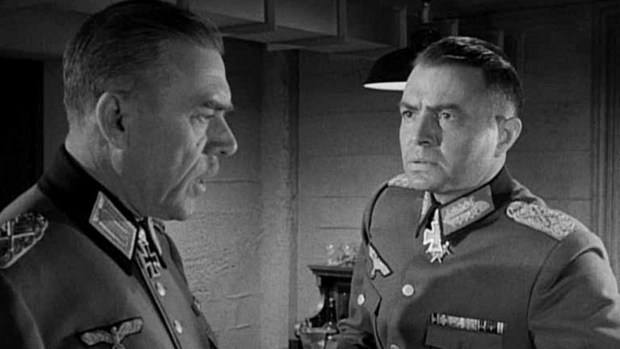
“From the moment the Bohemian corporal promoted himself to the supreme command of our forces, the German Army has been the victim of a unique situation: not only too many of the enemy, but one too many Germans.”
The show kicks off with a ‘cold open’—then novel—action scene before the opening credits, here a well-staged Brit commando raid (‘Operation Flipper’) attempt to capture or kill the commander of the Afrika Korps, Field Marshal Erwin Rommel, followed by Daniel Amfitheatrof’s pounding score over the credits. Thereafter most of the combat coverage is documentary footage used in montages to progressively forge ahead between the well-crafted segments of dialogue constituting the bulk of the presentation. A little background shooting was done in Europe, the North African desert scenes handily accomplished in Arizona and California.
With narration dispensing with his life and outstanding career (his WW1 exploits were larger-than-life), before 1942, the plotline runs from Egpyt and the battle of El Alamein, to France in 1943-44 where he was tasked with defending against the Allied invasion, and eventually to his fateful decision to support the plot to kill Hitler which nearly succeeded on July 20th, 1944.
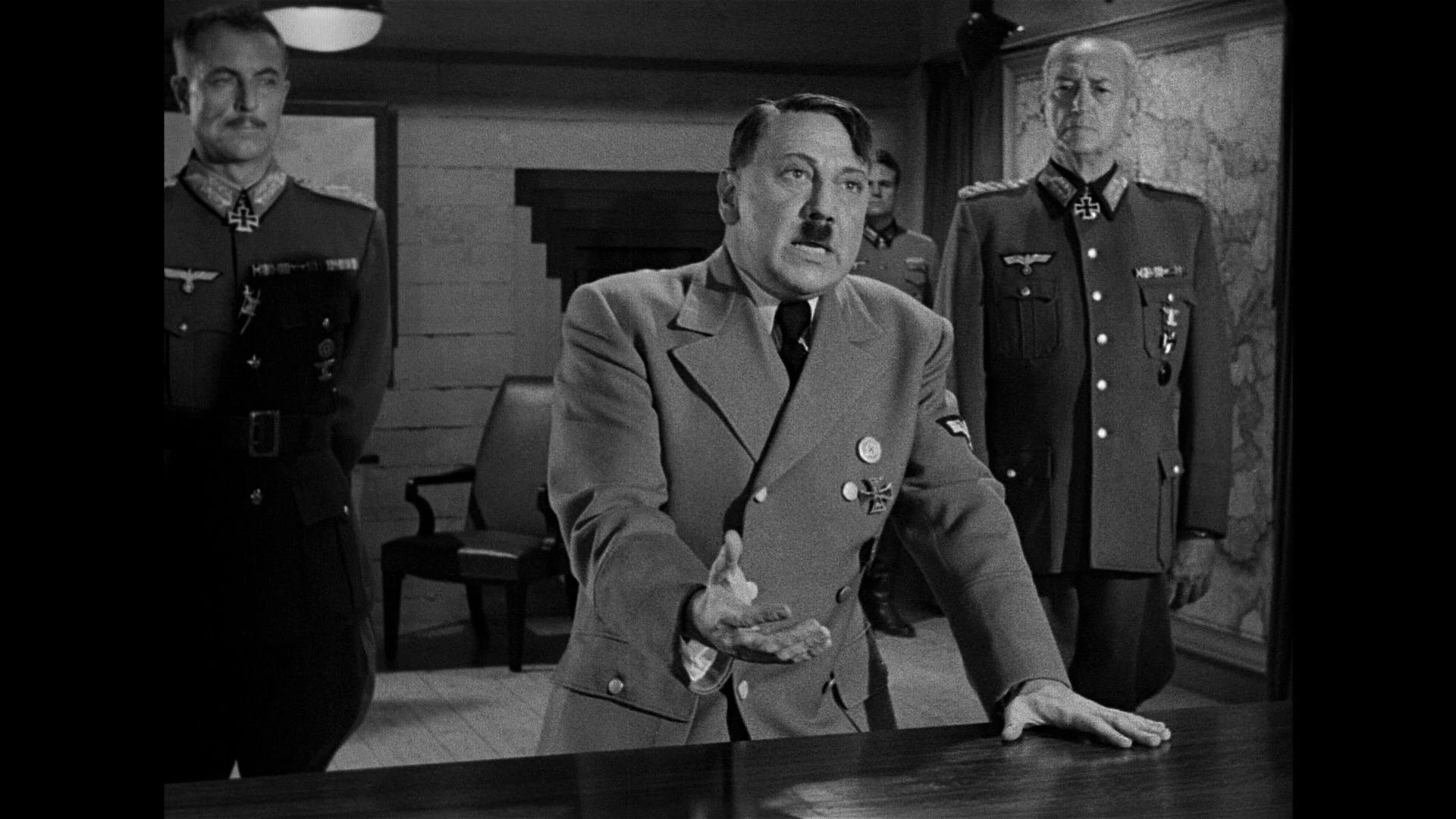
The short running time of necessity omits much in order to hit the most trenchant points leading to the uber-soldier eventually turning on his once-admired, then clearly batshit insane leader and the hierarchy steamrolling Germany to ruin. Key supporting roles are given to Cedric Hardwicke, as Dr. Karl Strolin, the Mayor of Stuttgart, in on the plot; Leo G. Carroll, as Gen. Gerd von Rundstedt, defeated by the Fuhrer’s insanity; Jessica Tandy, as Frau Rommel, wife and closest confidante; and Luther Adler as Hitler, delusional and raving explosively. At 41, James Mason had been acting in British films for 16 years, building an impressive resume, but after shifting to Hollywood in 1949 his first half dozen pictures didn’t click for one reason or another (we really like Pandora And The Flying Dutchman); his intensity—it feels like Rommel is burning right thru his skin—and provoked interest in the subject itself began a renewed career upswing. A number of fine actors would suit up as the famed general, but Mason’s remains the go-to interpretation. Irony did one of its jibes: Mason, fully convincing as one of the 20th century’s most famous soldiers, had been a conscientious objector during the war. **
Box office in the States was $6,900,000, 31st in ’51, and the film—a few naysayers aside—was very well received in England and, unsurprisingly, West Germany.
Rommel’s widow Lucie Marie acted as technical advisor. Smaller roles are loaded with veteran or soon-to-be-familiar faces: Everett Sloane, George Macready, Richard Boone, William Reynolds (as son Manfred Rommel), Eduard Franz, (as Claus von Stauffenberg), Robert Coote, John Hoyt (as Field Marshal/Hitler lickspittle Wilhelm Keitel), Scott Forbes, Sean McClory, George Nader, Dan O’Herlihy, Ivan Triesault, Peter van Eyck, Philip Van Zandt, Carleton Young.
* Conflict-conflicted 1951’s strike force of 18 war movies included three about the ongoing Korean ‘police action’, the other 14 set in WW2 equally divided between the European and Pacific halves of the struggle. Of the lot the best was another guarded handshake to then-occupied Germany, the superb Decision Before Dawn.
As if there isn’t enough hate randomly available from deranged or depraved individuals, war generates, encourages, extols and rewards it on national and industrial scales (toss in race, religion and other forms of ageless stupidity). At some point after slaughter stops and reason returns, blame hopefully gets properly apportioned (apparently never allowed to apply to the Middle East, ever). One could make a good case for this movie doing its bit—and reaching a huge impressionable audience when shown via NBC’s Saturday Night At The Movies on October 21, 1961)—by keeping Hitler and die-hard Nazi fanatics on the chopping block they deserved while giving the German people as a whole, soldiers included—dragged along to destruction and shame by lies, laws and force—some measure of sympathy. Now who’s turn is it?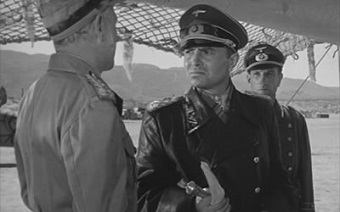
** Everybody’s Favorite German General—Mason would do a Rommel cameo two years later in The Desert Rats. Erich von Stroheim played him in Five Graves To Cairo, Werner Hinz in The Longest Day, Christopher Plummer in The Night Of The Generals, Karl Michael Vogler in Patton, Wolfgang Preiss in Raid On Rommel, Helmut Griem in The Plot To Kill Hitler, Bernard Hill in Valkyrie.
Nunnally Johnson: “If Rommel hadn’t been involved in the plot against Hitler, this screenplay wouldn’t have been written. Circumstances allowed Rommel to be a pretty good fellow because there were no civilians involved in the North Africa campaigns. I have tried to write the script with detachment. There is no effort to solicit sympathy for him, except in the final sequence. There are the circumstances as he says goodbye to his wife and son to go to his death [which] would undoubtedly create sympathy for any man. Rommel was a very limited man intellectually. His problem was a conflict of loyalties. He followed a false god and when he found that out he risked being a traitor.”
Winston Churchill: “His ardor, and daring, inflicted grievous disasters upon us. But he deserves the salute, which I made him, in the House of Commons, in January, 1942. He also deserves our respect, because, although a loyal German soldier, he came to hate Hitler, and all his works, and took part in the conspiracy to rescue Germany, by displacing the maniac and tyrant. For this, he paid the forfeit of his life. In the somber wars of modern democracy, there is little place for chivalry.”
 Movies ala Mark