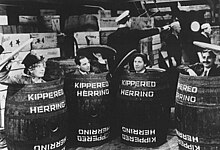
MONKEY BUSINESS, the third cinematic assault on behavioral norms by the Marx Brothers, didn’t monkey as much business as 1929’s The Cocoanuts or 1930’s Animal Crackers, respectively the 7th and 10th biggest hits of their years, but its gross of $2,800,000 was still a respectable 30th place for 1931. Written (with allowances for the bro’s inspired interference) by S.J. Perelman, Will B. Johnstone and Arthur Sheekman, it was directed (or managed) by Norman Z. McLeod, who would deal with the zanies one more time the following year in their biggest hit Horse Feathers. *
WAITER: “Would you like to have anything before lunch? ” CHICO: “Yes, breakfast.”

Four stowaways on an ocean liner create havoc among the flustered crew and affronted passengers until the ship docks in New York City, whereupon the three wackos (Groucho, Chico and Harpo) and the one who’s there to be a (frankly dullsville) straightman (Zeppo) end up first at a party and then at a barn, embroiled with dueling gangsters and two of the ladies they’d badgered on the ship.
GROUCHO: “You call this a barn? This looks like a stable.” CHICO: “Well, if you look at it, it’s a barn. If you smell it, it’s a stable.”

Typical Marx lunacy will depend on your fondness or tolerance for the guys. Conceding there are numerous funny elements at play, I’m not nuts about this one, which creaks with age. Doubtless it convulsed crowds who needed a break from Herbert Hoover. Groucho’s innuendo patter zips mile-a-minute, Chico plays the piano amusingly, Harpo plays the harp beautifully, Zeppo, well, never mind. Yet funnybones being individualistic and hard to predict with certainty, you may find Monkey Business a riot. If so, swell and good for you, really. I’ll order Duck Soup.
MADAME SWEMPSKI: “Oh, you impudent cad!” GROUCHO: “Eh, my shrinking violet? Say, it wouldn’t hurt you to shrink thirty or forty pounds.” MADAME SWEMPSKI: “I’ll report you to your paper.” GROUCHO: “I’ll thank you to let me do the reporting. Is it true you’re getting a divorce as soon as your husband recovers his eyesight? Is it true you wash your hair in clam broth? Is it true you used to dance in a flea circus?”
In their way or sites: Thelma Todd, Harry Woods, Tom Kennedy, Ruth Hall, Billy Barty. 74 minutes.

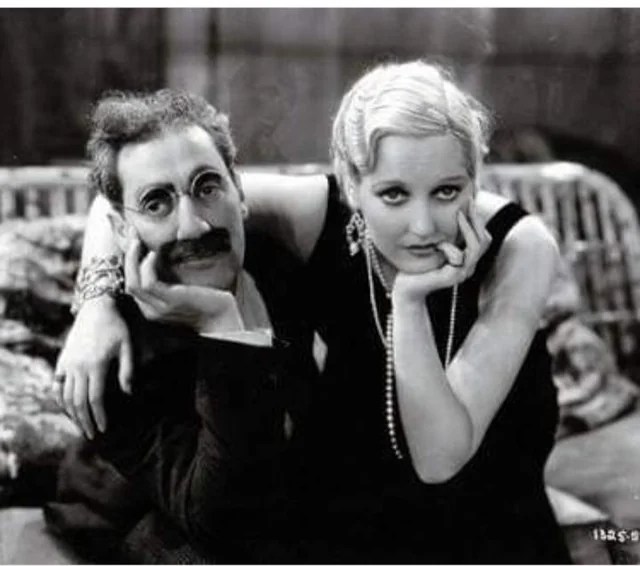
Thelma Todd, 1906-1935
* Echoes—-Groucho tells Thelma Todd, “You’re a woman who’s been getting nothing but dirty breaks. Well, we can clean and tighten your brakes, but you’ll have to stay in the garage all night“. In 1935 Todd was found dead in her car inside her garage with the engine running. Whether it was suicide, accident or murder was never solved to satisfaction. She’d been married to an abusive hood named Pat DiCicco, associate of Lucky Luciano. She was 29.
Monkey Business was banned in Ireland for “anarchic tendencies. The ban was lifted—in 2000.
Nostalgia has been around since people realized that the cave they left across the river didn’t have as many fleas as their new digs. The movies of the 1940’s and 50’s were loaded with pictures set during the ‘Gay Nineties’ or the vaudeville era not just because most of the producers, writers and directors could recall those days but likely due to audiences—having gone thru a Depression immediately followed by a World War—nursed memories of a less-fraught time. Further down the apparent highway to hell road, the turmoil of the Vietnam insanity and the rapid expansion of fast & coincidentally fun ways to expand stifled consciousness helped usher in a delirious rediscovery of certain once-popular entertainers who had faded from view, the Marxes becoming essential viewing not just to college kids but anyone with access to a bong and who had a sneaking suspicion that maybe Everything Was A Crock. Back when (chose not to use ‘back in the day’ because of truly detesting that smug shorthand) I thought the Marx Brothers were hilarious (especially Duck Soup and Horse Feathers) but of late (as in five decades late) find much of their schticking somewhat of a chore. Always liked Groucho.


 Movies ala Mark