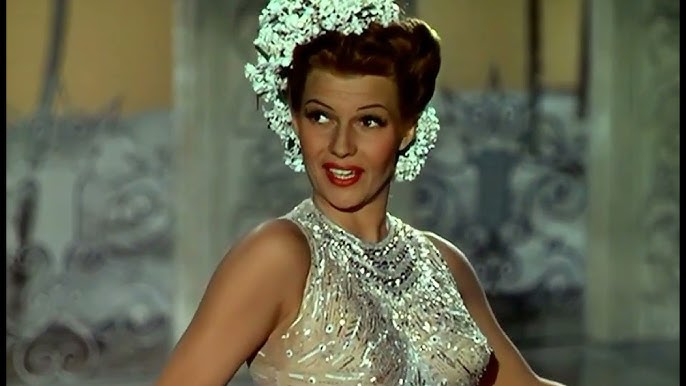
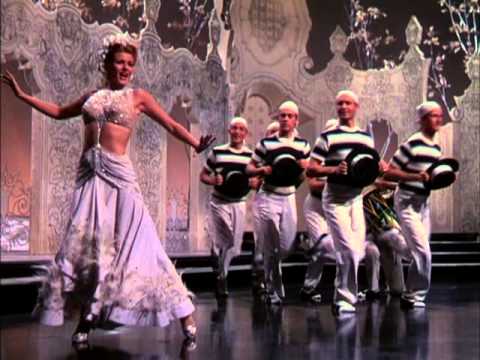
TONIGHT AND EVERY NIGHT, a morale rouser musical-romance-drama came out in January of 1945. The war in Europe had four months to go, the Pacific seven. This entry, which is really a light drama with a half-dozen musical numbers attached, was directed by Victor Saville (The Green Years, Green Dolphin Street), and took inspiration from the saga of London’s Windmill Theatre in Soho, a variety revue house which won admiration for staying open during the entire war (their motto “We Never Close”) even during the height of the Blitz in ’40-’41. The screenplay was written by Abem Finkle and Lesser Samuels off Lesley’s Storm’s 1942 play Heart Of The City. That only ran 26 performances, but the idea was still sound enough for a film adaptation. Add Technicolor. And Rita Hayworth— especially Rita Hayworth, who shows enough dazzle in the appropriately titled “You Excite Me” to generate a cyclone. *

London, 1942. Though the Luftwaffe is nightly pulverizing the city, the cast & crew putting on shows at the ‘Music Box Theatre’ don’t let bombs get in the way of trouping. American star performer ‘Rosalind Bruce’ (Rita) is pals with singer ‘Judy Kane’ (Janet Blair) and dancer ‘Tommy Lawson’ (Marc Platt). Then RAF Squadron Leader ‘Paul Lundy’ (Lee Bowman) catches Rosalind’s act and he’s good as gone with the wind churned up by her kicks and spins.

Janet Blair, 1921-2007
PAUL: “Rosalind, please. So, I acted like an idiot. But, you can’t rule a man out for trying, can you? After all, even a dog is entitled to one bite…Now, wait a minute. I don’t mean that literally. I just mean…” ROSALIND: “I know exactly what you mean. We’re grown up. We’re modern. We know what it’s all about. “Remember, darling, there’s a war on.” Routine number 3.”
The script set-up is fairly obvious from the moment Paul gets a gander at Rosalind, with the only real dramatic surprise coming at the finish, a Nazi-delivered tragedy that spurs a climactic call for determination to keep going “Tonight and every night.” On the debit end, Bowman, 29, is a wan choice to be a representative amour ambassador to the radiant Rita (he was also in Hayworth’s Cover Girl); the only sparks come from German incendiaries. The mostly American players ensure that everyone who puts on a British accent does a bad one. Then there’s some clown called Professor Lamberti who does a vaudeville act with a xylophone that is excruciatingly unfunny—where’s that hook gizmo they used to jerk lousy acts offstage?
On the plus side of the ledger are the incandescent 26-year-old leading lady, peppy Blair, 23, who lights up any scene she’s in, and dance dynamo Platt, 30 in his screen debut; next to Hayworth’s “You Excite Me”, Platt’s solo audition number is the sharpest display of movement in the lineup. The color cinematography is finessed by ace cinematographer Rudolph Maté, who would soon transit into the director’s seat.
Oscar nominations went to Scoring (of a Musical Picture) and Song (“Anywhere”). The box office ranking in ’45 was 43rd, the gross looking to be $6,900,000.
With Florence Bates, Dusty Anderson, Leslie Brooks, Adele Jurgens and—if you can spot her—an early, unaccredited appearance from 21-year-old Shelley Winters. 92 minutes.

* When a male dancer sprained an ankle, choreographer Jack Cole stepped in to cover in a number with Hayworth: “So I rehearse with Rita a couple of times and we’re ready to start. Well, baby, I don’t know what hit me when they turned the camera on… When it was for real, it was like ‘Look out!’ Suddenly this mass of red hair comes hurtling at me, and it looked like ninety times more teeth than I ever saw in a woman’s mouth before and more eyes rolling, and was the most animated object ever.”

 Movies ala Mark