
THE YELLOW ROLLS ROYCE, a puffed-up trifle from 1964, puts a potpourri of stars in a triptych pastiche of stories centered around the title vehicle as it changes disparate wealthy owners over a number of years and countries. Seven A-listers and a gaggle of veteran supporting players bring their pro—if untaxed—game to a mildly entertaining trifle, buffered by some attractive scenery.

Brit aristocrat ‘Charles, the Marquess of Frinton’ (Rex Harrison, to the manor borne) buys his French wife ‘Eloise’ (Jeanne Moreau, with her dazzling smile) a wedding anniversary present: the elegant title toy. Charles’ consideration comes a cropper (during the Ascot Gold Cup, for good well-bred measure) when he finds Eloise in the car, in the clutches of a dashing diplomat (Edmund Purdom, dull nixing dash). His cuckolded Lordship keeps Eloise (what can one do?) but returns the rig because “It displeases me.” Which is what I say whenever I return a Rolls Royce. That shortest segment gives way to the longest, and best of the three, “20,023 miles later, Genoa, Italy” when touring American gangster ‘Paolo Maltese’ (George C. Scott) snaps up the vehicle for his travel-bored fiancée ‘Mae Jenkins’ (Shirley MacLaine, in sparring mode). During their spin around Tuscany & Co., they encounter ‘Stefano’ (Alain Delon), a gigolo posing as a photographer (great work if you can get it–and if you look like Alain Delon at 28). Paolo’s hood buddy and driver ‘Joey’ (Art Carney, deft scene-stealer) smells a rat, and a romance. Push into shove then brings the durable chassis and well-used back seat up to “Trieste on the Yugoslav border – the year, 1941″ and another American with bucks, socialite widow ‘Gerda Millet’ (Ingrid Bergman) en route to meet the new King of Yugoslavia. Wouldn’t you know it, Hitler wants another piece of another country. Snooty Gerda gets tangled up in the Yugoslav resistance, and in trite & true thanks-to-war fashion gets kiss-embroiled with guerrilla-at-large ‘Davich’ (Omar Sharif) and so must help his hearty comrades. The war doesn’t end, but the movie does, 122 minutes after the MGM Lion roars it to life. Polite applause or stifled yawn will be up to the individual.

After their success with the glittery, star-laden The V.I.P.’s—basically rich people playing rich people who are unhappy—the team of producer Anatole de Grunwald (putting up the $3,900,000), writer Terence Rattigan (peering at the idling class once more) and director Anthony Asquith (cobbling together the flimsiness) rolled this out, and though critics sniffed, the star wattage of the cast drew enough audience curiosity to take 14th place in the States, grossing $13,300,000, a sum if not Roycean at least Continental.
The script is wafer thin, and while there’s nothing wrong with any of the acting, the characters (Carney’s excepted) aren’t compelling, the romantic elements forced. Some rather obvious rear-projection footage and synthetic interiors clash with the otherwise engaging location work (Jack Hildyard cinematographer). Shooting was done in England and Austria (posing as Yugoslavia), and the sunny Italian locations include Pisa, Florence, Naples and the Amalfi Coast, so there’s plenty of postcard scenery to admire.
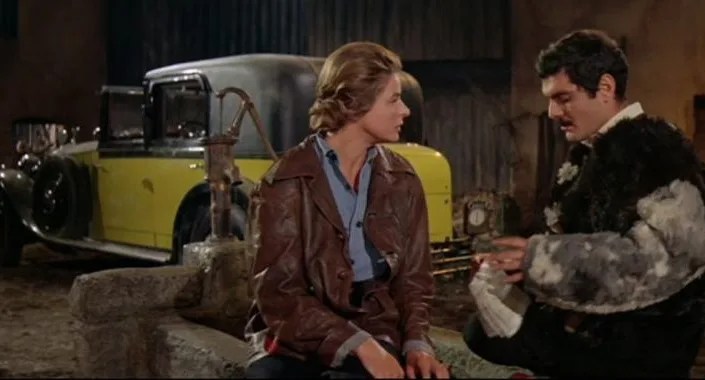
The Rolls in question: a pale blue number dolled up with twenty coats of yellow paint, was a 1931 Phantom II Barker Sedanca de Ville. Riz Ortalani’s score drills the okay main theme into “enough, already!” by injecting it ten times too often; some of the other cues in the soundtrack are pleasing, however, and it did serve to introduce the catchy pop song “Forget Domani”; versions of which followed from Connie Francis and Frank Sinatra.
A slew of 2nd-tier stalwarts are on paycheck duty: Joyce Grenfell, Wally Cox, Michael Hordern, Moira Lister, Grégoire Aslan, Roland Culver, Isa Miranda, Anthony Dawson, Reginald Beckwith and Lance Percival.

Click on the pic to enlarge and be able to read the blurbing
 Movies ala Mark