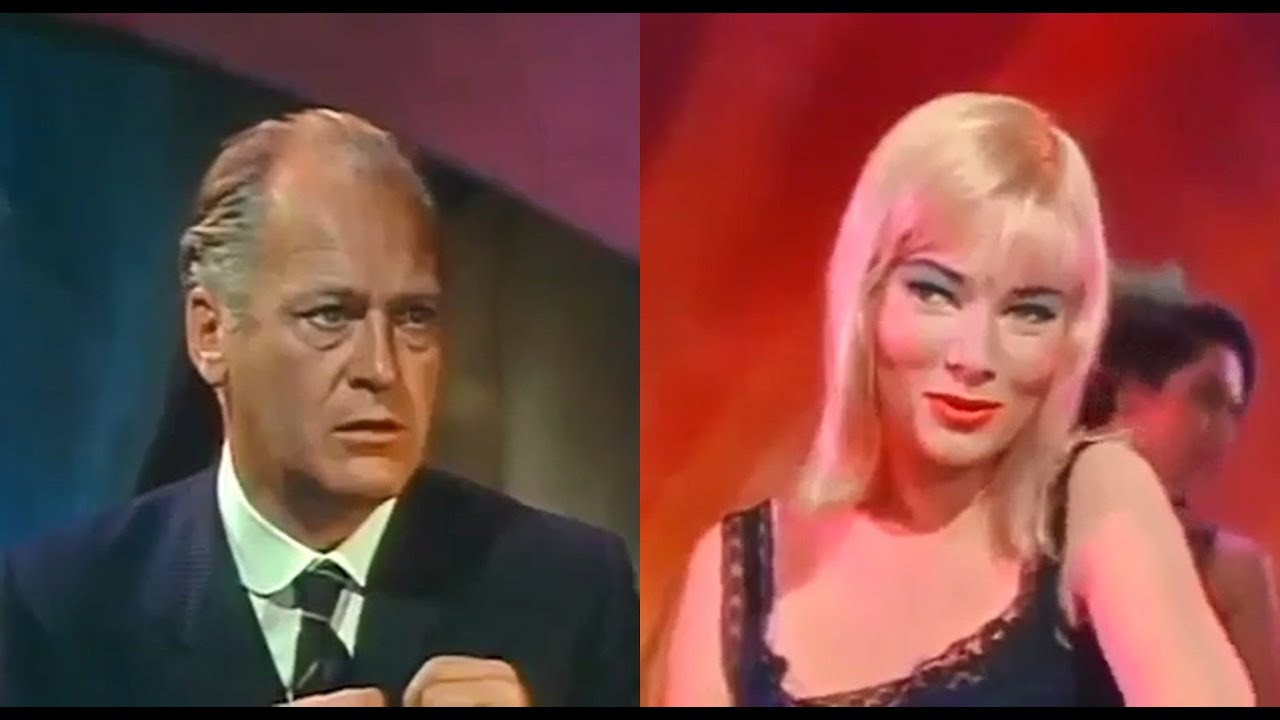
THE BLUE ANGEL, the 1959 American-made remake of the early German talkie from 1930 moved the original’s setting (Weimar Germany, ala Cabaret) up two decades to the West Germany of the 1950’s, and added CinemaScope and Color by Deluxe. It did moderately well at the box office, a placement of 65th and a gross of $4,000,000 likely enough to cancel out the $1,700,000 budget. But admiration verging on loyalty to the original, which launched the stardom of one-of-a-kind Marlene Dietrich—and the shadow cast by the aura of her legend—provoked a mostly harsh reaction from critics: like stale cigarette smoke in a dingy club, the diss has lingered. Overkill reliably pops up with remakes, almost as if it’s contractual–“How dare they?” Just another tiresome trope for reviewers to wade thru and buffs to parse, hoping to decide whether their hour or two will be worthwhile or wasted. Horen Sie schon jetzt auf mit den negativen Wellen! It isn’t great, but it’s not bad, either. *

“I’ve seen more beauty in the past twenty-four hours than I’ve seen in the last twenty-four years.” So declares middle-aged high school botany professor ‘Emmanuel Rath’ to his concerned principal. Once a joke to his students, and respected (he thinks) by his community, now he’s been lighting-bolted (legs & lust on line 1) and love-blinded by a few hours in the sordid-for-sale cafe where a Krupp-variety blonde bombshell named ‘Lola Lola’ struts her stuff and serenades the suckers. Tossing reason into the Rhine, the intellectually smart but emotionally stunted teacher falls for the oldest lesson in the book. Bemused, even charmed, Lola-Lola plays along, sincerely—until such time as she changes her mind.
Newly popular internationally (The Enemy Below, The Inn Of The Sixth Happiness), the compelling Curt Jurgens, 43, took on the role once played by Emil Jannings (the first Oscar winner for Best Actor and later a disgraced Nazi) and striking Swedish import May Britt, 24, stepped into the stockings and limelight once roamed by Dietrich. Edward Dmytryk had scored a run of hits with The Caine Mutiny, Broken Lance, Raintree County and The Young Lions (with Britt, the year before). Nigel Balchin’s script credit is accompanied by acknowledging the writers of the earlier film, and of course the source material, Heinrich Mann’s 1905 novel “Professor Unrat”(“Professor Filth”). Some exteriors were done in Germany, in Rothenburg, Bavaria, with the interiors on sets in Hollywood.

Updating only served to make the material seem more dated; the Weimar Era seediness worked better as a then-current contrast to the book’s early 1900s. The club settings lack atmosphere, though cinematographer Leon Shamroy makes effective use of the color scheme to disguise the shortcomings of the art direction. Dmytryk’s direction is no more than functional.
 But the basics hold—who hasn’t chased the wrong rabbit and ended up in a trap? Drop any p.c. whine down the Danube, this self-sabotage ‘from the heart’ is built in to most models and is bitterly true for any sex. Jurgens—who a few years before had lusted in vain for the sin-vision of Brigitte Bardot in And God Created Woman— is superb as the pitiable fool who can’t see the Black Forest for the bratwurst. His fumbling hopes, crumbling pride and humbling deterioration are painful to witness: you want to tell the myopic Professor to pay attention to Lola-Lola’s signals; she’s brutal, but she’s being honest. History reveals that Dietrich’s legs were famous (perhaps out-flashed by upstart Betty Grable) but only a blind hermit would knock Britt’s knees and their attachments, and there’s nothing in her performance to be ashamed of. If May Britt is let down by anything it’s the distanced direction. Since she was a newcomer with just a few credits, there was no way she was going to be given a fair shake. Think on this, Fox could have assigned the part to one of their other contract starlets–Terry Moore, or the Kaiser forbid, Jill St. John! Gott im Himmel! Marilyn Monroe turned down the part (a tad similar to Bus Stop and other teasers she’d done); it’s doubtful even she would have been accepted.
Music score by Hugo Friedhofer. Britt does her own singing of the classic lament (and Marlene signature) “Falling In Love Again”. With Theodore Bikel, John Banner (very good as the principal of Rath’s school), Ludwig Stossel, Fabrizio Mioni, Dickie Tyler, Gene Roth and Wolfe Barzell. Unaccredited, two of the chorus girls are Stella Stevens, 20, and Barbara Luna, 21. The running time is 107 minutes.

* Heinrich Mann (1871-1950) had scouted the territory well, at any rate: besides his social criticism, among other things he was noted for philandering, acquiring mistresses and frequenting prostitutes. Thus the immortal Lola-Lola.
The venerated 1930 version, directed by Josef von Sternberg, made a star of 28-year-old Dietrich, and their subsequent films developed her flamboyant style and showcased the director’s staging flair. Reliably possessive and truculent, von Sternberg sued Fox for a million smacks, claiming Dmytryk’s version was “so inferior that it decreased the value of the original.” Which one plays better is something left to the individual tastes, acumen and/or inclination of a viewer, but the word on von Sternberg is that he would likely have had the same sour take if the remake was done by Wilder, Welles, Wyler, Huston….

 Movies ala Mark