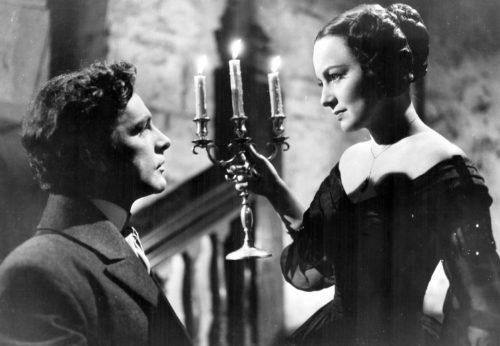
MY COUSIN RACHEL introduced 26-year-old Welsh bloke-of-interest Richard Burton to international attention and a Hollywood debut. He was tasked to prove his mettle against Olivia de Havilland, 35, a 17-year veteran of 34 features including a slew of classics, an established star sporting two Best Actress Oscars on her mantle. Though the opposites did not attract when working together, their animus doesn’t show on film, and the end result brought Burton the first of seven Academy Award nominations. For some reason, even though he has a lead role, that initial recognition went into the Supporting Actor category. *
“There are some women, good women very possibly, who for no fault of their own impel disaster. Whatever they touch, somehow turns to tragedy.”

Cornwall, England, the late 1830s. Raised by his wealthy cousin and surrogate father ‘Ambrose’, ‘Philip Ashley’ (Burton) is distressed when he learns his beloved benefactor has taken ill in Italy, soon after marrying another cousin, ex-pat ‘Rachel Sangalletti’ (de Havilland). When Ambrose dies, Philip thinks the circumstances shady; after Rachel arrives at the family estate in England, his suspicions grow. Who is she? What really happened? What does she want? Why is Philip suddenly drawn to her? Why does she respond the way she does?
The immediately arresting locale, relatable plot setup and shaded characterizations gather momentum, then survive an awkward jump when halfway thru things take a too-sudden shift into a different gear. That’s likely because Daphne du Maurier’s novel ran to 400 pages and the adaptation by Nunnally Johnson streamlined it down to a audience-friendly running time of 98 minutes. Past that bump, the pull of an atmospheric Gothic mystery-romance-melodrama remains strong, the actors are keen and the finish leaves interesting room for speculation.
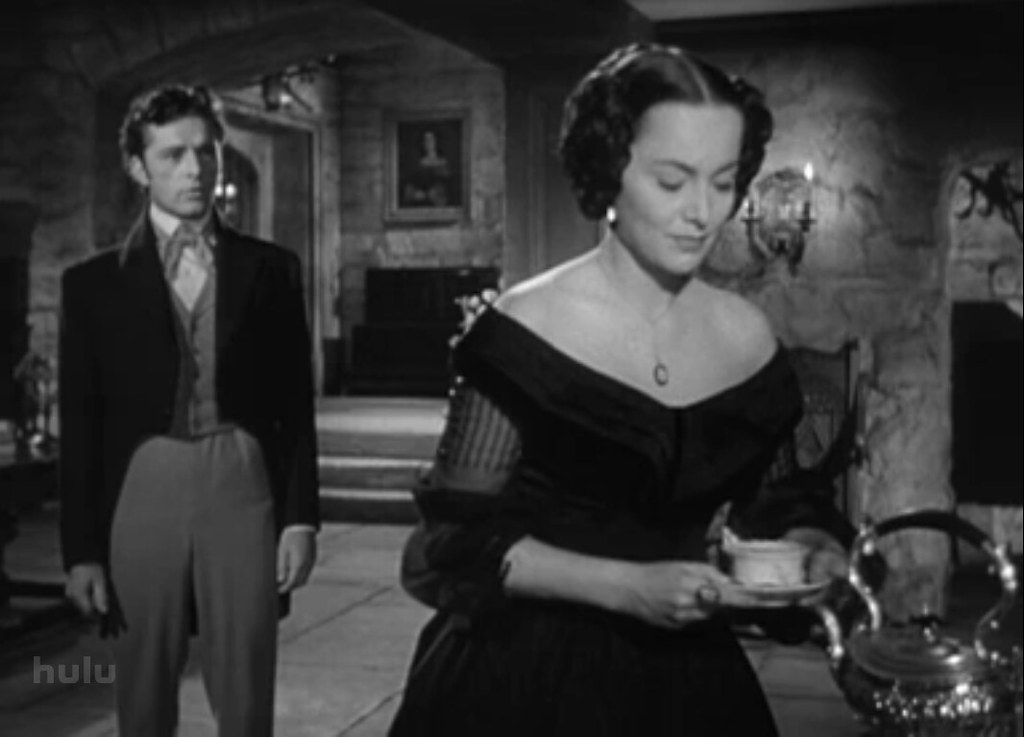
Direction by Henry Koster is clean and unobtrusive, Franz Waxman adds to the mood with his dramatic scoring, the cinematography, sets and costuming are all quality Fox studio attributes. As she did in The Dark Mirror and The Snake Pit, the surprising de Havilland once again shows that she had much more in her dramatic arsenal than the sweet heroines of her Errol Flynn adventures, Gone With The Wind‘s ‘Melanie’, or the sympathetic victim of The Heiress. Rachel has several sides to her makeup—the script leaves it up to us to decide how to place bets. With his his brooding intensity, rugged handsomeness and that wonderful mellifluous voice fresh to the fray, Burton is compelling as a man who lets passion best intuition, gambling on trust and hope rather than logic and sense. Been there? More than once? Uh-huh. Welcome to a large and non-exclusive club.

When those Oscars rolled around, besides Burton’s curious placement in the supporting lineup, other nods went to the Cinematography, Art Direction and Costume Design, all appropriate. The production cost of $1,200,000 was covered by a gross of $3,600,000, though it deserved better than position #95 among the year’s earners.
With Audrey Dalton (18, assured debut, soon to embark on Titanic), George Dolenz (father of ‘Monkee’ Micky), John Sutton (nice guy for once, as Ambrose), Tudor Owen, J.M. Kerrigan, Hamilton Camp. Remade 65 years later with Rachel Weisz, to good reviews.
* Olivia, per Richard (Livvie-upon-Dick, if we must)—“a coarse-grained man with a coarse-grained charm and a talent not completely developed, and a coarse-grained behavior which makes him not like anyone else”.
Burton was forever after dismissive about his leading lady due to her arrogant behavior to him and the crew during the production. A further chewtoy is the catty item that de Havilland’s lifelong feud with her sister Joan Fontaine fired further fuel when, before Olivia was cast, Joan told a well-known columnist “she’d swap her next six pictures for the chance to star in …’My Cousin Rachel.'”

 Movies ala Mark