
THE BIG LIFT, from 1950, tackles the triumphant Berlin Airlift that took place in & over the war-ravaged city in fifteen months of 1948-9. It has documentary-like aspects thanks to the location filming and participation of military personnel, with some obvious propaganda value on tap but it’s mostly concerned with a fictional pair of US servicemen and their romantic entanglements with two German women. Viable drama and forced comedy mix, the former effective, the latter irritating. George Seaton wrote and directed, doing better in the latter capacity.

“Now don’t start feeling sorry for ’em, they hate our guts. If the situation was reversed they’d kick our teeth in, twice a day.”
When the Soviets blockade the rail, road and water access into the divided city (the US, the USSR, Britain and France jointly administering sections), already prostrate Berlin faces starvation. The US and UK begin round-the-clock airlifts of coal and food. ‘Tech Sgt. Danny MacCullough’ (Montgomery Clift), flight engineer of a C-54 transport plane and ‘Master Sgt. Hank Kowalski’ (Paul Douglas), a ground-controlled approach operator, are buddies, though their temperaments are unalike. Thoughtful Danny falls for wistful, forlorn war widow ‘Frederica Burkhardt’ (Cornell Borchers), and she reciprocates, while German-hating Hank, a former P.O.W., bullishly lords it over ‘Gerda’ ((Bruni Löbel), his demure, cowed “Schatzi”. They all share a mutual friendship with genial ‘Herr Steiber’ (O.E. Hassie) a spy for the Russkies who’s actually working for the Yanks. But all is not what it—or they—seem to be.
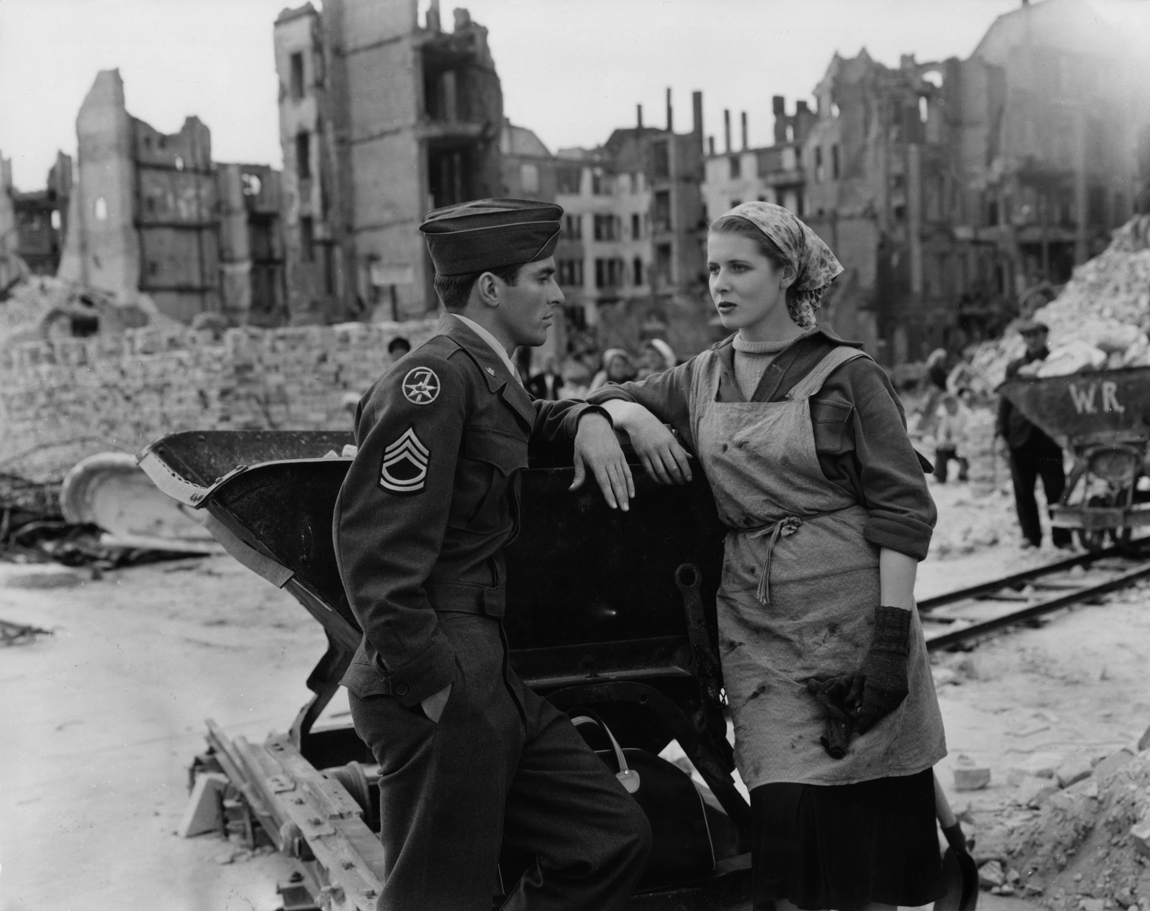
Clift’s low-key and workmanlike performance isn’t a grabber like other early turns, it’s proficient in service of the piece rather than an opportunity to scene steal (trying to do that from affable, no-nonsense Douglas had them at odds during the shoot). Douglas is solid, but he’s saddled with Kowalski being an overbearing jerk. Borchers does well with a complicated character, Löbel is fine but is stuck with “learn about democracy” dialog that’s pat and heavy-handed. Hassie is excellent as the philosophical survivor. The other roles are filled with military non-actors playing versions of themselves and it may have been a nice gesture to the fellas, but most of them sound exactly like amateurs and their byplay is the weakest aspect of presentation. Some sense of the technical complexity of the flying and traffic control and the dimension of the operation seeps in between the personal mini-dramas. ‘Safely’ into The Cold War, the script allows the German characters—defeated, demoralized, destitute and desperate—a good deal more range than movies had given them since 1939 and all hell broke loose. The turnabout finale is well done.
Clift’s fourth film, bracketed between the critically acclaimed The Heiress and big hit A Place In The Sun, this flawed but interesting picture has long fallen off the radar and deserves rediscovery. Effectively scored by Alfred Newman, it runs 120 minutes and grossed $3,600,000, 92nd place in the 1950 roll call.

* This introduced 24-year-old Lithuanian-German actress Cornell Borchers to international audiences. She only made a handful of US films and was given polar opposites in leading men—Rock Hudson in Never Say Goodbye and Errol Flynn in Istanbul. Her 1954 British drama The Divided Heart is well regarded. She passed away in 2014 at the age of 89.
The Big Lift was one of a handful of American movies shot on location in immediate postwar Germany before relations with the Soviet Union went ice cold, joining The Search (also with Clift), Berlin Express, A Foreign Affair, I Was A Male War Bride, and Decision Before Dawn. Italy’s Roberto Rossellini contributed Germany, Year Zero.
At the height of the airlift, a plane landed at Templehof Airport every 45 seconds, 227,228 flights by the US Air Force (76.4%) and the RAF (23.3%).

 Movies ala Mark