
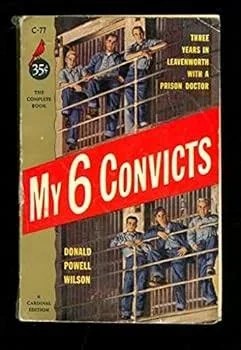
MY SIX CONVICTS sums up its heart-sleeve message with one line from its doggedly earnest protagonist—“I could see from the Rorschach test that he was a man torn by some deep frustration“. Whether you nod in reflection or snort in derision may depend on your attitudes towards crime & punishment and its subset: rehabilitation. Directed in 1952 by Argentine-gone-Hollywood craftsman Hugo Fregonese (The Raid), the script by Michael Blankfort was based on Donald Powell Wilson’s “My Six Convicts: A Psychologist’s Three Years in Fort Leavenworth“. Wilson worked in the early 1930s, studying drug addiction’s connection to criminal behavior. The screenplay skips chemical excuses and plays a no-blame-game off assorted anti-social ‘tendencies’, makes Leavenworth into ‘Harbor State Prison’ and is a seriocomic treatment, because, per message-delivery mission, we want to “like” the fellas who are locked up. Ask a crime victim. Should be easy to find one.
 John Beal does a good job playing ‘Doc’ (aka Wilson), who learns the ropes while trying to untie the knots that put his inmate assistants behind bars. His six case-studies who volunteer their expertise (honed) and time (aplenty) are ‘Connie’ (Millard Mitchell), a cagey safecracker; ‘Punch Pinero’ (Gilbert Roland), mob bigshot; ‘Blivens’ (Marshall Thompson), amiable alcoholic thief; ‘Kopac’ (Jay Adler), sad sack recidivist; ‘Clem’ (Alf Kjellin), haunted bank robber; and ‘Dawson’ (Harry Morgan), ice-blooded killer-for-fun. Who’ll teach who, and what?
Obviously carbon-dated by attitudinal sand-shifts in society at large and specifically by the modern day curse of casual viciousness, merry brutality, gangs equipped like armies and profitable glorified dehumanization, the debit end of this well-meaning oldie suffers from whimsy and an inculcated case of wishful thinking; the hopeful liberalism is so honest and quaint that its naivete is heartbreaking.
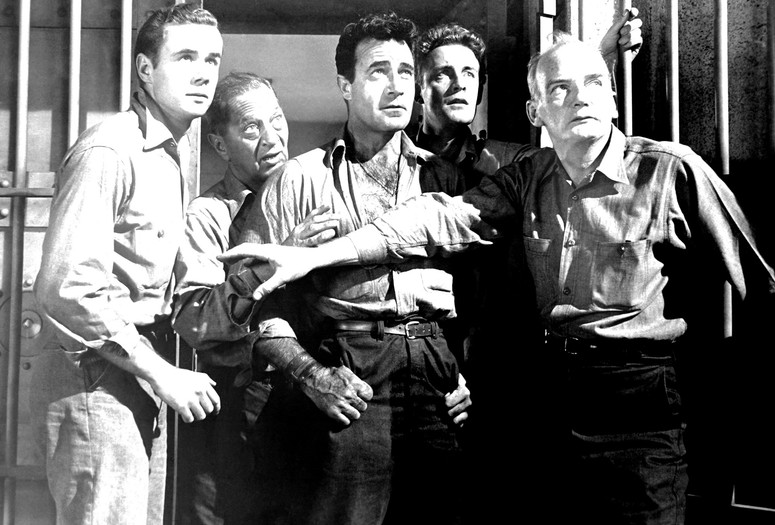 On the positive slate, the performances are uniformly strong, the supporting array is stocked with reliable and familiar faces, the black & white photography is effective (with some location shooting in San Quentin), it’s well directed by Fregonese and is burnished by the dramatic flair inherent in a Dimitri Tiomkin music score.
“I also remember how grateful I was that at least some of my men had learned to be loyal. Not to a gang or to power but to a job; in a small way to society and this gave me hope for their future.”
In that last year of the Truman administration, box office of $3,100,000 tagged 117th place. 104 minutes, with Regis Toomey, Fay Roope (the Warden), Carleton Young, Charles Bronson (billed Buchinsky), Russ Conway, John Marley, Byron Foulger, Barney Phillips and Wesley Addy.
 Movies ala Mark