
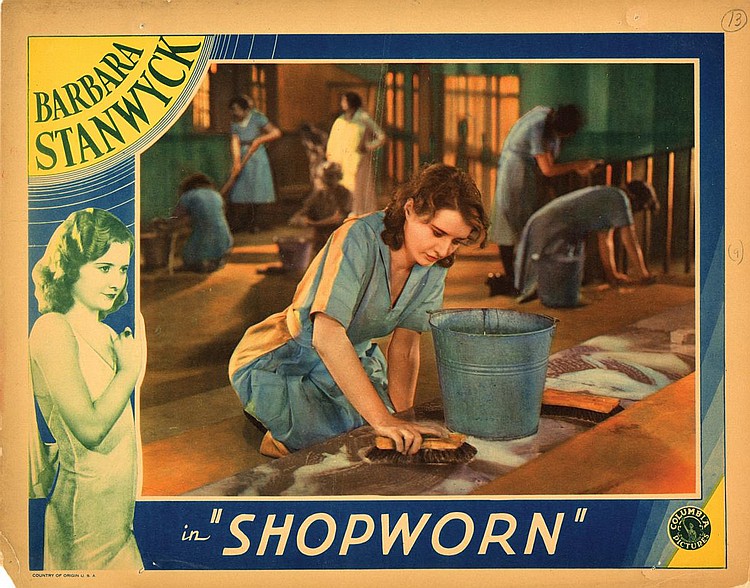
SHOPWORN—-“Your thoughts are just like your kitchen … dirty.” This 1932 oldie zips thru a see-saw of emotional turnabouts like flashcards, the quaintness of problems presented & resolved, often in less than a minute: a viable title could’ve been ‘Breathless’. Two elements salvage the archaic plot and steamroller handling. One is that the script does have some amusing dialogue, courtesy of writers Jo Swerling and Robert Riskin (Swerling slammed out ten in ’32 alone). Two and most important: the heroine is Barbara Stanwyck. The 24-year-old fast-riser made the fearless most out of every assignment. The reviewer for “Variety” summed it up: “the clumsiest kind of literary hoke, trashy in the last degree but somehow made fairly endurable by the curious knack of Barbara Stanwyck for investing even the most theatrical roles with something of earnest sincerity.”

‘Kitty Lane’ (Stanwyck) and ‘David Livingston’ (Regis Toomey) fall for each other. The fly in the buttermilk: she’s a waitress from the wrong side of the tracks, and he’s a wealthy medical student, whose domineering mama (Clara Blandick, ‘Aunt Em’ from The Wizard Of Oz) deplores Kitty from the first sniff. The mean old bat connives to have Kitty locked up on a phony morals charge. Fooled, David goes to Europe and becomes a doctor. Kitty gets out of the joint and faster than you can read this sentence she becomes a “sensation” on the stage. Will their respective stars cross again? Take a wild guess.
Variety’s review also noted “episodes that do not blend into the story smoothly, sequences that hang in the air lacking background and significance as though passages depending upon them had been deleted.” That was due to extensive cuts around Kitty’s “rise”, boosted via prostitution. Somehow the scandal-snoops in Censorland allowed a scene with Kitty learning new words, one of which being “ejaculation”, which presumably the bluenoses took as meaning, per Oxford, “something said quickly and suddenly”: these things happen.

Directed by B-vet Nick Grinde, this chestnut is forgotten today, yet the $2,600,000 gross placed 20th in 1932, doing more business than better-known pictures like Red Dust, I Am A Fugitive From A Chain Gang, Scarface and Island Of Lost Souls. Indeed, factoring inflation, it was Stanwyck’s 5th most financially successful film. Even though she’s stuck with dross material and a less-than-exciting leading man, she rips into the part with vigor, conveying survivor pluck in her eyes (soulful, flashing), that panther-sashay walk and especially in a couple of blow-up moments where her impassioned angry delivery of outrage powerlifts the movie by several notches. *
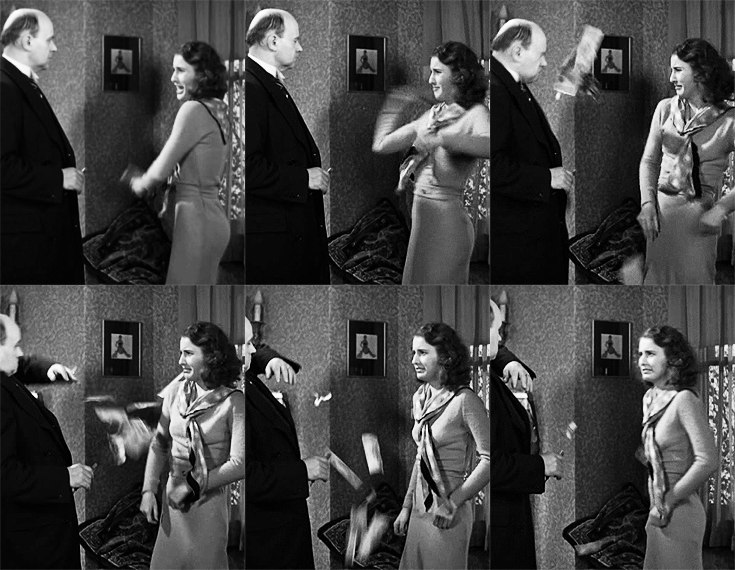
“And in conclusion, Kitty Lane, it is the duty of this court to protect and help such as you. I therefore commit you to the State Home for the Regeneration of Females for a period of 90 days. I earnestly hope that while there, you will learn the error of your ways.”
72 minutes, with ZaSu Pitts, Lucien Littlefield, Oscar Apfel, Joseph Sawyer and Tom London. Mr. London, according to “The Guinness Book Of Movie Records”, holds the world record for film credits, over 2,000 logged between The Great Train Robbery in 1903 and a 1963 episode of TVs The Dakotas.

* Stanwyck: “one of those terrible pictures they sandwiched in when you started.”
Nick Grinde, director. In his 46-flick oeuvre can be found chewy morsels Million Dollar Legs (belonging to Betty Grable), Ladies Crave Excitement (“A Picture As Exciting As Its Title!”), Girls Of The Road (lady hobos), The Man They Could Not Hang (Karloff) and Hitler–Dead Or Alive (ex-cons/bounty hunters take out Adolf). As a 2nd-unit man, he delivered the wild action scenes for Tarzan the Ape Man and Tarzan and his Mate.
Once Upon the Omnipresent—-Regis Toomey was given leads in a half-dozen pictures in the early 30s, but as with this outing, he just didn’t click in that regard. He’s quoted with “I’d rather be a supporting actor than a star.” Fair enough: he became an uber-reliable character actor, logging 273 feature & TV credits between 1929 and 1985.
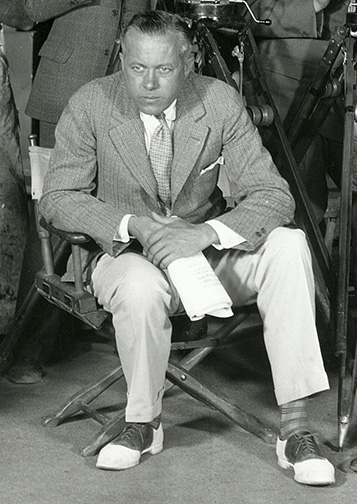
Nick Grinde, between “Action!” and “Cut!”
 Movies ala Mark