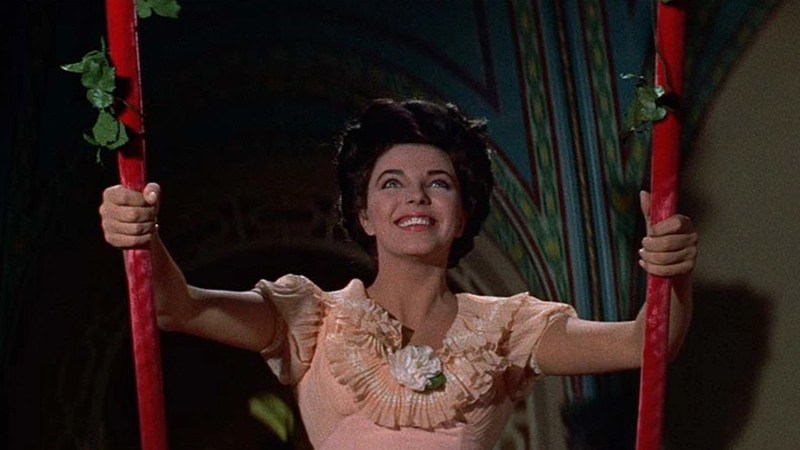
THE GIRL IN THE RED VELVET SWING was Evelyn Nesbit, a teenage chorus girl who in 1901 became the mistress of famous architect Stanford White. Their variant social status, age difference (32 years) and illicit liaisons were enough for scandal, but after Nesbit married mentally unstable millionaire Harry Thaw, things went literally ballistic: a publicly conducted murder in 1906 produced “The Trial Of The Century”, making newspaper sales soar, leaving reputations in tatters.

The real deal was tawdry all around, but while the Production Code had relaxed some by the time the 1955 movie version was released, the treatment still tread lightly, neutering the salacious aspects enough to get past censors and avoid giving Eisenhower America, already reeling from rock & roll, another reason to clinch. Good-looking and capable stars did commendable work in a plush production. Richard Fleischer’s direction doesn’t show much flair, but the story, albeit sanitized (70-year-old Nesbit was an ‘advisor’) was still compelling with two top screenwriters in Charles Brackett and Walter Reisch. Brackett produced as well, and the $1,700,000 that Twentieth Century Fox allowed for the effort showed nicely in the period sets and costumes. Reviews were decent, box-office demure at $3,700,000, posting 88th place in a year stuffed to the rafters with Americana of one sort or another. *

Ray Milland, 48, fresh off a hit in Dial M For Murder, suavely handles the bewitched White (whose decidedly unsavory side gets a real pass in the screenplay, turning satyr into swain) while Farley Granger is given more flamboyance as the arrogant, eruptive man-child Thaw: at 29, Granger bowed out for TV and stage and wouldn’t appear in a feature film for 13 years.

The guys would be left grappling in the melodramatic murk without a distressing damsel to duel for, and fortunately casting called on an exquisite Brit import, 22-year-old Joan Collins. Internationally revealed that year in Land Of The Pharaohs and The Virgin Queen, she won the role after Marilyn Monroe (too old at 30 to play a teenager) turned it down. Others briefly considered included Sheree North (lively), Debra Paget (comely) and Terry Moore (grating). As with the sympathetic treatment of White, the script paints a more flattering portrait of Evelyn than facts suggest: reality’s vixen schemer becomes a sweetie. Thanks to Collins skill at combining coquetry with charisma, Miss Nesbitt’s/Mrs. Thaw’s dilemma achieves a measure of tragedy. It doesn’t hurt that she’s drop-dead beautiful. The finale packs a reasonable wallop. **

With sturdy support from Glenda Farrell (Evelyn’s cautioning mother), Luther Adler (Thaw’s cold-blooded attorney), Gale Robbins, Cornelia Otis Skinner, John Hoyt, Robert F. Simon, Emile Meyer, Ivan Triesault, Henry Kulky, Leslie Parrish (as a ‘Floradora girl’) and Ruta Lee. 109 minutes.

* Memory—this ripened senior may not remember where I put my glasses (while wearing them) or catch myself looking for my phone (when it’s in my hand) but can recall snatches of trivia from six decades past. In 1964 this was broadcast on the invaluable series NBC’s Saturday Night At The Movies. My folks and I were visiting my aunt’s super-tidy home in Portland and the big deal was they had a color TV (!), albeit with a greenish tint. Lad that I was squirmed thru it: what was interesting to my mom, aunt and grandmother (dad, uncle and grandpa were discussing LBJ, golf and bourbon) was, to a typical 9-year-old boy, about as fascinating as a sermon or paint store. Went to the basement and ‘played’ Combat.
** Aged & wizened, we now concur with a then-contemporary observer from ‘The Daily Sketch’—“Joan Collins is a young woman of almost disturbing beauty, technically accomplished, perfectly poised, stylish from the top of her head, to the turn of an ankle. She possesses the capacity to express an eager eroticism, beneath the appearance of virginal innocence and gives a performance as sweet and intelligent as any we have reason to expect.”

Here comes trouble. Evelyn.
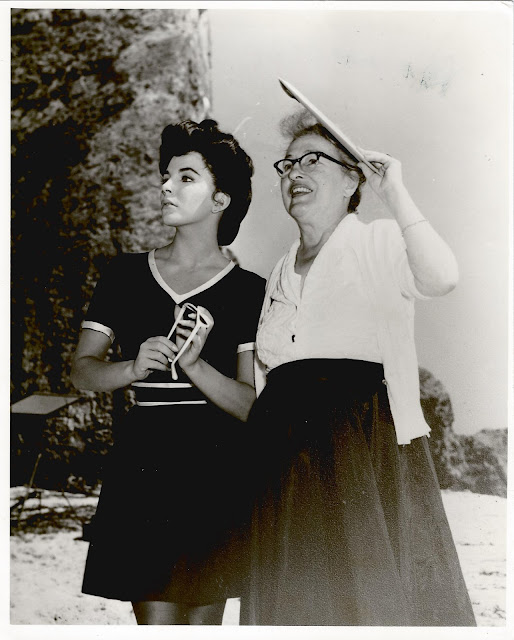
Joan, 22, on the set with Evelyn (1884-1967)
 Movies ala Mark